Name/Title
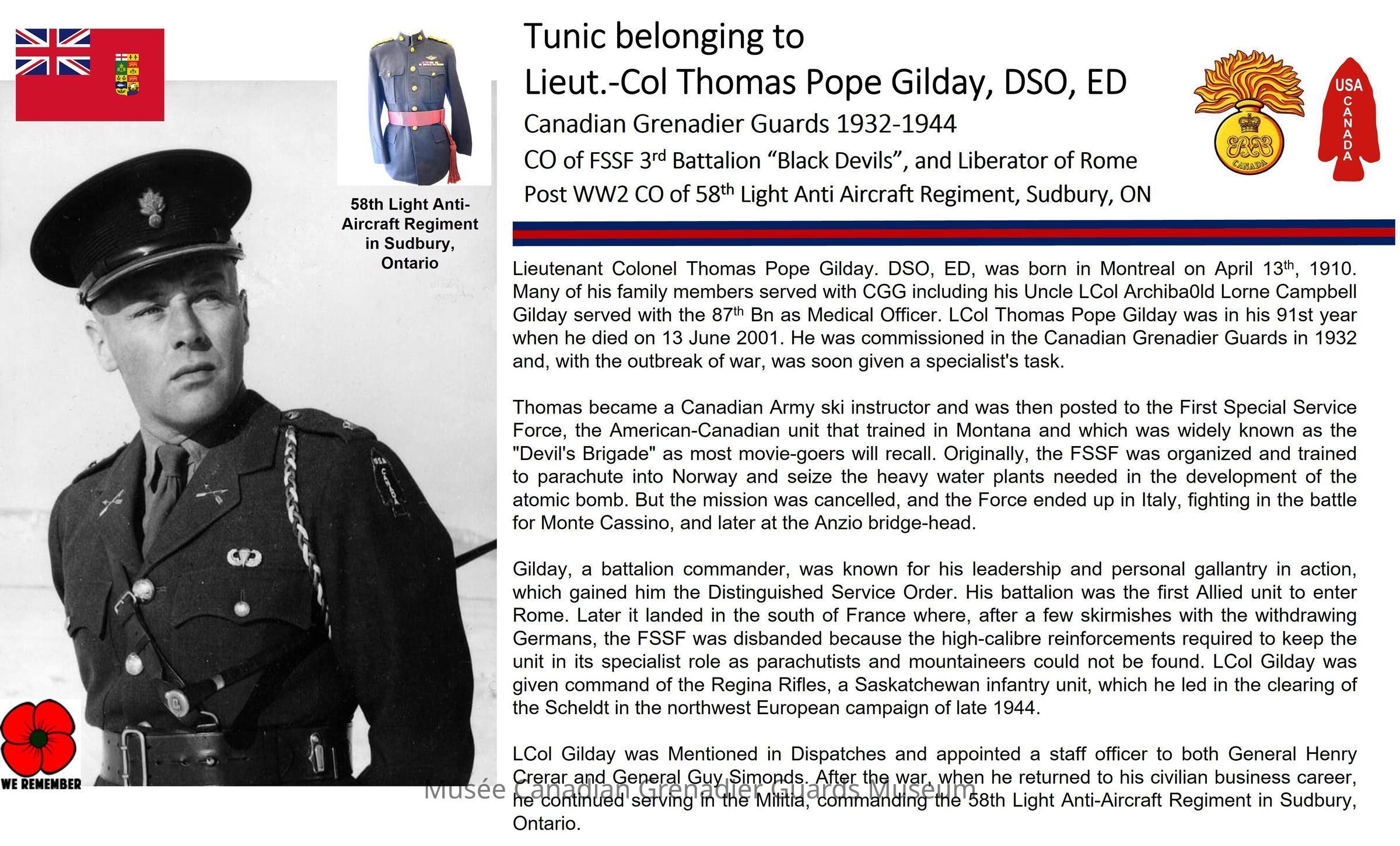
1945 - WW2 Era - Patrol Blues Tunic named to Lieutenant Colonel Thomas Pope Gilday, DSO, ED - Commanding Officer of the 1st First Special Service Force (FSSF) 3rd Battalion and first Allied unit to Liberate Rome, ItalyDescription
Part of the Lieutenant Michael A. Hayes-Rivet (MHR) Trust Collection *** FOR ARCHIVE PURPOSES ONLY - ARTIFACT NOT PART OF MUSEUM COLLECTION ***
Patrol Blues Tunic and Forage Cap belonging to Lt. Col. Thomas Pope Gilday, DSO, ED.
Lieutenant Colonel Thomas Pope Gilday. DSO, ED, was born in Montreal on April 13th, 1910. Many of his family members served with CGG including his Uncle LCol Archiba0ld Lorne Campbell Gilday served with the 87th Bn as Medical Officer. LCol Thomas Pope Gilday was in his 91st year when he died on 13 June 2001. He was commissioned in the Canadian Grenadier Guards in 1932 and, with the outbreak of war, was soon given a specialist's task.
Thomas became a Canadian Army ski instructor and was then posted to the First Special Service Force, the American-Canadian unit that trained in Montana and which was widely known as the "Devil's Brigade" as most movie-goers will recall. Originally, the FSSF was organized and trained to parachute into Norway and seize the heavy water plants needed in the development of the atomic bomb. But the mission was cancelled, and the Force ended up in Italy, fighting in the battle for Monte Cassino, and later at the Anzio bridge-head.
Gilday, a battalion commander, was known for his leadership and personal gallantry in action, which gained him the Distinguished Service Order. His battalion was the first Allied unit to enter Rome. Later it landed in the south of France where, after a few skirmishes with the withdrawing Germans, the FSSF was disbanded because the high-calibre reinforcements required to keep the unit in its specialist role as parachutists and mountaineers could not be found. LCol Gilday was given command of the Regina Rifles, a Saskatchewan infantry unit, which he led in the clearing of the Scheldt in the northwest European campaign of late 1944.
LCol Gilday was Mentioned in Dispatches and appointed a staff officer to both General Henry Crerar and General Guy Simonds. After the war, when he returned to his civilian business career, he continued serving in the Militia, commanding the 58th Light Anti-Aircraft Regiment in Sudbury, Ontario.
Thomas Gilday was one of three gallant Gildays of CGG: His Uncle, Father & himself were distinguished CGG officers who between them were awarded 2 DSO's, and all 3 played important roles while serving with The Regiment.
Lieutenant Colonel Archibald Lorne Campbell GILDAY, DSO & 2 MIDs (1878-1963) was one of the founding members of our regiment, our 87th Battalion Medical Officer, and Later 13th Canadian Field Ambulance Commander during WWI.
LCol Thomas Pope GILDAY, DSO, MID, ED, (1910-2001) was a distinguished member of our unit from 1932-1940 later to become one of the founding members and a Battalion Commander (1st Bn, 3rd Regiment of The First Special Service Force - “Devils Brigade”). "He was Mentioned in Dispatches and appointed a staff officer to both General Henry Crerar and General Guy Simonds."
Captain Frederick W Gilday, C.A.M.C attached to 1st Regiment CGG 25th Feb, 1916. Captain Gilday was LCol Tom Gilday’s Father.Created By
Lieutenant Michael Hayes-Rivet, retired.Create Date
January 20, 2022Updated By
R. John Dolbec C/Sgt. (ret.)Update Date
August 8, 2025