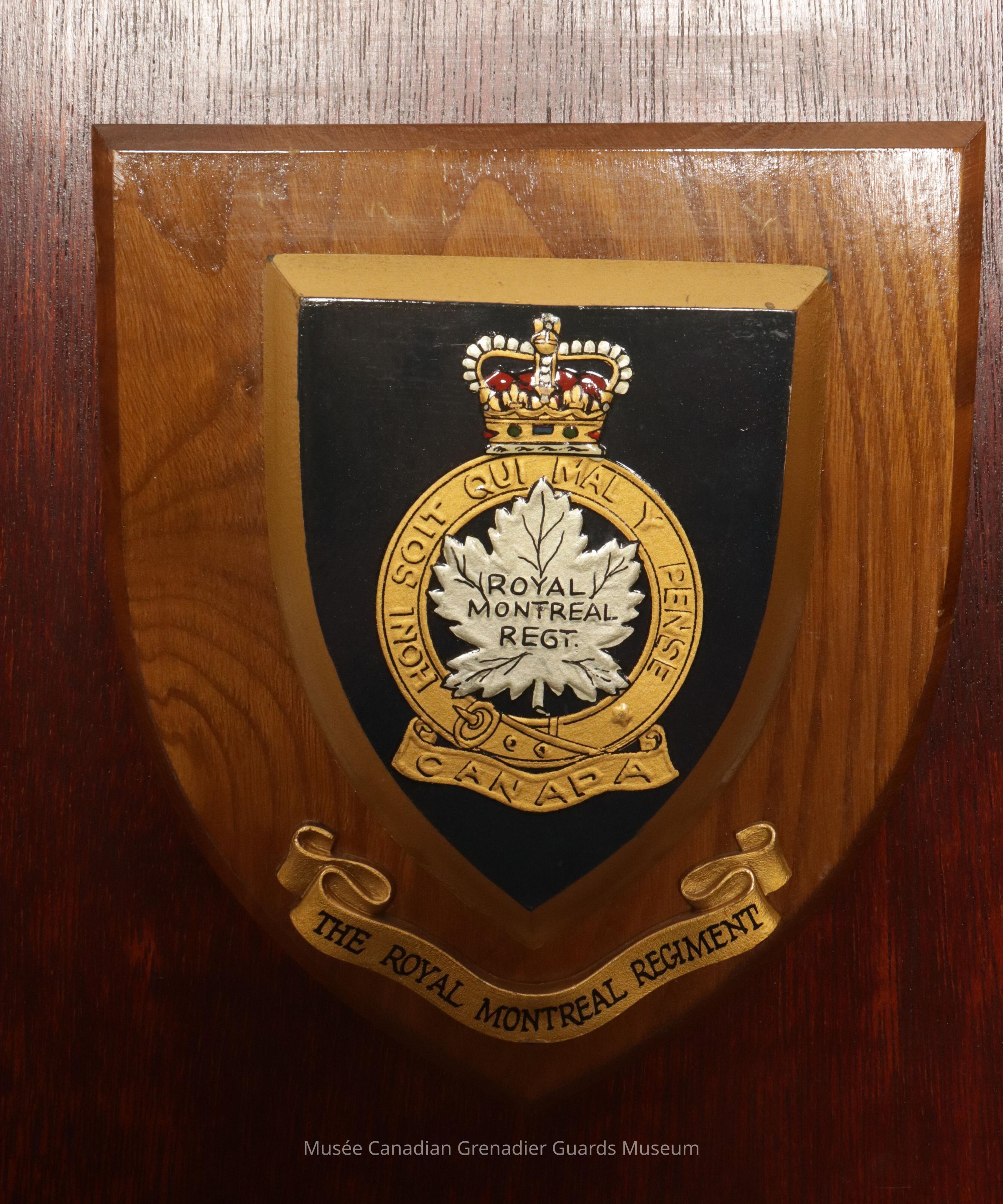
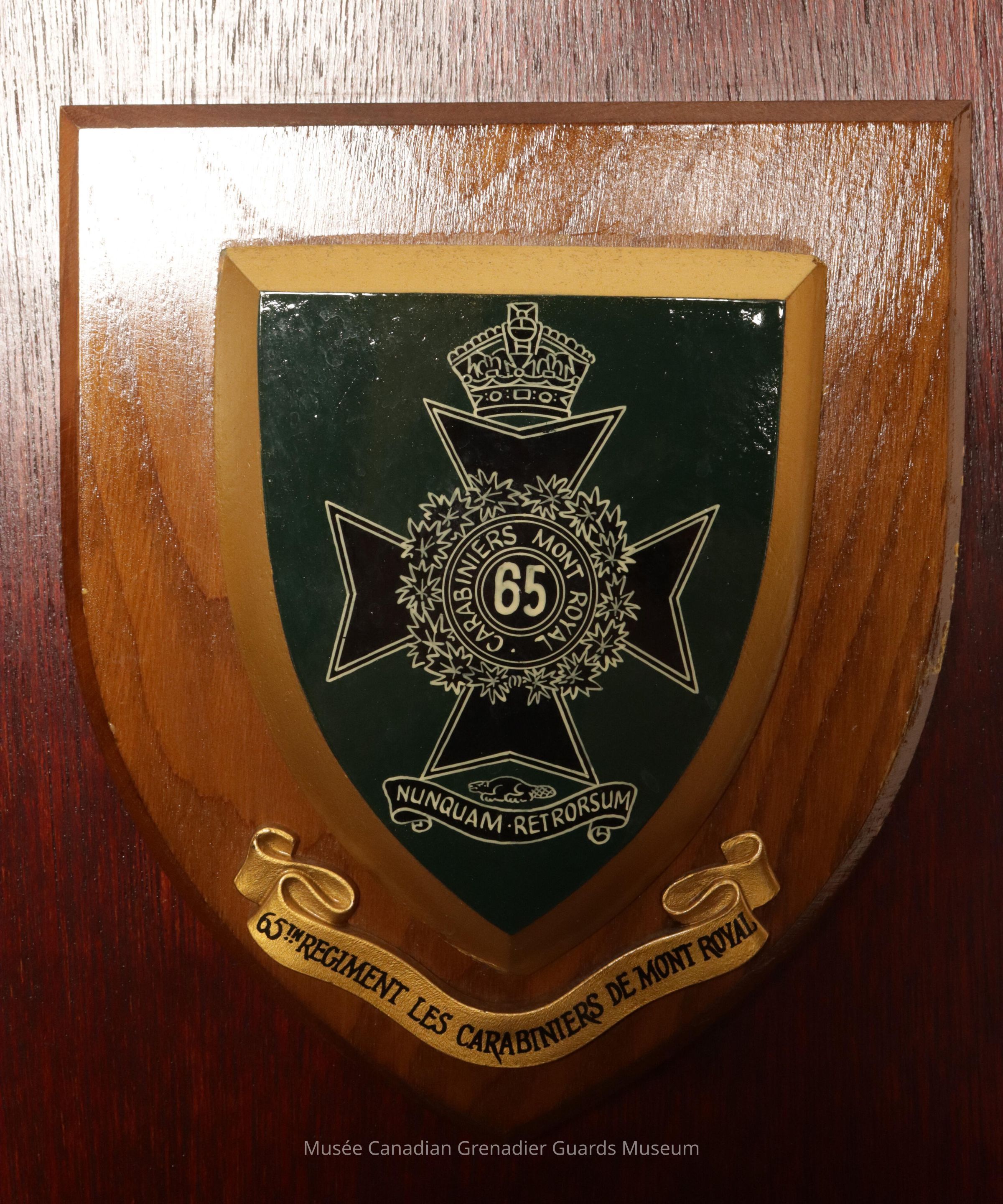
Name/Title
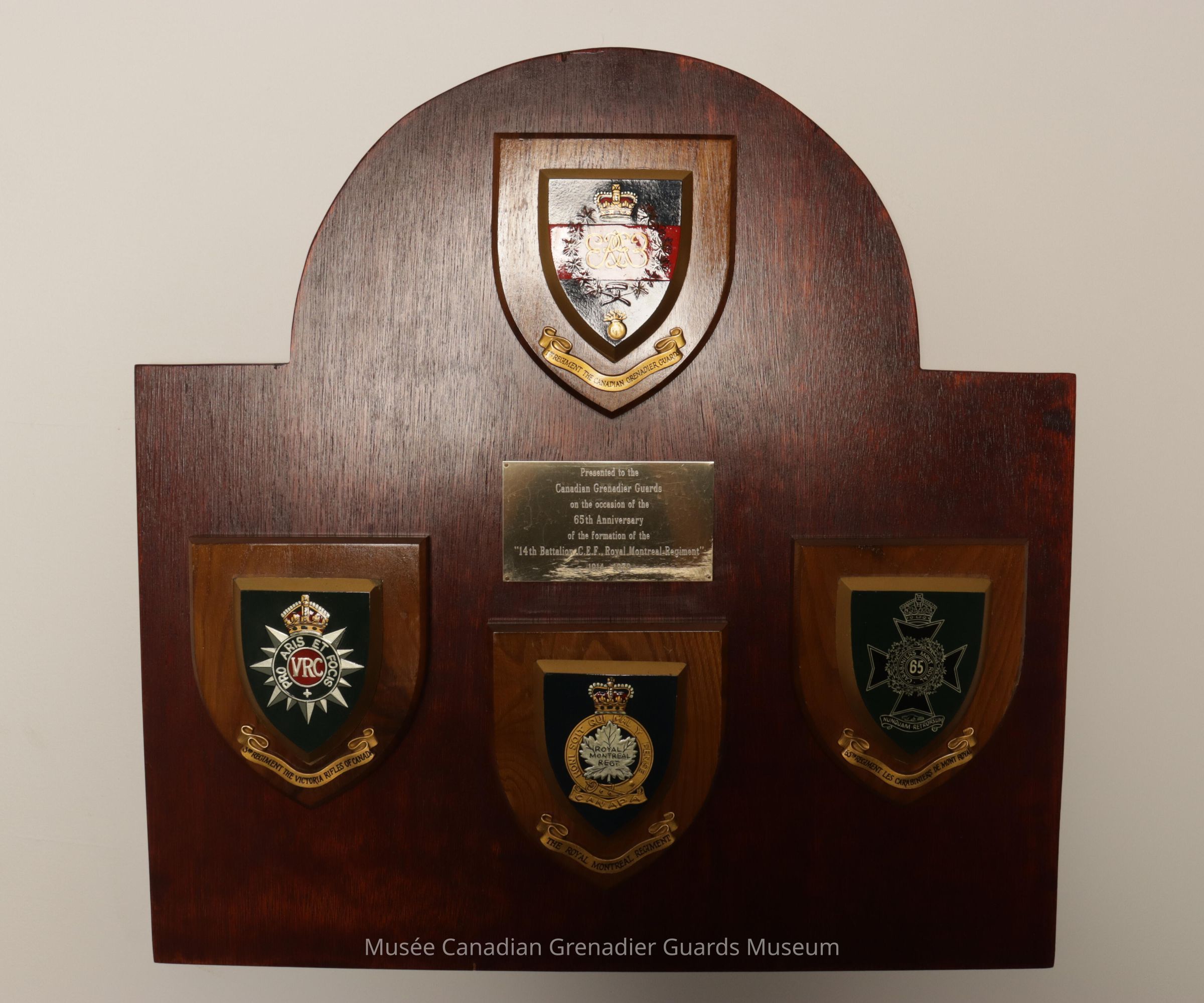
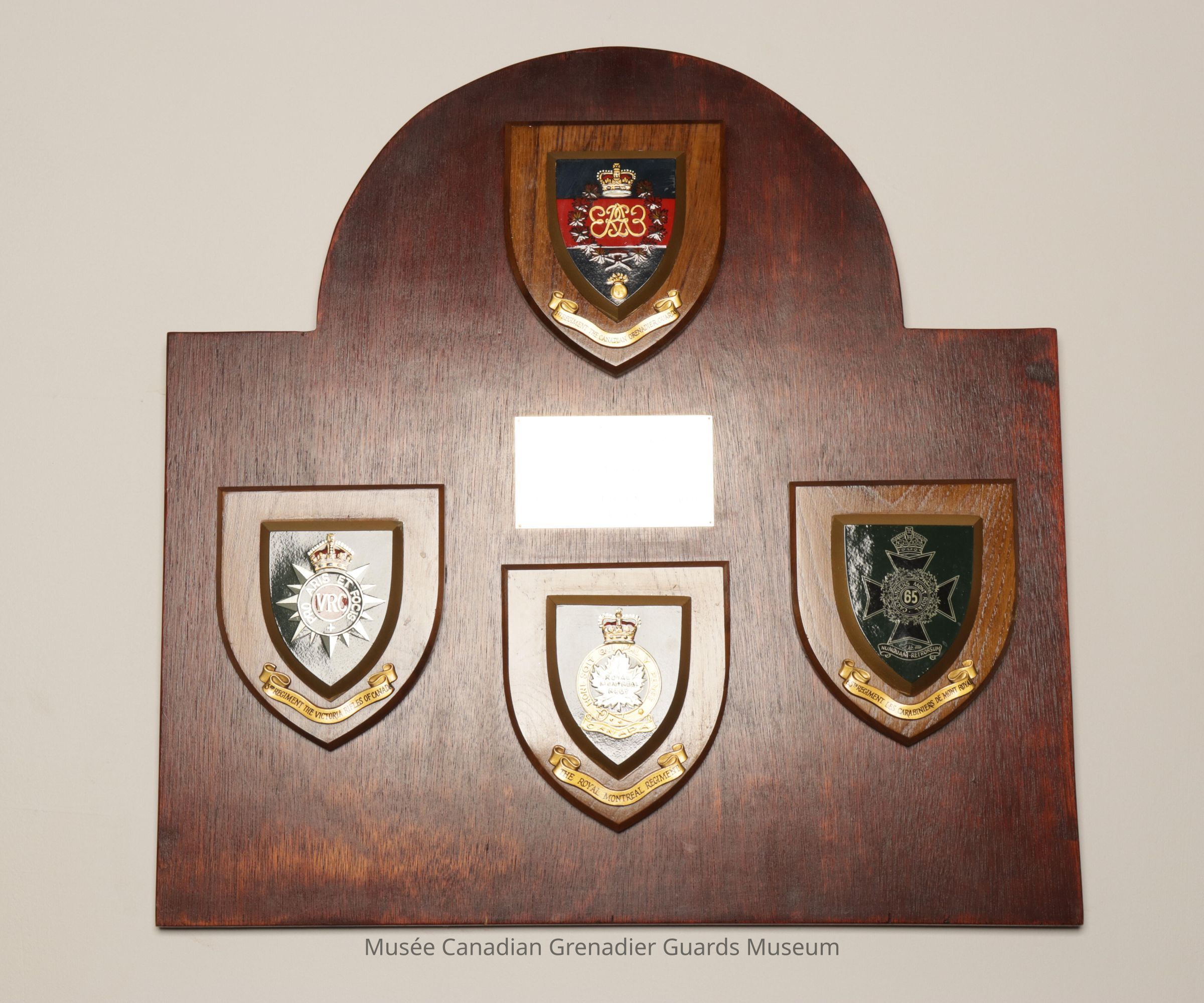
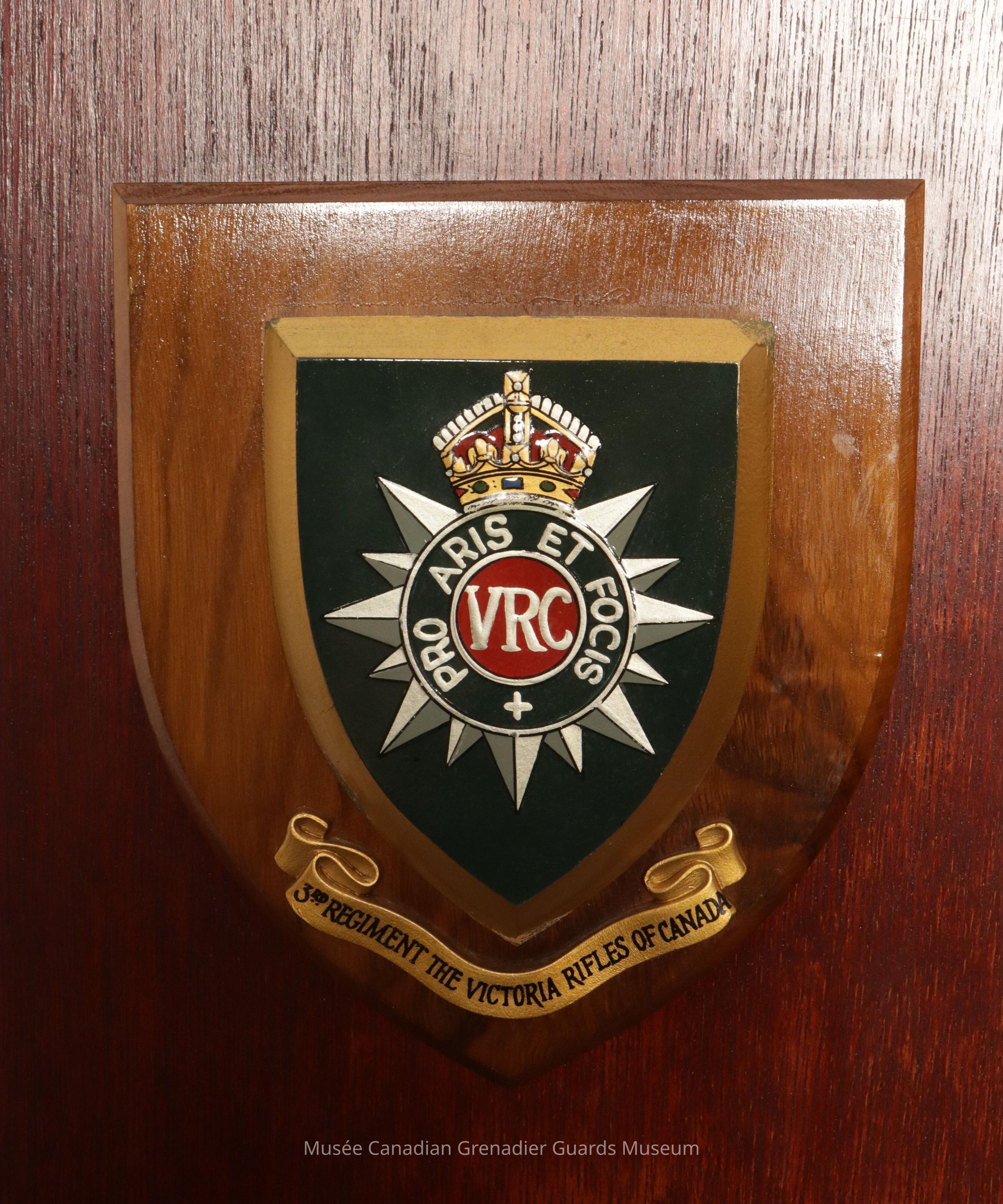
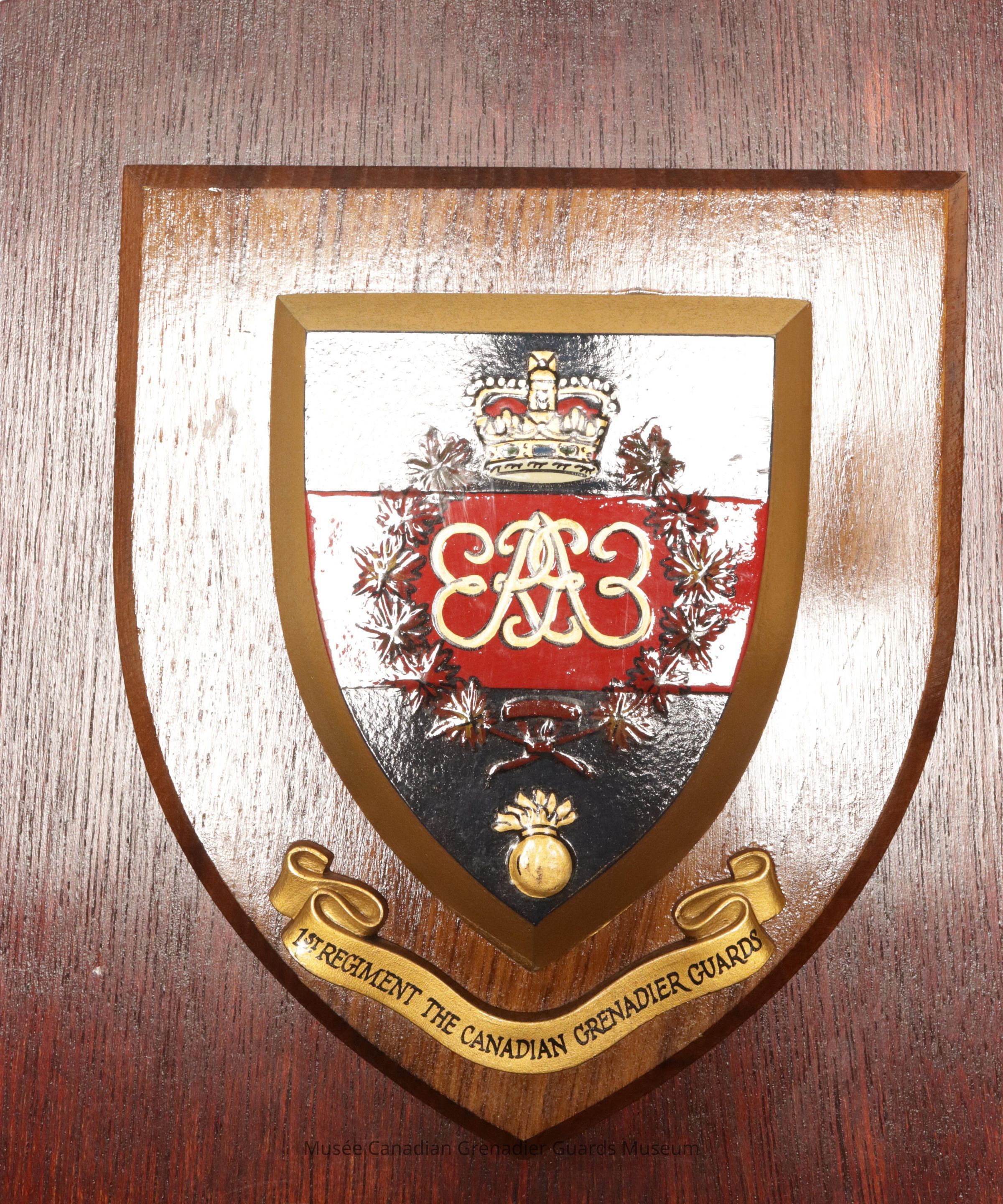
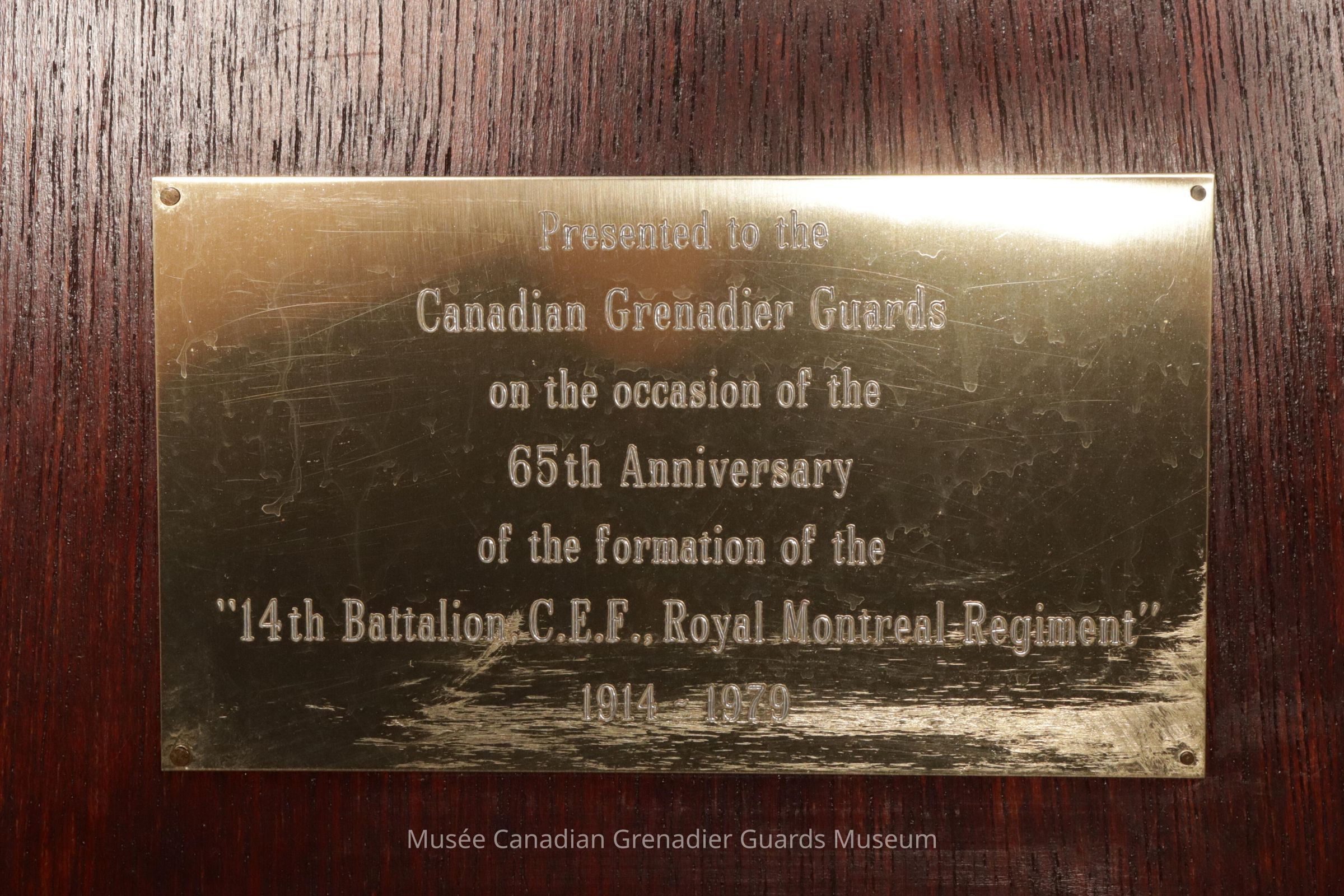
1979 - Presented to the Canadian Grenadier Guards on the occasion of the 65th Anniversary of the formation of the "14th Battalion C.E.F., Royal Montreal Regiment"Description
*** NEED TO RESEARCH WHAT EVENT AND OCCASSION THIS PLAQUE WAS PRESENTED ***
1979 - Presented to the Canadian Grenadier Guards on the occasion of the 65th Anniversary of the formation of the "14th Battalion C.E.F., Royal Montreal Regiment"
A BRIEF DISCRIPTION OF CGG's CONTRIBUTION TO THE 14th BN (RMR) CEF
A total of 484 CGG members and 105 Casualties (KIA) ended up fighting with the 14th Battalion (Royal Montreal Regiment) CEF during the First World War. Of these, 352 men and 15 Officers joined the initial enlistment with a majority forming No2 Company (CGG), the other 132 soldiers were later reinforcements from the 23rd, 60th, 87th, and 245th Battalions (CGG) around 1917 or later.
RESEARCHERS NOTE(S):
Chapter IV of the CGG Patterson Regimental History (pages 81-92) does a great job describing CGG's relationship with the 14th Battalion (RMR).
9 Original CGG Members (4 Officers and 4 ORs) who served with the 14th Bn returned to Canada in 1915 and helped form as original members the 87th Battalion (CGG) CEF in 1916.
OFFICERs: BGen FS Meighen, Lt-Col Alfred Soden, Lt-Col Reginald William Frost, Lt-Col Reginal W. Frost, Major Herbert Smith, and Capt. John Henry Richardson.
OTHER RANKS: RSM William Wallis, DCM, RSM James Arthur Rooke, Pte Edgar Thompson, and Pte F Guthrie.
CGG ACHIEVEMENTS WITH 14th BN
1. CGG Lieutenant Colonel Frank Stephen Meighen (Late Major-General) was the first Commanding Officer of the 14th Battalion (RMR) CEF
2. Sgt Reginald Harry Drake (CGG) a Stretcher Bearer with the 14th Bn (RMR) won Canada's first DCM of WWI on 11th of March 1915.
3. First CGG Casualty of WW1: Pte William Herbert V. Hartley on 19th of October 1914
4. First CGG Combat (killed by enemy fire) Casualties of WWI: Charles Edward Hunt, Sgt. Thomas Moore, DCM, and Pte Charles Maltby Molt all on the 10th of March 1915
5. CGG earned 3 Battle Honours (Ypres 1915, Festubert 1915, and France and Flanders 1915
6. CGG's second most decorated soldier was Lieutenant-Colonel Dick Worral of the 14th Bn. who earned 7 gallantry awards during WWI while serving with the 14th Battalion (RMR), DSO & Bar, MC & Bar, Order of St. George (Russia), and 2 Mentioned in Despatches (MIDs)
7. 41 CGG soldiers won a combined total of 61 Gallantry awards while serving with the 14th Battalion (RMR).
8. On April 22nd, 1915, during the Battle of 2nd Ypres, at St-Julien, after the first major German gas attack, the entire line of the allies was in jeopardy of collapsing if not for a Company of CGG 14th Bn (No2 Canadian Grenadier Guards), and a company of Montreal Black Watch who stood firm at great loss.
HERE IS HOW THE BATTLE WAS REPORTED BACK IN MONTREAL:
When the attack opened on the afternoon of April 22nd, the 14th Battalion, … lay in billets in St. Jean and St. Julien. No. 2 Coy., in St. Julien, formed part of a special reserve and came under the orders of Lieut.-Col. F.O.W. Loomis, Town Commandant of St. Julien, and Commanding Officer of the 13th Battalion. As soon as it became certain that the Germans had penetrated the French lines to the Canadian left, Lieut.-Col. Loomis ordered Major Hanson (CGG) to take up a defensive position north of St. Julien and between the Steenbeek and the St. Julien along Keerselaere Road. Heavy fire was encountered during the move forward and after the position was occupied, Major Hanson (CGG), the Company Commander, and Lieut. W.K. Knubley (CGG) suffering severe wounds and Capt. Steacie (CGG), second-in-command, being killed. Command of the company thereupon devolved on Capt. W.C. Brotherhood (CGG), who dug in and linked up with Capt. R.Y. Cory, who commanded a half company of the 15th Battalion on the right. Later Cory sent to Brotherhood’s (CGG) support a party of approximately 200 French coloured troops, under a gallant subaltern, who were requested to dig themselves in on Brotherhood’s left. The French troops were willing, but were discovered by a French senior officer, who sharply ordered them to the rear. This senior officer appeared dazed and was obviously lost, none the less the subaltern in command of the Turcos dared not disobey his explicit orders and the French troops accordingly withdrew.
As the position of No. 2 Coy. was vital to the safety of the troops on the forward flank, Lieut.-Col. Loomis gave orders that it must be held at all costs. In obedience to these orders, the men of the company prepared to hold on, come what might. Shell fire poured on the position throughout the night, halting occasionally to permit sharp attacks by battle patrols of the enemy.”
St. Julien and Kitchener's Wood: “The Second Battle of Ypres was the first time Germany used chemical weapons on a large scale on the Western Front in the First World War. The Second Battle of Ypres actually consisted of four separate battles:
Source: Archives of Captain Stacie (1st Regt GG and 14th Bn RMR)Created By
Zarina CarlevarisCreate Date
August 18, 2022Updated By
Lieutenant Michael Hayes-Rivet, retired.Update Date
September 29, 2025