Name/Title
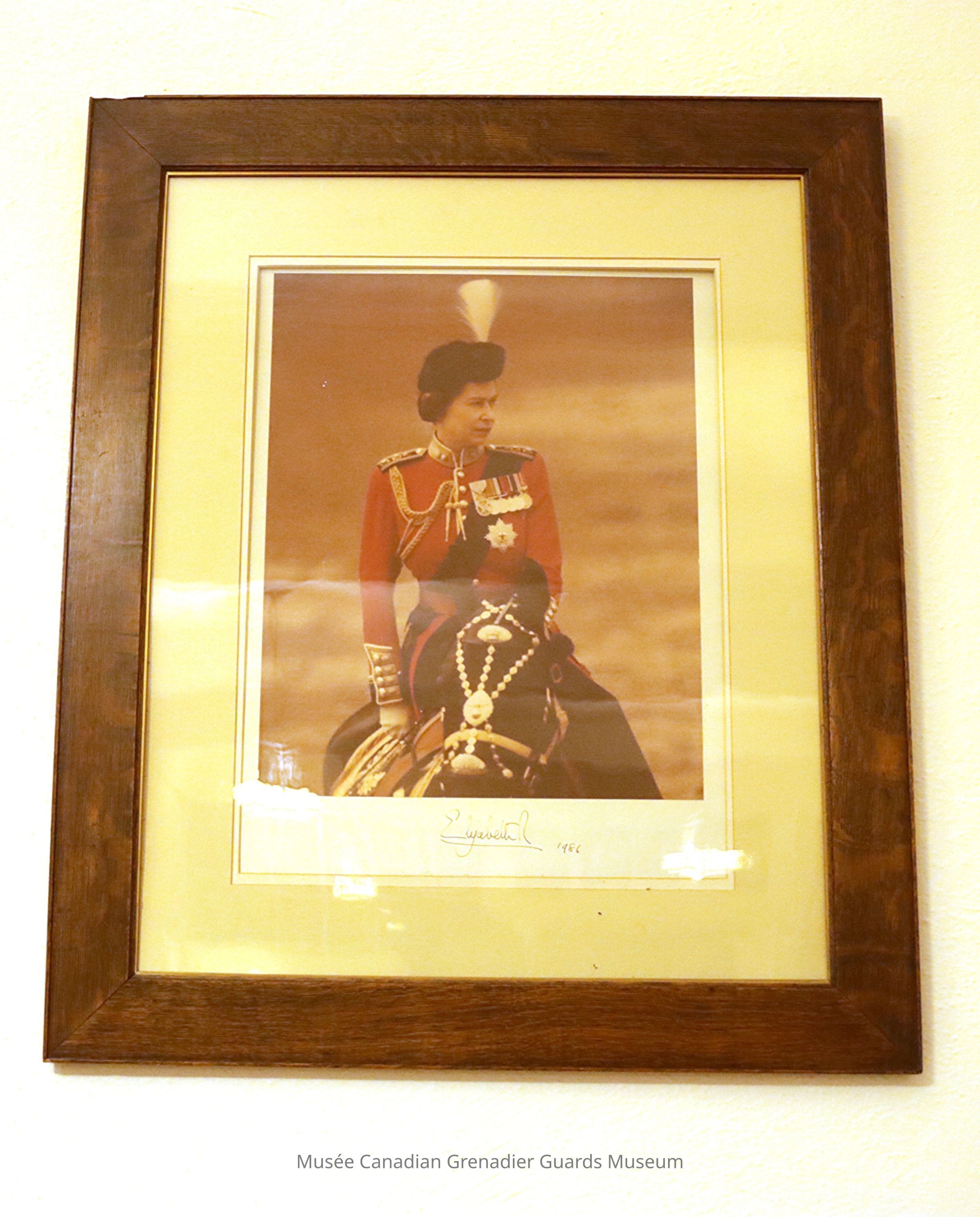
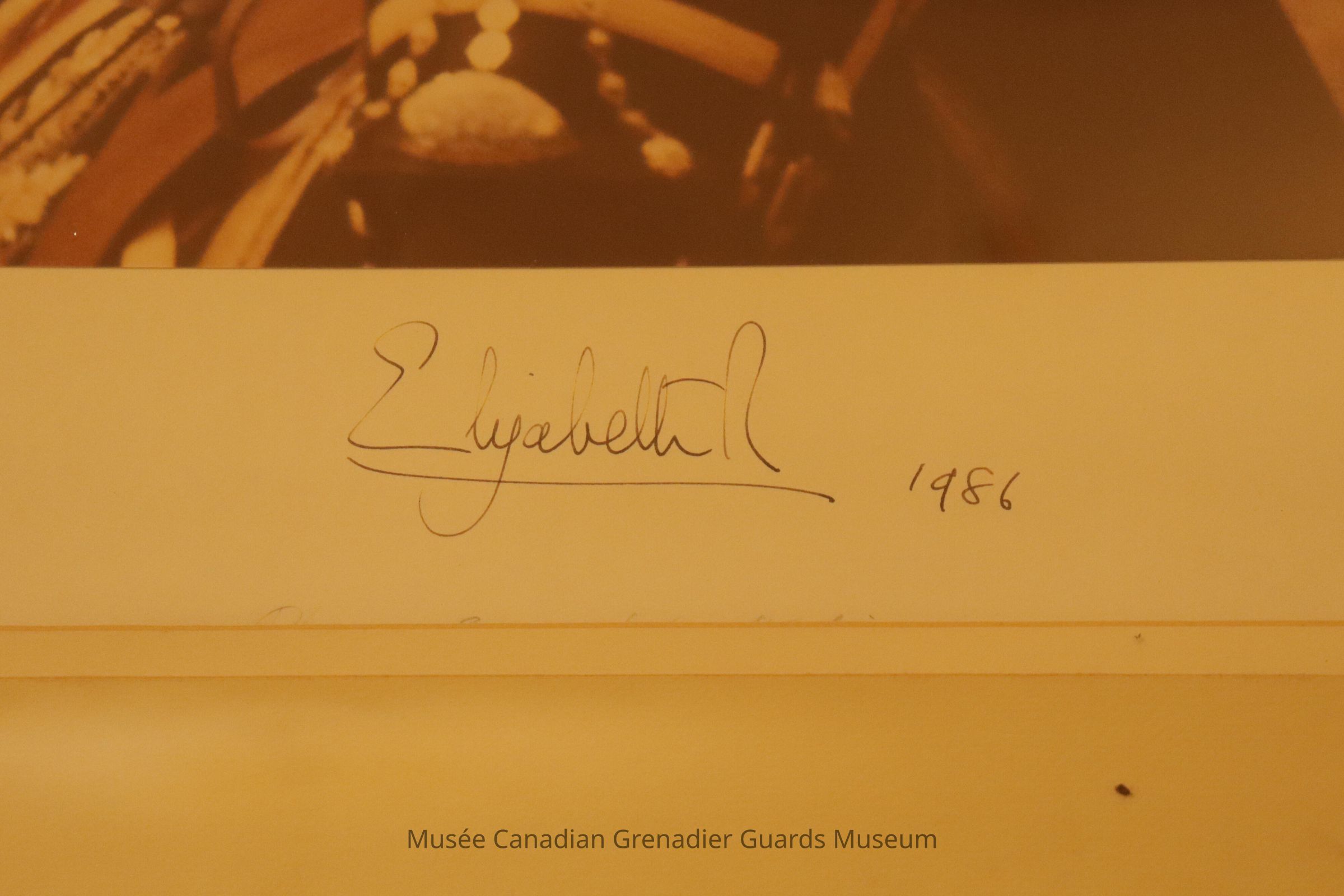
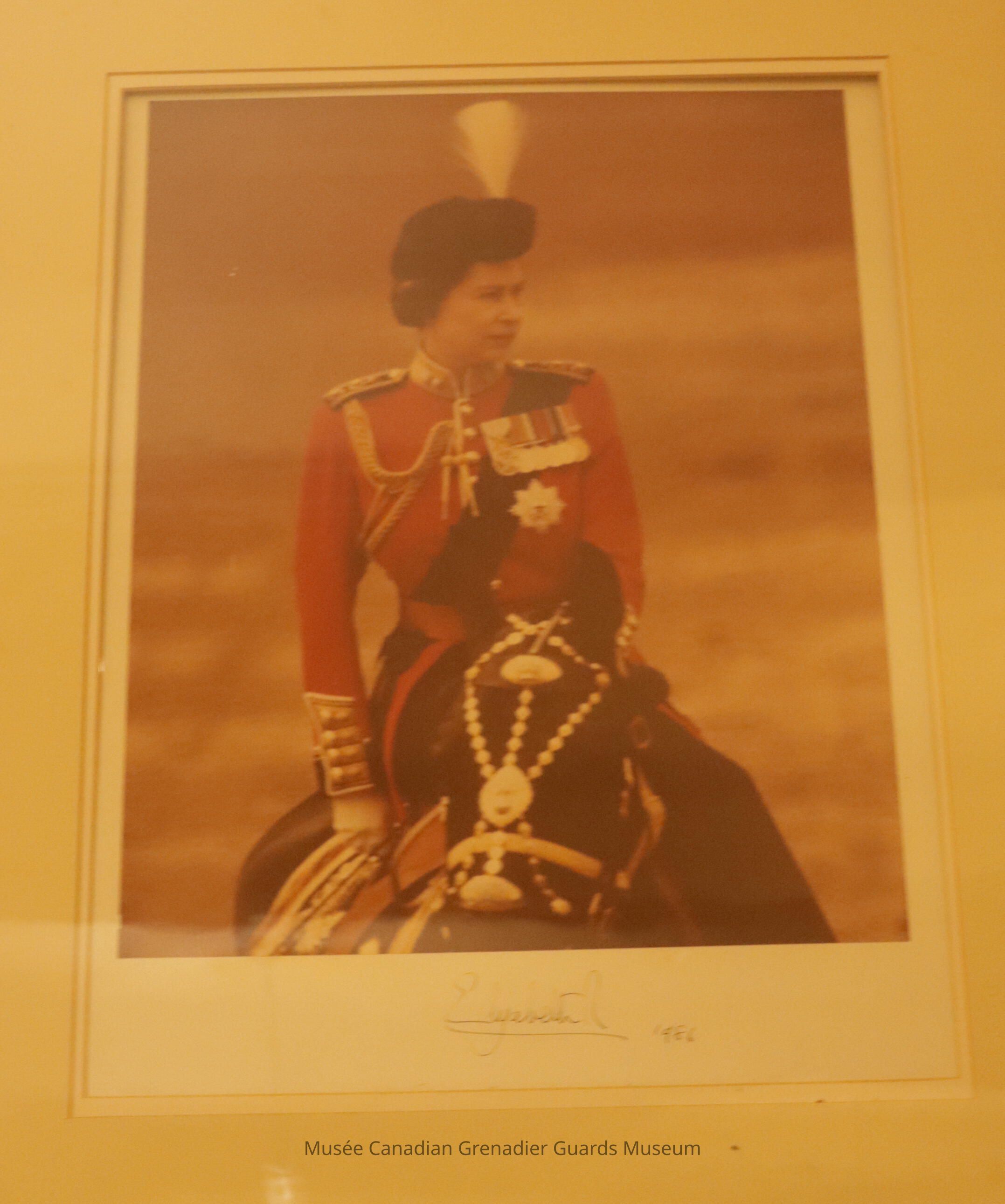
1986 - Signed Portrait of Her Majesty, Queen Elizabeth II (1926-2022) - Colonel in Chief of The Canadian Grenadier Guards (1953-2022)Description
1986 - Signed Portrait of HM Queen Elizabeth II - Colonel in Chief of The Canadian Grenadier Guards
Elizabeth II (Elizabeth Alexandra Mary; 21 April 1926 – 8 September 2022) was Queen of the United Kingdom and other Commonwealth realms from 6 February 1952 until her death in 2022. She had been Queen regnant of 32 sovereign states and was the monarch of 15 realms including Canada at her death. Her reign of 70 years and 214 days is the longest of any British monarch, the second-longest of any sovereign state, and the longest of any queen regnant in history.
BRITISH MILITARY SERVICE (1945-1950)
During WW2, and prior to becoming Queen, she served in the British Army and held ranks as follows:
24 February – 26 July 1945: Hon. Second Subaltern, Auxiliary Territorial Service
26 July 1945 – 24 July 1947: Hon. Junior Commander, Auxiliary Territorial Service
24 July 1947 – 1 February 1949: Hon. Senior Controller, Auxiliary Territorial Service
1 February 1949 – March 1950: Hon. Senior Controller, Women's Royal Army Corps
GRENADIER GUARDS APPOINTMENTS
She was Colonel with The Grenadier Guards from 1947-1952, and Colonel in Chief of The Grenadier Guards and The Canadian Grenadier Guards from 1952-2022.
BIOGRAPHY
Elizabeth was born in Mayfair, London, during the reign of her paternal grandfather, King George V. She was the first child of the Duke and Duchess of York (later King George VI and Queen Elizabeth The Queen Mother). Her father acceded to the throne in 1936 upon the abdication of his brother Edward VIII, making the ten-year-old Princess Elizabeth the heir presumptive. She was educated privately at home and began to undertake public duties during the Second World War, serving in the Auxiliary Territorial Service. In November 1947, she married Philip Mountbatten, a former prince of Greece and Denmark. Their marriage lasted 73 years until his death in 2021. They had four children: Charles, Anne, Andrew, and Edward.
When her father died in February 1952, Elizabeth, then 25 years old, became queen of seven independent Commonwealth countries: the United Kingdom, Canada, Australia, New Zealand, South Africa, Pakistan, and Ceylon, as well as head of the Commonwealth. Elizabeth reigned as a constitutional monarch through major political changes such as the Troubles in Northern Ireland, devolution in the United Kingdom, the decolonisation of Africa, and the United Kingdom's accession to the European Communities as well as its subsequent withdrawal. The number of her realms varied over time as territories gained independence and some realms became republics. As queen, Elizabeth was served by more than 170 prime ministers across her realms. Her many historic visits and meetings included state visits to China in 1986, to Russia in 1994, and to the Republic of Ireland in 2011, and meetings with five popes and fourteen US presidents.
Significant events included Elizabeth's coronation in 1953 and the celebrations of her Silver, Golden, Diamond, and Platinum jubilees. Her Majesty, Queen Elizabeth II died aged 96 at Balmoral Castle in 2022, and was succeeded by her eldest son, Charles III.
ROYAL VISITS TO CANADA
Elizabeth II conducted 20 official tours of Canada from 1951 to 2000. She first toured Canada in 1951, as Princess Elizabeth, Duchess of Edinburgh. In her subsequent tours of the country, she toured it as the Queen of Canada. In addition to official tours, in the 20th century, the Queen made nine stopovers in Canada, to refuel her aircraft.
ROYAL VISIT 1992 - CGG NEW STAND OF COLOURS
The Queen undertook a royal tour of Canada from 30 June 1992 to 3 July 1992 in order to preside over commemorations for the 125th anniversary of Canadian Confederation and her ruby jubilee. On 30 June, she unveiled an equestrian statue of herself at Parliament Hill in Ottawa. The statue is placed across a statue of Queen Victoria, the first monarch of a confederated Canada. On the same day, the Queen also unveiled two stained-glass windows at Rideau Hall, one to commemorate her ruby jubilee, the other to commemorate the 40th anniversary of the appointment of the first Canadian-born governor general of Canada. The following day, she presided over the swearing in of new members for the Queen's Privy Council of Canada, before presiding over official Canada Day celebrations on Parliament Hill including the presentation of CGG's new stand of Colours.Created By
Zarina CarlevarisCreate Date
August 18, 2022Updated By
Lieutenant Michael Hayes-Rivet, retired.Update Date
May 6, 2025