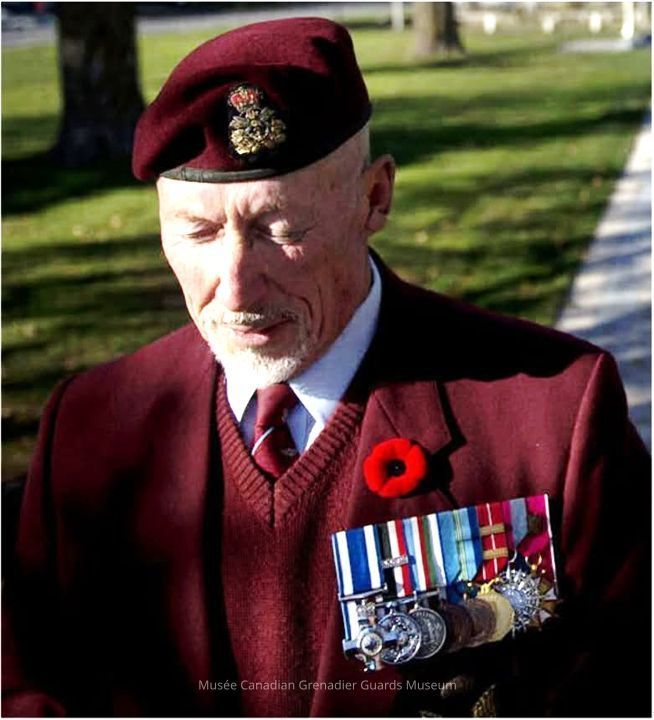
Name/Title
2024 - Interview by CGG Regimental Family Member Brigadier General Ian Douglas, MSC, CD - Former Commander of Canada's Special Service Force (SSF)Scope and Content
Brigadier-General Ian Douglas, MSC, CD
Canadian Airborne Regiment
Enlistment: Ian’s entire career in the Canadian Forces was as an Infantry Officer, first starting out with The Canadian Grenadier Guards and the Regiment of Canadian Guards.
Regiment of Canadian Guards: The Canadian Guards (officially known as the Regiment of Canadian Guards) was an infantry regiment of the Canadian Army that served in the same role as the five regiments of foot guards in the British Army.
Ian deployed to Cyprus as a Captain with the 1stBattalion of the Guards to serve as a United Nations Peacekeeper.
UNFYICP: The United Nations Peacekeeping Force in Cyprus is a United Nations Peacekeeping Force that was established under United Nations Security Council Resolution 186 in 1964 to prevent a recurrence of fighting. Cyprus had been invaded by the Turkish Army in 1974, they captured and occupied the northern part of the island where they still are today.
After his peacekeeping deployment was over in Cyprus Ian returned to Canada. He remained with the Guards until the Regiment was dissolved in 1970 due to a reduction in military spending. Prior to that he had completed training at the Canadian military staff college and was in command of one of the companies with the Guards. When the requirement to move to another regiment came, he took command of a new company with 3 RCR.
Royal Canadian Regiment: The Royal Canadian Regiment is an infantry regiment of the Canadian Army. The regiment consists of four battalions, three in the Regular Force and one in the primary reserve.
After Ian’s posting with 3 RCR, he was posted to Mobile Command Headquarters, Army Headquarters.
Mobile Command Headquarters: On 1 April 1966, prior to the unification of the Canadian Armed Forces, the land forces were placed under a new command called Mobile Command (French: Commandement des forces mobiles). For two years following, the Army existed as a distinct legal entity before its amalgamation with the Royal Canadian Navy and the Royal Canadian Air Force to form the Canadian Armed Forces. In the 1990s, the command was renamed Land Force Command (French: Commandement des Forces terrestres), until it reverted to its original name in August 2011.
Ian served three years as the Senior Staff Officer Infantry and Senior Staff Officer Reserve Training. He then was promoted and commanded the 3 Mechanized Commando of the Airborne Regiment in Germany for two years.
Canadian Airborne Regiment: The Canadian Airborne Regiment was a Canadian Forces formation created on April 8, 1968. It was not an administrative regiment in the commonly accepted British Commonwealth sense, but rather a tactical formation manned from other regiments and branches. It was disbanded in 1995 after the Somalia affair.
After his command of 3 Mech Commando, CAR he was made the SSO at Ops for the 4th Brigade. Completing that task he returned to Canada.
Army Headquarters: Ian was employed as Deputy Chief of Staff for Combat Development – “we were looking at the future of the army – as a Colonel. I ran exercise RV81, the first divisional level exercise in seventeen years, in 1981, as the Chief of Staff working for Major General Baker”.
RV81: “CANADIAN FORCES BASE GAGETOWN, N.B. -- Several thousand Canadian troops will descend on this vast military base near Fredericton in June for the largest Canadian Forces war games exercise in 16 years. After being cancelled in 1979 by budget cuts and in 1980 because the federal government was nervous about ordering troop movements during Quebec's independence referendum, 'Rendezvous '81' will, according to military brass, provide a much-needed morale boost for Canada's forces.
It will involve almost 9,000 troops, including those from the 1st and 2nd Canadian Brigade groups, with respective headquarters in Calgary and Valcartier, Que., and the Special Service Force from Petawawa, Ont. Current strength of Canada's military is estimated at more than 80,000 persons.
Planned in minute detail by military tacticians and computers of Gagetown's Forces Combat Training Center, the exercise will be a month-long series of troop and armor movements, assault and defensive maneuvers and tests -- using both live and dummy ammunition. It will climax in a week-long mock battle pitting one-half of Canada's military strength against the other half, with field referees judging each unit's performance. Whatever the result of the 'battle,' Lt. Gen. Jean-Jacques Paradis, the man who retires this month as head of the Canadian Forces, feels the exercise can't help but sharpen Canada's defense response.”
Ian, after this was returned to the Canadian Airborne Regiment for a further 3 years.
Regimental Commander CAR: Between 1982-85 Ian was the Canadian Airborne’s Regimental Commander. After his command of the CAR, he became the Deputy Chief of Operational Research where he worked for Dr. George Lindsay in Ottawa.
Special Service Force: Ian returned to Petawawa, where he had served with the Regiment of Canadian Guards at the start of his career. This time he would be in Petawawa to Command the SSF at the rank of Brigadier-General.
Special Service Force: In 1977, 2 Combat Group combined with the Canadian Airborne Regiment to form the Special Service Force, a formation of the Canadian Army. This latter-day Special Service Force represented a compromise between the general-purpose combat capabilities of a normal brigade and the strategic and tactical flexibility that derived from the lighter and more mobile capabilities of the Canadian Airborne Regiment. Its insignia was a winged sword with the word Osons (French for 'Let us dare'). The Force was a brigade-sized command with a strength of 3,500, created to provide a small, highly mobile, general-purpose force that could be inserted quickly into any national or international theatre of operations. To this end most units in the Force had a parachute sub-unit that would be used to support the Canadian Airborne Regiment as the Airborne Battle Group. All but one unit were located in Petawawa, Ontario (1st Battalion The Royal Canadian Regiment was based in London, Ontario). The 8th Canadian Hussars armoured regiment had three squadrons: A, B and D. A and B were equipped with Cougar armoured vehicles, while D Squadron, an armoured reconnaissance squadron, was equipped with Lynx vehicles (D Squadron eventually developed an airborne capability and a two-car Lynx patrol was airdropped in Goose Bay, Labrador, in January 1986 during Exercise Lightning Strike 86. In 1987, the 8th Canadian Hussars deployed to Canadian Forces Base Lahr in the former West Germany, while the Royal Canadian Dragoons replaced them in the Special Service Force at Petawawa after redeploying from Lahr. The 2nd Regiment, Royal Canadian Horse Artillery, had a parachute battery (E Battery) with 105 mm L5 Pack Howitzers and from 1991, an airborne air defence troop. 2 Combat Engineer Regiment provided an airborne engineer troop. Command and supporting elements of the SSF Headquarters and Signals Squadron were airborne, as were a platoon provided from 2 Field Ambulance and a Tactical Air Movements Section from 2 Service Battalion. In keeping with the Total Force concept that evolved in the late 1980s several combat arms units of the Army Reserve were assigned operational taskings to provide subordinate units in order to augment the Special Service Force when required. These sub-units were provided by units from the Central Militia Area (later re-designated as Land Forces Central Area and now known as the 4th Canadian Division). Units tasked included the Queen's Own Rifles, elements of the 2nd Field Engineer Regiment, and a composite battery of Royal Canadian Artillery militia units. The Special Service Force's readiness and deployability were never tested as a formation, but its units and soldiers served in operations both at home and around the world. They served in Cyprus, Somalia, the former Yugoslavia, Rwanda, Namibia and internally at the protests in Ipperwash and southeastern Ontario. With the addition of Leopard tanks for the RCD, M109 howitzers for 2 RCHA and the addition of the 2nd Battalion, the Royal Canadian Regiment, and the disbandment of the Canadian Airborne Regiment and the resulting reduction in the parachute capability, the Special Service Force was redesignated as 2 Canadian Mechanized Brigade Group (CMBG) by a ministerial order signed on 24 April 1995. This decision and the associated reorganizing and re-equipping of the formation are a reflection of the current emphasis in Canadian defence policy on general purpose capabilities. With a smaller force structure, a smaller defence budget and more frequent operational taskings, it became clear that general purpose capabilities provide the best return on investment in defence. Accordingly, 2 CMBG was designed to be a mirror image reflection of its two sister formations, 1 CMBG in Western Canada, and 5 CMBG in Quebec. In completing this transformation, 2 CMBG maintained the spirit and traditions of the Special Service Force, while mastering the equipment and tactical doctrine that give it wide employability in a range of possible taskings.
Director General of Reserves and Cadets: Following his command of the SSF, Ian returned to Ottawa in the role of Director General of Reserves and Cadets. A position he did for only a short duration of time.
“I was sent to ONUCA in Central America during part way through that tour and I returned to Ottawa to do some studies for the DCDS on peacekeeping operations.”-Ian Douglas
ONUCA was the first United Nations operation in Central America, no one had experience as a peacekeeper in Central America leading up to the operation. Ian had limited peacekeeping experience going back to when he was a junior officer. He believed he was selected for the mission because of his command experience. Ian also spoke Spanish, which would aid him in his duties while on the operation overseas.
ONUCA: was established by Security Council resolution 644 (1989) of 7 November 1989. The Group's mandate was to conduct on-site verification of compliance by the Governments of Costa Rica, El Salvador, Guatemala, Honduras and Nicaragua with their security undertakings contained in the Esquipulas II Agreement, namely (a) the cessation of aid to irregular forces and insurrectionist movements, and (b) the non-use of the territory of one State for attacks on other States. The latter undertaking was to include preventing the establishment or use of facilities for radio or television transmissions for the specific purpose of directing or assisting the military operations of irregular forces or insurrectionist movements in any of the five countries.
On 27 March 1990, the Council, by its resolution 650 (1990), authorized, on a contingency basis, an enlargement of the mandate of ONUCA and the addition of armed personnel to its strength in order to enable it to play a part in the voluntary demobilization of the Nicaraguan Resistance.
On 20 April 1990, following the signing by the Nicaraguan parties of a complex of agreements relating to the voluntary demobilization of the members of the Nicaraguan Resistance in Nicaragua, the Security Council, by its resolution 653 (1990), decided to expand ONUCA’s mandate to include additional tasks of monitoring the ceasefire and separation of forces, and the demobilization process.
After the completion of the demobilization process in June/July 1990, ONUCA continued to implement its original tasks and contribute to the peace efforts in the region. The mandate of the Mission was terminated in January 1992.
INTERVIEW CONTROL NUMBER: 31D 6 DOUGLAS I.
INTERVIEWER: How many were you?
DOUGLAS: We wound up with two hundred and sixty-five military observers, but we started off with a much smaller group. I would say the first group probably was about 25 or 30.
INTERVIEWER: You were in a Spanish Command, eh?
DOUGLAS: A Spanish Commander who was not a combat arms officer, had never had command experience in the field, as we found out latterly, and brought a large Spanish staff with him. His immediate staff were all Spanish. It was very, very interesting. The philosophy from which he worked was quite different from that from which I worked as a Canadian combat arms officer.
INTERVIEWER: Was this a good thing as far as relations with the people of Central America?
DOUGLAS: Well, the idea that the commander could speak Spanish was almost essential. We were – as I said, ONUCA was a new paradigm and until that time, the only working languages were the official languages of the UN which at the time were English and or French. And, indeed, throughout the entire mandate that I was there, we had problems with such contingents as the Irish who insisted that English be the only language used. Having said that, it was essential to have Spanish to work fully in the area. So, the idea of sending someone with the Spanish language capabilities was essential.
INTERVIEWER: What about the people who were demobilizing, the Contras? Were they – my ignorance shows here – were they spread beyond Nicaragua into all these countries?
DOUGLAS: Well, the Contras, which was the Nicaraguan resistance – the proper name for them – were, indeed, Nicaraguans. In the days of the Cold War, they were supported by the United States and the Sandinistas were supported by Cuba, by the Soviet Union. So, you had these two basic ideologies clashing. And, of course, the war had gone on for ten years. The average Contra fighter was a campesino. He was dirt or subsistent farmer. He had come from the northern or the coastal part of Nicaragua. They rebelled against the oppression of the Sandinistas who were taxing them, who were taking over their land etc. etc. This, then, became the driving force for the United States to support the Contras and, of course, the Soviet or Cuba to continue supporting the Sandinistas. Things came apart, of course, as the Cold War came to an end. The Soviet Union, of course, was starting to break up. The support, through Cuba, was no longer there for the Sandinistas. There was an election in Nicaragua that, despite all of the forecasts, saw the government or the coalition of Violeta Chamorro, beat the government – the Sandinista government – of Ortega which was accepted, strangely enough. That, indeed, was the point where it was decided that perhaps demobilization and disarming was a possibility, when the election happened. It was planned before that or hoped to do it before that. But it was only when the election happened that we realized that this indeed was going to happen.
“A humorous anecdote – the underwear that they brought with them – which had all been purchased by the United States, of course, as we found – they gave each Contra fighter two sets of bikini playboy underwear. Well, imagine! I mean these fellas had been in the jungle for ten years – probably didn‘t wear underwear! And you are giving these little sort of briefs – well – a bit of a giggle there. It just showed, I mean, the people that were doing this did not understand the people that we‘re dealing with, the facts of life. [laughs] Having said that, I mean, they appreciated the designer jeans they got, the golf shirts and what have you, and frankly, at the end of the day, it was the thing that got me into peace keeping after I got out. At one stage and at one of the sites, I saw a Contra and his family. He had his wife by one hand, and he had three or four children, and he had a big bag of rice that we had given him, over his shoulder. And he was in his new designer jeans and golf shirt. His wife had the bottles of oil. They were climbing on to a Sandinista truck and the Sandinista army was taking them back to their villages. He was as happy as the proverbial. He had been promised a little bit of land by the new government. He had food for the time being and he didn‘t have a gun in his hand for the first time in ten years. There was a bit of stability. Just the sort of, absolute joy of this man got to me. I said, ―Look what we‘ve done. We‘ve absolutely done something that‘s right, So, I got into it, and we frankly have not had one as successful as that one since. Some of them might work out. Some of them are not working out. But that in itself was quite a success.” – Ian Douglas
Meritorious Service Cross: Brigadier-General Ian Douglas, CD
Citation: Brigadier-General Douglas was the Deputy Chief Military Observer of the United Nations Observer Group in Central America during the demobilization of the Nicaraguan Resistance in April 1990. Demonstrating outstanding leadership, initiative and dedication, he planned, coordinated and directed the disarming and demobilization of more than 23,000 Nicaraguan Resistance fighters under dangerous conditions. His personal involvement in all aspects of the negotiations and subsequent demobilization accelerated the peace process. Brigadier-General Douglas' continuous display of courage and leadership earned him the respect of the United Nations Forces and the region's combatants alike. Date Awarded: January 14, 1993
BGen Ian Douglas was also honoured by the Order of Jose Dolores Estrada, Batalla de San Jacinto from the Republic of Nicaragua for his service to ONUCA.
Orden General José Dolores Estrada, Batalla de San Jacinto: Brigadier-General Ian Douglas, MSC, CD
Criteria: Established on 20 February 1991 by President Violeta Chamorro, the Order of Jose Dolores Estrada, Batalla de San Jacinto, is awarded to both military and civilian recipients who have rendered service to Nicaragua. The Order consists of five grades: Grand Cross, Grand Officer, Knight Commander, Officer and Knight. Canada Gazette, 27 July 1996
As his foreign award was entered into the Canada Gazette, he is authorized to wear the decoration behind his Canadian honours and awards.
Retirement: After ONUCA Ian ended his career as the military attaché to the United States. He retired in 1993, since which time he had been either serving in peace operations as a civilian around the world or teaching out of the Pearson Peacekeeping Centre in Nova Scotia.
Ian was further decorated by way of another foreign award by the United States of America for his duties as the Military attaché to the US. He was awarded the Officer of the Legion of Merit.
Officer of the Legion of Merit: Brigadier-General Ian Coutts DOUGLAS, MSC, CD (Retired)
Canada Gazette, 11 March 1995
As his foreign award was entered into the Canada Gazette, he is authorized to wear the decoration behind his Canadian honours and awards.
Not long after his retirement, Ian would be called upon again to serve with the United Nations, this time as a civilian.
Liberia: “I received a call within a day or two of arriving back in Canada from Maurice Baril, who was an old friend of mine – who then was the military advisor to the secretary general. Then from Iqbar Riza, who asked if I could give them a hand in Africa. I led the technical mission to Liberia in September 1993. The technical mission is that mission which goes to the country with the experts and decides how one is going to apply the accords that have been signed. And in this case, it was the Cotonou Accords had been signed between the different factions in Liberia. When I‘d come back, I was asked if I would go to the mission and head the DDR office. I said I would and, indeed, I planned the Liberian mission in ‘93, 94 in the same room as Romeo Dallaire, who was planning Rwanda. He was a one star, I was a one star, just about ready to retire, because I went to Liberia as a civilian. But we split the planning room – as a bit of a story – Romeo turned to me at one stage in September and said, ―Ian, I feel very sorry for you. ―Romeo, why?‖ He said, ―Well, your mission in Liberia is so complicated. You‘ve got four factions and maybe a fifth faction coming on,‖ he said. ―I am going to Rwanda where it‘s very simple,‖ he said. ―We have two factions. We have all signed the Arusha Accords and it‘s going to be great fun.‖ In April, of course, of ‘94, when things happened, I couldn‘t help but think of that statement that Romeo had made to me in all innocence the fall before.” – Ian Douglas
“Having said that, I went for a year to Liberia. It was an absolute disaster, for the simple reason that the parties to the conflict were not ready for peace, that the political accord had not really been – they had signed off on the accords, but they had no intention of keeping them because all factions wanted power. “– Ian Douglas
Zaire: “The next year I was asked to go back to UNDP – or sorry, UNHCR –and head the camp security forces in Zaire, as it was at the time. So, with 1500 Zairian soldiers under command as policemen, I took over security in 41 camps for a million and a half refugees in eastern Zaire, in the north and south
kivus. I did that for six months.”- Ian Douglas
Sierra Leone: Ian went to Sierra Leone as the DDR advisor to UNDP and to the government of Sierra Leone, shortly after the election of President Kabbah in 1995/96. UNDP's mandate is to end poverty, build democratic governance, rule of law, and inclusive institutions. We advocate for change, and connect countries to knowledge, experience and resources to help people build a better life.
Missions: Ian had done a series of missions on evaluating different missions such as that around the world – the disarming in Kosovo, Albania and other countries and at the same time I helped Pearson – the Pearson Peace Keeping Centre – set up their curriculum. Ian set up the DDR course ten years ago and had been working on courses there and around the world ever since.
Medals Awarded: Meritorious Service Cross (MSC), Special Service Medal w/ NATO bar, Canadian Peacekeeping Service Medal, UNFYICP-Medal, ONUCA-Medal, Canadian Forces Decoration w/ 2 Clasp, Grand Officer of the Order of Jose Dolores Estrada, Batalla de San Jacinto (Nicaragua) and The Legion of Merit-Officer (USA).
A Canadian, retired Brigadier-General Ian C. DOUGLAS, MSC CD,
participated in the United Nations Technical Reconnaissance of Liberia in
1993 as a civilian. He did not receive the medal.
Legacy:” I think that we should continue to be involved in developing the mechanics of this sort of thing. Our mechanics and models are still right, though in today‘s missions such as that we face in Darfur and Southern Sudan and in Haiti, are much more complicated than the missions we have here. What has happened, I think, is the world body has moved ahead into saying we are going to do DDR before the political facts of life are in place, before real accords are there. But having said that, it‘s sometimes forced by the fact that, if you don‘t do something about the instability, they‘ll go immediately back to war. So how do you balance all of these things off? I don‘t think there is any great secret to the doctrine – the body of doctrine that we have now – though I think we have a good body. But I think what we need is education of the senior policy makers. It still has not been done well enough. One of the initiatives we are pushing right now – certainly the Swedes are leading in this regard – I make the point about Sweden because I‘ve just came back from Sweden – is that we conduct senior seminars or symposiums for policy decision makers in government around the world, to make sure they understand the facts of life. Because at some stage or another, the political imperatives will be put into play and that might put everything aside. But the fact of the matter is, I think too many decisions are being made today without an understanding of the mechanics of how such an operation should be run.”-Ian Douglas
His interview with the CWM can be read here at: Interview with Ian Douglas CWM Oral History Project | Canadian War Museum
OSONSCreated By
Lieutenant Michael Hayes-Rivet, retired.Create Date
July 5, 2026Updated By
Lieutenant Michael Hayes-Rivet, retired.Update Date
July 15, 2026