Name/Title
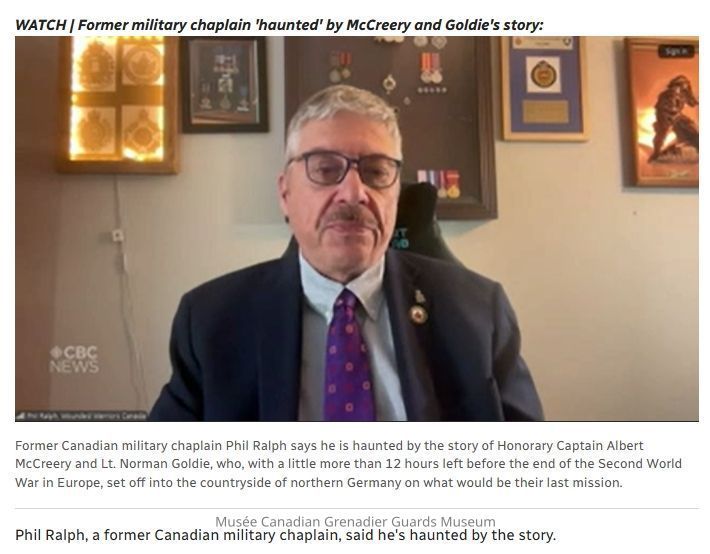
2025 - CGG's last two WW2 Combat casualties (Lt. Norman Goldie and Hon. Capt. Albert McCreery) - CBC Audio account of on the last day of the war before armistice on May 4th, 1945 by Canadian Military Chaplain Phil RalphScope and Content
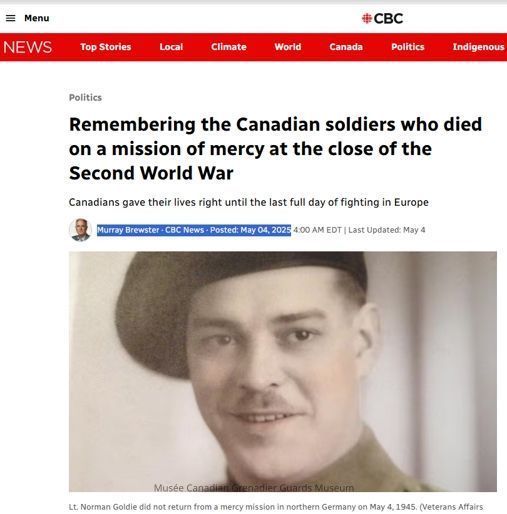
2025 - 4 May - CBC Audio account of CGG's last two WW2 Combat casualties (Lt. Norman Goldie and Hon. Capt. Albert McCreery) on the last day of the war before armistice on May 4th, 1945, by Canadian Military Chaplain Captain Phil Ralph and CBC Correspondent Murray Brewster · CBC News · Posted: May 04, 2025
SOMETIME in the afternoon of May 4, 1945, in the final hours of Canada's engagement in the European phase of the Second World War, a 27-year-old officer named Albert McCreery, son of an Irish Protestant dairy farmer from Ingersoll, Ont., left his regiment's base camp in northwestern Germany to try to locate wounded Canadian prisoners. The injured men, Captain McCreery told his comrades before he set off, were being abandoned by fleeing Nazi troops. He had to find them.
Another officer went with him. They never came back.
No one knows how Capt. McCreery died. The Official History of the Canadian Army in the Second World War, written in 1955, can cite only "circumstances which remain obscure." His body, run through with bullets, was found a few days later in the boggy terrain between the Dutch-German border and the North Sea. (The body of his fellow officer, Lieutenant N. A. Goldie, was not found.) By then, the fighting was, in theory, finished. So it is quite possible that Capt. McCreery was the last Canadian killed in combat in the European war.
He was a chaplain, and he was unarmed.
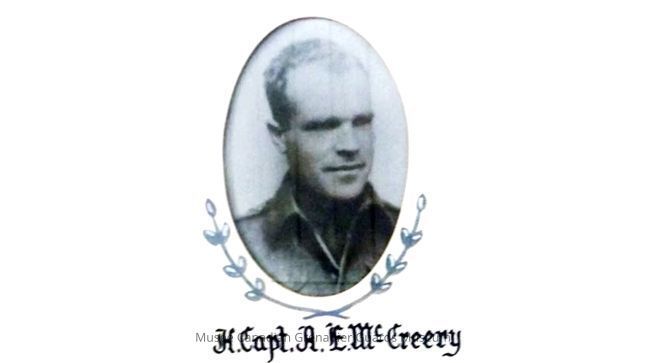
Albert E. McCreery, padre to the Canadian Grenadier Guards, held the rank of Honorary Captain. He was first buried under a small wooden cross in the Lutheran churchyard in the German hamlet of Wiefelstede west of Bremen. A photograph taken a few weeks later shows Albert's brother, Kenneth, desolate and bewildered, wringing his beret in his hands as he stands by the grave.
Kenneth McCreery had been stationed in England and never had to go into combat. He was celebrating V-E Day, he remembers, on the green in Aldershot, Hampshire, when someone told him his older brother had been reported missing in the war's final action. He can no longer remember where he was when he heard that Albert, a soldier of God, was dead.
The Nazi capitulation in Holland and northwestern Germany was announced by the British Broadcasting Corp. at 8:35 p.m. on May 4. It was to take effect at 8 a.m. the following day. Some Canadian units had seen no fighting for more than a week. But the Grenadier Guards, most of them men from the Montreal area, were still rolling north out of Oldenburg, along with the Lake Superior Scottish Regiment and the Argyll and Sutherland Highlanders of Hamilton, Ont., Casualties were being suffered until the hour the Germans quit.
At the front, the cessation of hostilities brought little immediate joy. In Battle Royal, the diarist of the Royal Regiment of Canada wrote that the announcement "seemed to leave everyone a little dazed." A high- school history teacher from Ingersoll, Jack Herbert, commanding a company of the Argyll and Sutherland Highlanders, wrote to his wife, simply, "it was quite a relief." The chronicle of the Queen's Own Rifles of Canada said: "Ticker-tape frenzy does not seize the souls of men who, for a long time, had lived close to death."
The Grenadier Guards, deep in German territory, were more nervous after the surrender than before it. One of them, a non-commissioned officer named Bruce de Cambra, recalls the anxiety: "There were refugees running around, 24 hours a day. Who were they? Friend or foe? Did they know there was a truce, or not? We heard small-arms fire all the time. We didn't get a chance to celebrate. We were never told to stand down. Our weapons were always loaded. We became a self-contained fortress."
On the last afternoon of combat, into this mad marriage of peace and war, Capt. McCreery and Lt. Goldie departed. Sergeant de Cambra remembers that the rest of the brigade was "a little bit skeptical" about the rescue mission. No one else seemed to know the whereabouts of the wounded Canadians. Outside the camp, all was confusion. But Capt. McCreery said he had "received information." He was needed. And so he went. ON a concession road just north of Ingersoll, Kenneth McCreery hands me a photo of his brother. We're sitting in the living room of a brick house built on farmland that various McCreerys have owned and worked for more than 60 years, give or take the brief span when Ken and his wife Annie tried to make a go of the Aragon Restaurant downtown. The food-service industry, they soon learned, is not for everyone.
In the old curled photograph, Albert is a smooth-cheeked young man in uniform and beret, reclining in a sunny pasture somewhere in England, propped on his right arm, gazing at the camera through wire-rimmed spectacles. A fellow soldier lounges beside him. Perhaps the other man came home alive. Or perhaps he was another of the 11,336 Canadian Army soldiers who died in the campaign to liberate northwest Europe.
The living room is full with McCreerys this day. Kenneth is 73, a wry, gnomish fellow with an untended harvest of hair. He and Annie have invited his two sisters and their husbands to tell me what they remember of Albert. Major Jack Herbert, the former Ingersoll history teacher and high- school principal, has come as well, bringing some of the letters, on blue paper and lovingly folded, that he wrote from the front when he was rumbling through the boglands with the fighting Argylls.
After 50 years, there is solemnity, not grief, and patience with a stranger's curiosity. Eva Baigent, the youngest of the four McCreery children of Albert's generation, recalls how her brother scored 100 per cent on his exams in Latin and Hebrew when he was studying at Toronto Bible College.
"Anybody gets a hundred in Latin," Ken McCreery pipes up, hearing this, "there's something wrong with him."
Albert McCreery went from Bible school to McMaster University in Hamilton, and it was there that he volunteered for the war in 1940. Although as a divinity student he had served churches in several Ontario communities, he did not join up to be a chaplain; rather, he became an officer in the Royal Canadian Armoured Corps. But when the padre of the Grenadier Guards was wounded, Albert agreed to be ordained a Baptist minister and to take his place. It may be that leaving the role of combatant cost him his life.
In other lands, the legend of an unarmed Protestant chaplain who became their last hero of a six-year war might be sung by every school child. But not in Canada.
The mysterious "errand of mercy" of Lt. Goldie and Capt. McCreery receives only three sentences in the Official History. In A Nation Forged in Fire, by Jack Granatstein and Desmond Morton, it is stated that "an officer and the padre of the Canadian Grenadier Guards left their lines to try to assist German wounded. Both were killed."
The newspaper Canadian Baptist reported, years later, that Albert McCreery "went forward to give aid to the crew of a tank that had been hit. It was there that he was shot by a sniper." The History of the Canadian Grenadier Guards by Colonel A. Fortescue Duguid says that he and Lt. Goldie went off "to bring in wounded Germans said to be somewhere on a side road." What actually happened, no one knows.
"His youth and the closeness to the end of the war seem to add to the poignancy of his passing," Major (Hon.) Walter T. Steven wrote in In This Sign, a history of the Protestant chaplaincy in the Canadian military. "But perhaps they tie him all the more closely to the many thousands who gave their lives over there."
There are no statues of a Last Canadian Hero. Today, only his relatives and neighbours remember. In the entrance hall of the First Baptist Church in Ingersoll, there are photographs of Capt. McCreery and of four other men from that handsome town who were killed in action. An inscription on a plaque of honour reads: We of this place let this of us be said That we who live are worthy of our dead These gave their lives that we who live May reap a richer harvest ere we fall asleep I have been escorted to the church by Sam Hamilton, who married Margaret McCreery, Albert's other sister. He can't stay long: Sam drives a school bus and the children will soon be out of class and ready for the ride home.
In the silence of the vestibule, Sam points out his own name, and those of his two brothers James and Joseph, now dead, on a roster of Baptist Church members who volunteered for the war. So many names, from a single house of worship, from a town of a few thousand people.
Fifty years ago, Sam Hamilton was in the Canadian army, rumbling toward the Reich. He was driving a transport truck when one of the Germans' V-2 rockets exploded at the side of the road. It was nasty. But he survived.
Bruce de Cambra of the Grenadier Guards remembers sitting with Albert McCreery not long after the new padre joined the regiment. (It was an honoured unit, formed in Montreal in 1760 from the remnants of the defeated militia of Nouvelle France. The Guards fought with distinction at the Somme, Vimy Ridge and Passchendaele in the First World War.) Mr. de Cambra says Capt. McCreery was "a very quiet guy. He didn't profess to be any big hero. War bothered him. The brainless killing. For what? For what?"
The irony of the death of the Protestant chaplain has stayed with his comrade for 50 years.
"I often wondered about it," Mr. de Cambra says on the telephone from Montreal. "A man of God, out to do good, and this happens. You expect it within the fighting echelons - I mean, if his squad car went over a mine; if he was in a tank crew, or the advance guard. But a man of God who carried no weapons. Why? Of all people, why?"
"Maybe it sounds crazy," says Eva McCreery Baigent, a slim, white- haired woman, dressed in royal blue. "But I guess I didn't accept the idea that he was killed. Anytime I'd see anybody with a beret on, I thought it was him. I always thought he was going to appear. Somewhere. Sometime."
Twenty-five years ago, the McCreerys made a journey of remembrance to Holland. The chaplain's remains had been moved from the Wiefelstede churchyard to a Canadian cemetery on Dutch ground at a place called Holten, east of Apeldoorn. The family visited the grave and took snapshots that now are passed to me, in the living room in the farmhouse on the Ingersoll concession road.
I study a picture of Eva in the Dutch cemetery.
"After seeing his grave and stone," she says, "I stopped having those thoughts that he might come home one day. I must have found peace there."
Albert's father died in 1940. His mother took part in the European trip, posing blankly by her son's headstone with Ken and Eva. She would live until 1986, finding no peace, wondering always what really had happened to her eldest boy.
It is a riddle not likely to be solved; a minor puzzle from the thick- bound annals of death. I ask Ken McCreery if he finds any solace or symbolism in the sacrifice of his brother in the dying hours of the war.
"Last to die or first to die," he says. "Somebody had to be." Allen Abel is a Toronto writer.
A story in Saturday's Focus section made reference to the Lake Superior Scottish Regiment. It should have been the Lake Superior Regiment (Motor). (Thursday, May 11, 1995) (Page A2)
Source Citation:"SOLDIER OF GOD The last Canadian hero The final Canadian casualty on European battlefields was very probably Albert E. McCreery of Ingersoll, Ont., a padre to the Canadian Grenadier Guards. Unarmed, he died in German territory as he looked for injured soldiers from his homeland.(FOCUS)." Globe & Mail (Toronto, Canada) (May 6, 1995): D4. InfoTrac Custom Newspapers. Gale. Library of Michigan. 12 Jan. 2009Context
<iframe src="//www.cbc.ca/i/phoenix/player/syndicate/?sourceId=9.6746515" width="640" height="360" frameborder="0" allowfullscreen></iframe>Created By
Lieutenant Michael Hayes-Rivet, retired.Create Date
May 19, 2025Updated By
Lieutenant Michael Hayes-Rivet, retired.Update Date
May 20, 2025