Name/Title
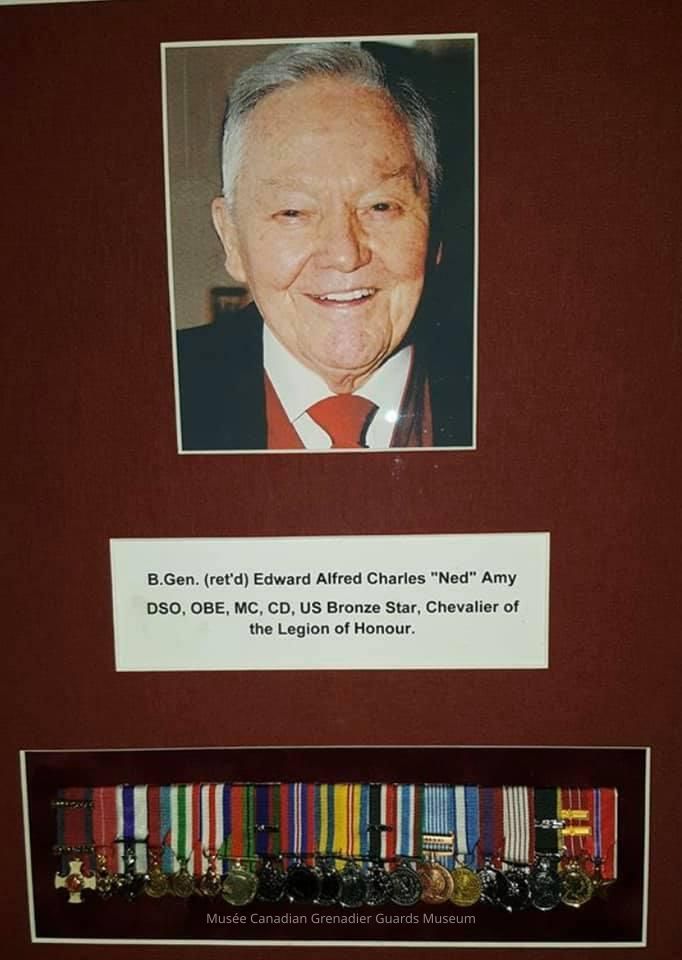
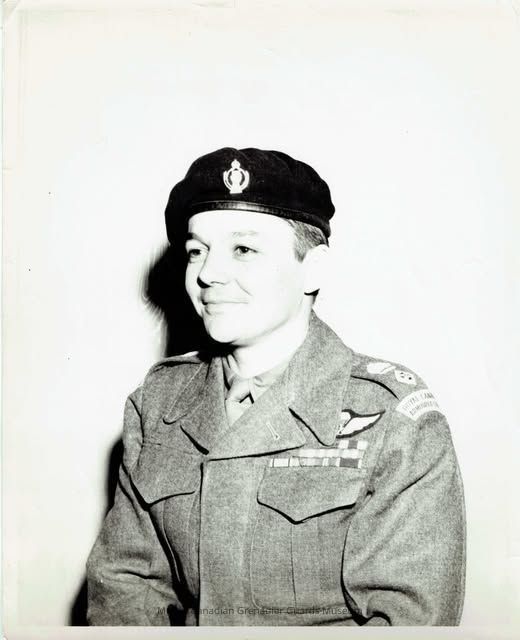
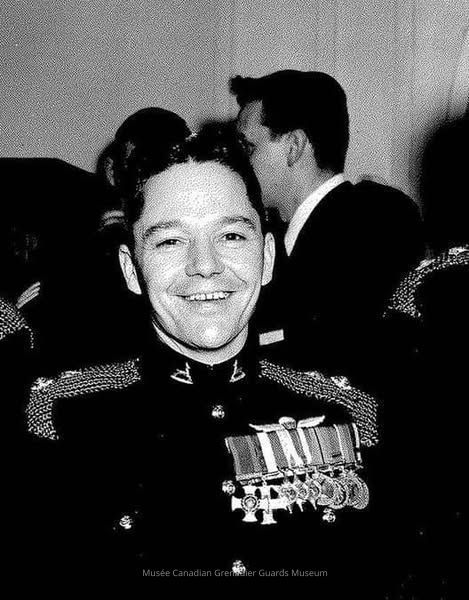
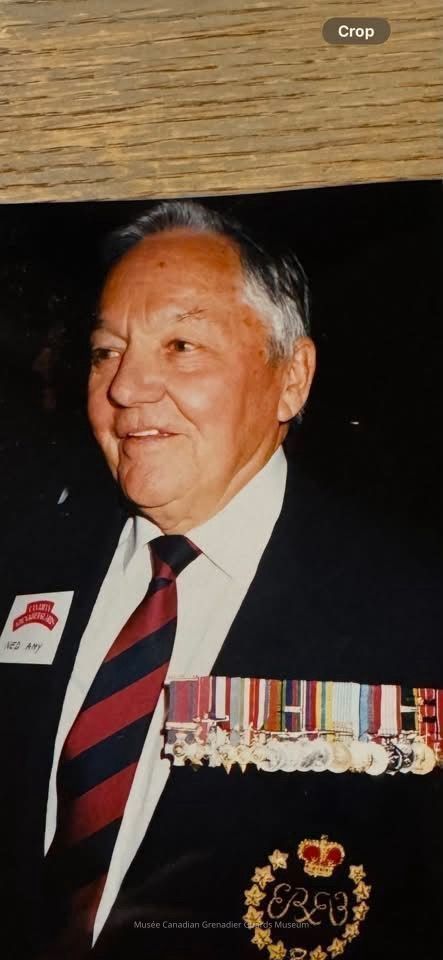
Brigadier General Edward Alfred Charles 'Ned' Amy, DSO, OBE, MC, CD, LoH (France), Bronze Star (USA) - Past Commanding Officer of 22nd Canadian Armoured Regiment, Canadian Grenadier Guards (1918-2011)Description
Canadian Grenadier Guards most decorated soldier of WW2
One of 18 Generals to have served with CGG
First Commander of UNFICYP (Cyprus 1964)
Born in Newcastle, New Brunswick, in 1918 and an alumnus of Kings County Academy in Kentville, Nova Scotia, Ned was already in the militia when he was accepted to RMC in 1936 -- graduating early, in 1939, as Canada was at war. He joined the Royal Canadian Armoured Corps and trained at the Armoured Fighting Vehicles Training Centre, Camp Borden before deploying overseas and joining the Ontario Regiment as a tank troop leader. In 1943, he saw action in Sicily and Italy, was promoted to Major, and joined the King's Own Calgary Regiment as a squadron commander. He won the Military Cross that year for action to take and hold a crossing at the Moro River against German panzers and infantry.
In 1944, Major Amy joined the Canadian Grenadier Guards as commander of a tank squadron which he led in the battle to close the Falaise Pocket. His squadron broke through the German rear guard to relieve a force of the Polish Armoured Division.
During the liberation of the Netherlands, he was awarded the Distinguished Service Order for establishing and holding a bridgehead in late 1944. In February 1945, at the age of 26, he was promoted to Lieutenant-Colonel and appointed Commanding Officer of the Canadian Grenadier Guards during the Battle of the Hochwald Gap. Ned was wounded in action twice during the war, first in 1943 and again in 1945.
At the end of the war, he was selected to command the only tank regiment - the 22nd. Tank Bn. (CGG) - assigned to support Canada's newly constituted 6th. Division committed to the planned invasion of Japan. 130 Grenadiers of the 22CAR (CGG) volunteered for this unit. The dropping of the A-bombs made this unit redundant. After the war, he commanded the Royal Canadian Armoured Corps School at Camp Borden before going to war in Korea in 1952 and 1953 as the General Staff Officer (GSO 1) on the staff of the 1st Commonwealth Division. He was awarded the Bronze Star by the U.S. Army for meritorious service in that conflict and made an officer of the Order of the British Empire.
From 1953 to 1956, he commanded the Royal Canadian Dragoons at Camp Petawawa, followed in 1961 by appointment to Director of Armour for the Canadian Army, and then command of the first Canadian United Nations contingent in Cyprus in 1964. After a year with the Supreme Headquarters Allied Powers Europe (SHAPE) and the North Atlantic Treaty Organization Headquarters in Paris, he was promoted to Brigadier-General (BGen). He returned to Canada in 1966 to command the 1st Canadian Infantry Brigade Group in Calgary, followed later the same year by command of the 4th Canadian Mechanized Brigade Group in Europe, Canada's NATO brigade assigned to the British Army of the Rhine. BGen Amy returned to Canada to assume several senior staff positions, including Director General Land Force Operations, from which he resigned in objection to Canada's decision to discontinue use of the tank.
In retirement, BGen Amy was appointed Colonel of the Regiment of the Royal Canadian Dragoons from 1970 to 1975, and Colonel Commandant of the Royal Canadian Armoured Corps from 1978 to 1980. During this time, he also founded E.A.C. Amy & Sons Management Support Services in Ottawa, an executive support company to find employment for ex-servicemen.
When fully retired, BGen Amy was President of the Army Cadet League of Nova Scotia and a Life Member of the Army Cadet League of Canada. He was President of the Royal United Services Institute (RUSI) of Nova Scotia and in 2007, he was awarded the RUSI Strategic Affairs Committee Award. He was active on the Board of Governors of the Army Museum, Halifax Citadel and an Honorary Life Member of the Halifax Rifles Armouries Association for his lengthy efforts in returning the Halifax Rifles to the Order of Battle in 2009. In 2007, France made BGen Amy a Chevalier of the Légion d'honneur in recognition of his exceptional service during the fight to liberate France. He was featured in History Television's Greatest Tank Battles - The Hochwald Gap and, in 2009, wrote the Foreword to Robert Catsburg's Five Days in November: The Liberation of Welberg and Steenbergen in World War II.
Throughout his retirement years, Ned visited and assisted hospitalized veterans daily at Camp Hill Veterans Hospital, Halifax. His memorial service in February 2011, was attended by a squadron of The Royal Canadian Dragoons and a host of senior officers and ex-cadets. One said, "I hope that someone kept a lock of his hair, for if we decide to clone great commanders, Ned Amy is where we start."
Brigadier General Edward Alfred Charles "Ned" Amy served as a tank commander during WW2. He commanded A Squadron of the 14th Armoured Regiment (The Calgary Regiment), in Italy, where he won the Military Cross for his "determined and gallant leadership in taking and holding a vital bridgehead over the Moro River" with his Sherman tanks in December 1943. He was a recipient of the Distinguished Service Order, an Officer of the Order of the British Empire, and recipient of the Military Cross, the Canadian Forces Decoration and the American Bronze Star. He became a Chevalier of French Legion of Honour in 2007.
Major Ned Amy arrived in Normandy, France on July 26, 1944, seven weeks after D-Day. He commanded a troop of the 22nd Armoured Regiment (The Canadian Grenadier Guards) in the fight for Grentheville three days later. During the next five weeks, he participated in all the battles that led to the liberation of Normandy. His regiment was awarded four distinctions for its action in the Battle of Falaise. He led an attack against Kurt Meyer's 12th SS Panzer Division that resulted in the liberation of Cintheaux and Bretteville. From August 14 to 17, 1944, The Canadian Grenadier Guards were committed to the battle of Rouves, where his tank was destroyed. He took part in the fights of Falaise against elements of the 3rd SS Panzer Division and the 2nd SS Panzer Grenadier Regiment. After the Battle of Normandy, he went into action on the Seine and Somme Rivers, liberating many towns and villages and taking many German prisoners. In the closing months of the war, he fought in Belgium and Germany, where he was wounded. After the war, he remained in the Canadian Forces and retired as a brigadier-general in 1972.
Recognition
On July 18, 2007, he was awarded the Légion d'honneur, France's highest distinction. The citation, stated that he "demonstrated outstanding bravery in France during the fiercest battles of World War II." He lived at Indian Point, Lunenburg County then in Halifax, Nova Scotia. He was an advocate for the reactivation of the Halifax Rifles (RCAC) as a reconnaissance unit, a project which was successfully completed in 2009.
On November 14, 2007, Wilfred Moore, a Canadian senator, congratulated him, thanked him and those who served under his command for their service to Canada.[4]
The Lieutenant Governor of Nova Scotia, Mayann Francis, presented the Royal United Services Institute of Nova Scotia SAC Award to BGen Ned Amy on 7 November 2007.[5]
On February 10, 2011, Wilfred P. Moore, a Canadian senator gave a tribute in the Senate to the late Brigadier-General Edward "Ned" Amy, DSO, CD.Context
a book entitled "No Holding Back" about Operation Totalize on Aug. 7-9, 1944 in Normandy, the Regiment's first major Battle of WW2. Ned Amy wrote the prologue. He led No. 1 Sqn, in that battle, which led the assault of the 4th. Cd. Arm. Div, in Phase 2 It's a great book & a great detailed analysis of the operation, which includes the best account that I have read of then Lt. Ivan Phelan's/Sgt. Moe Hurwitz's memorable decisive Troop action outside of Cintheaux on Day One, as well as an account of the epic defense of Point 195 by the entire Regiment the next day against repeated German counter attacks, including by so-called robot (remote control) tanks. In Totalize, while successful, was a hard fought learning engagement for the Regiment. We lost about 2/3rds.of our tanks, & suffered more personnel casualties than any other single action in WW2.Created By
Lieutenant Michael Hayes-Rivet, retired.Create Date
December 27, 2021Updated By
Lieutenant Michael Hayes-Rivet, retired.Update Date
July 22, 2026