Name/Title
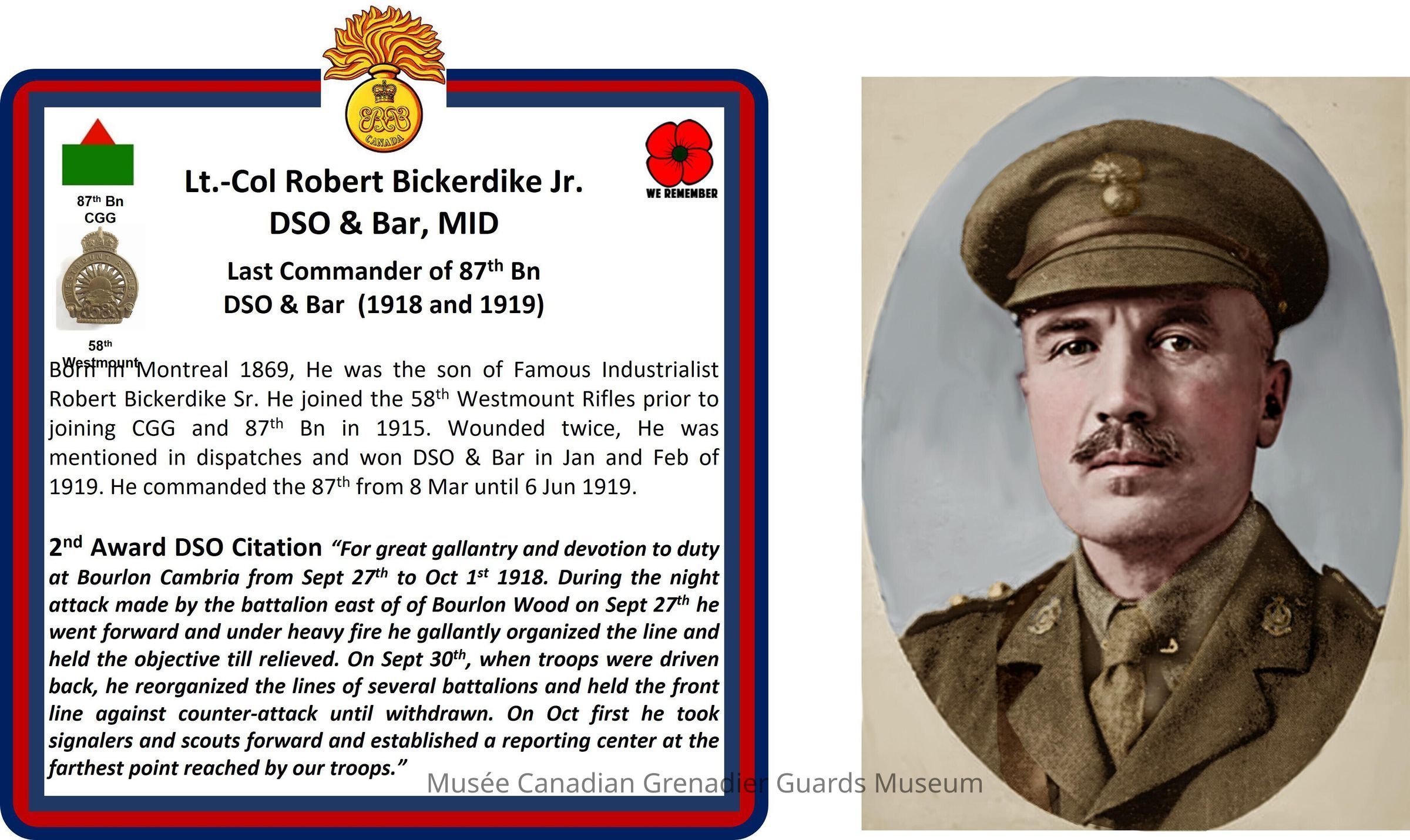
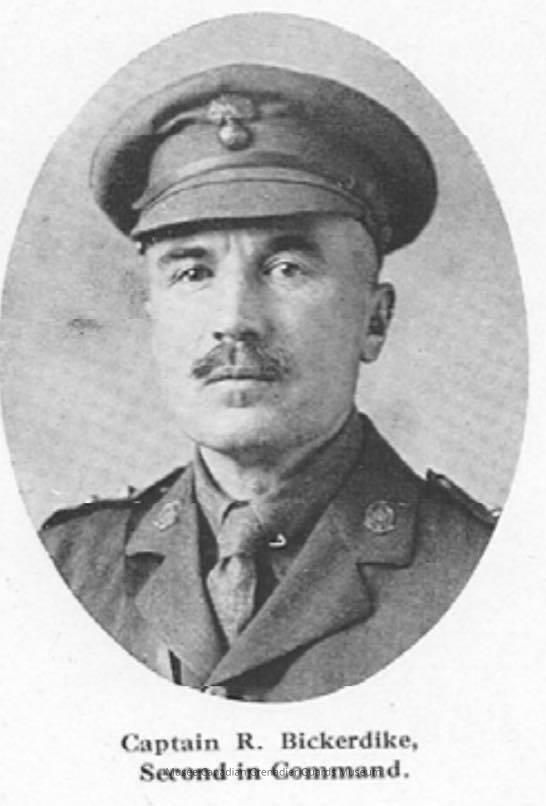
Lieutenant Colonel Robert Bickerdike Jr., DSO & Bar, MID - Last Commanding Officer of the 87th Battalion CEF (Canadian Grenadier Guards)Description
For Museum records only - Part of the Lieutenant Michael A. Hayes-Rivet (MHR) Trust Collection
*** FOR ARCHIVE PURPOSES ONLY - ARTIFACT NOT PART OF MUSEUM COLLECTION ***
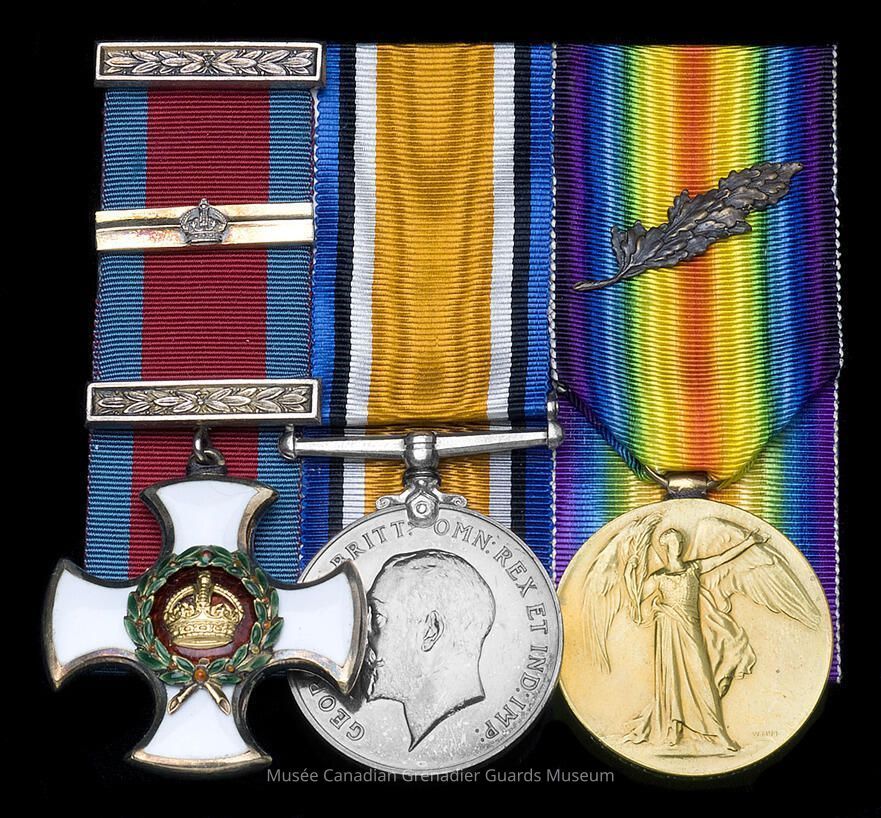
Medal group belonging to Lieutenant Colonel Robert Bickerdike, Jr., DSO
(From Left to right):
King George V British Distinguished Service Order (DSO) with Bar - only 92 awarded to CEF
WW1 British War medal - named to "Lt.-Col. R. Bickerdike" - 427,993 issued to Canadians
WW1 British Victory Medal - named as above - 351,289 medals issued to CEF.
WW1 Mentioned in Dispatches (MID) device won 4 times - 5,467 MIDs were awarded to Canadians.
*** HELPED FOUND THE 58th WESTMOUNT RIFLES
*** HELPED RAISE TWO CEF BATTALIONS (23rd and 60th)
*** LAST COMMANDING OFFICER OF 87th Battalion CGG
*** One of only 9 Distinguished Service Order recipients of the 87th Battalion CEF and one of only 92 Canadians (all CEF) to have won a DSO & Bar during the entire war.
*** One of only 19 Canadian Grenadier Guards to earn a DSO in any/All wars
*** 4th Highest DECORATED CGG SOLDIER OF WW1 / Tied for 9th Highest decorated Canadian Grenadier Guard of all time
Robert Bickerdike Jr. was a wealthy Montreal civil engineer and businessman who had helped to finance and form the Westmount Rifles. He was instrumental in recruiting for the 23rd Battalion and 60th Battalion, later joining the 87th Battalion as a Lieutenant, serving in France and rising to command this Battalion.
Born Montreal, Sept. 30th, 1869, son of Robert and Helen Thompson (Reid) Bickerdike, both of Montreal. Educated: Common Schools and Montreal Business College; McGill University (B.A. Sc., 1891; Ma.E., 1895).
From 1889-1890, he worked as an Instrument man on present C.P.R. short line, Montreal to Ottawa; In 1891, he became Assistant in Charge of the McGill College Observatory; 1892, Asst. Engr., United Counties Ry.; In 1893, he was an Asst. Engineer, C.P.R., on Atlantic & North Western ky.; Asst. Engineer, extension Drummond County Ry. ; 1894, Demonstrator of Surveying, McGill College; 1895 and 1896, Asst. Engineer, Montreal Harbour Works; 1897-1904, Dept. Public Works, St. Lawrence River, Montreal to Quebec; 1904-1908, Dept. Marine, St. Lawrence above Montreal; 1909 and 1910, Asst. Engineer, National Transcontinental Railway; 1911-12, with J. H. Hunter, Consulting Engineer, Montreal; 1913 and 1914, The Canada Starch Co., Ltd., on construction of plant at Port William; 1919, on demobilization, was employed by The Canada Starch Co., Ltd., on alterations and additions to plants at Cardinal, Ont., and Port William, Ont.; 1921, private practice as Consulting Engineer. Member, Engineering Institute of Canada; Member, Institution of Civil Engineers; Member, Corporation of Professional Engineers of Quebec.
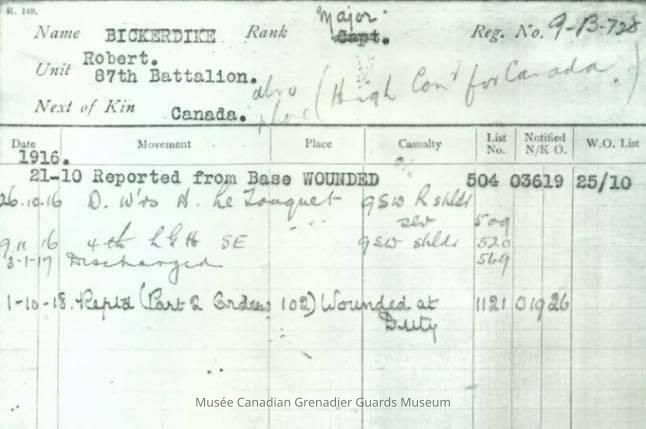
His military career began in 1904, as a Provisional Lieutenant, 86th Regiment. He qualified at Quebec and was Orderly Officer at Three Rivers Camp, 1904. In winter of 1905-1906, resigned commission on leaving district; 1914, when war was declared, He joined the 58th Regt., Westmount Rifles on organization; was actively employed recruiting for 23rd and 60th Battalions. Qualified as Captain and Field Officer at Halifax, he joined 87th Battalion Canadian Grenadier Guards on organization. In June, 1916, took a draft of reinforcements from 87th Battalion to Poperinghe France but was returned to England; In August 1916, to he returned to France as Captain in 87th Bttn. (with 4th Div.) and saw service in the Ypres salient; was present at Battles of Somme, Vimy Ridge, Lens-Avion, Hill 70, Passchendaele, Amiens, Arras, Cambrai and Valenciennes-Mons. Wounded seriously at the Somme , 21-10-16 and slightly at Cambrai, 1-10-18. Twice mentioned in Despatches, L.G. No. 30448, 28-12-17, and L.G. No. 31448, 11-7-19. Awarded the Distinguished Service Order for 1917, L.G. No. 30450, 1-1-18; Bar to Distinguished Service Order for Cambrai, L.G. No. 31183, 15-2-19. Promoted Major, Feb. 21, 1917; promoted Lieut.-Col. Mar. 8, 1919. Returned to Canada in command of 87th Battalion and on demobilization, June 12, 1919, was transferred to Royal Montreal Regiment. In July, 1920, he transferred to Reserve of Officers.Context
Robert Bickerdike Jr., DSO and Bar, Mentioned in Despatches, was among the most capable combat leaders produced by the Canadian Grenadier Guards during the First World War. Although overshadowed in later histories by commanders such as Frank Stephen Meighen and Kenneth Meikle Perry, Bickerdike's service spanned virtually the entire war, from the mobilization of the regiment in Montreal through the occupation of Germany and the return of the 87th Battalion to Canada in 1919. His career illustrates the transition of Canada's pre-war militia officers into experienced battlefield commanders who led the Canadian Corps during its greatest victories.
Family and Early Life
Robert Bickerdike Jr. was born in Montreal, Quebec, on 30 September 1869, the eldest son of the prominent Montreal businessman, philanthropist, and Member of Parliament Robert Bickerdike Sr.. His father was one of Montreal's leading civic figures, while Robert Jr. pursued a professional career as a civil engineer and maintained an active interest in the Canadian Militia.
Prior to the outbreak of war he served in the 58th Westmount Rifles, eventually attaining the rank of captain. His militia experience, gained over more than a decade before 1914, made him one of the more experienced officers available when Canada mobilized.
Mobilization and the Formation of the 87th Battalion
When Britain declared war on Germany in August 1914, Bickerdike immediately became involved in recruiting throughout Montreal. During the rapid expansion of the Canadian Expeditionary Force, he assisted in recruiting for several Montreal battalions before becoming one of the original officers selected for the newly authorized 87th Battalion (Canadian Grenadier Guards), CEF.
The battalion officially organized during the autumn of 1915 under Lieutenant-Colonel Frank Stephen Meighen. Bickerdike was commissioned as one of its original company commanders, bringing valuable militia leadership to a battalion composed largely of Canadian Grenadier Guards and recruits from across Canada. The battalion trained in Montreal and at Saint-Jean, Quebec, before departing Halifax aboard RMS Empress of Britain in April 1916.
Service in France, 1916–1917
The 87th Battalion arrived in France on 12 August 1916, joining the 11th Canadian Infantry Brigade of the 4th Canadian Division. Bickerdike entered combat during the closing stages of the Somme campaign.
During the next eighteen months he participated in nearly every major Canadian Corps operation, including:
The Somme (1916)
Ancre Heights
Vimy Ridge
Hill 70
Passchendaele
As casualties among senior officers mounted, Bickerdike assumed increasing responsibilities, progressing from company commander to senior field officer. His leadership earned the confidence of successive commanding officers, including Lieutenant-Colonel Reginald William Frost, Lieutenant-Colonel James Vincent Patrick O'Donahoe, and Brigadier General Kenneth Meikle Perry.
The Hundred Days Offensive
The Allied offensive launched in August 1918 transformed experienced officers like Bickerdike into key battlefield commanders.
During the Battles of Amiens, Arras, the Drocourt–Quéant Line, Canal du Nord, Bourlon Wood, Cambrai, Valenciennes, and the Sambre, Bickerdike repeatedly commanded battalion operations under intense enemy fire.
His finest performance occurred between 27 September and 1 October 1918, during the fighting east of Bourlon Wood.
The official citation for his Bar to the Distinguished Service Order, published in the London Gazette, records:
"During the night attack made by the Battalion east of Bourlon Wood... he went forward and under heavy fire gallantly organised the line and held the objective... On September 30th... he reorganized the line out of elements of several battalions and held the front line against counter attacks... On October 1st he established a report centre at the farthest point reached by our advanced troops. The skill and daring displayed by him throughout the operations were admirable."
The citation highlights several qualities that characterized his command style:
personal reconnaissance under fire;
rapid reorganization of broken formations;
coordination between scattered battalions;
determination in holding newly captured objectives against German counter-attacks.
These actions occurred during the Canadian Corps' assault on the Hindenburg Line and helped sustain the momentum of the advance toward Cambrai.
Decorations
Robert Bickerdike received some of the highest honours awarded to Canadian infantry officers.
Distinguished Service Order (DSO)
Awarded in the 1918 New Year Honours in recognition of distinguished leadership during operations in 1917.
Bar to the Distinguished Service Order
Gazetted on 15 February 1919 for gallantry during operations at Bourlon and Blecourt between 27 September and 1 October 1918. The Bar placed him among a very small group of Canadian officers to receive the decoration twice.
Mentioned in Despatches
He was Mentioned in Despatches on at least two occasions, recognition reserved for officers whose service attracted the attention of senior commanders.
Commanding Officer of the 87th Battalion
Following the Armistice, Lieutenant-Colonel Frank Stephen Meighen relinquished command and Robert Bickerdike assumed command of the 87th Battalion on 7 March 1919.
Although major combat had ended, command during the occupation period remained demanding. The battalion maintained discipline, prepared equipment for return to Canada, completed demobilization paperwork, and supervised hundreds of soldiers awaiting repatriation.
In June 1919 Bickerdike escorted 33 officers and approximately 875 other ranks of the battalion back to Canada aboard RMS Mauretania, bringing to a close nearly four years of overseas service.
Chronology of Service, 1914–1919
Date Event
Aug. 1914 Active militia officer, 58th Westmount Rifles; assists recruiting in Montreal.
Sept.–Oct. 1915 Appointed captain in the newly formed 87th Battalion (Canadian Grenadier Guards).
Apr. 1916 Embarks for England with the battalion.
Aug. 1916 Arrives in France with the 4th Canadian Division.
Sept.–Nov. 1916 Somme operations.
Apr. 1917 Battle of Vimy Ridge.
Aug. 1917 Hill 70.
Oct.–Nov. 1917 Passchendaele.
Aug.–Nov. 1918 Canadian Hundred Days campaign.
1 Jan. 1918 Appointed Companion of the Distinguished Service Order (DSO).
15 Feb. 1919 Bar to the DSO gazetted for Bourlon–Blecourt operations.
7 Mar. 1919 Assumes command of the 87th Battalion as Lieutenant-Colonel.
Jun. 1919 Returns to Canada with the battalion aboard RMS Mauretania.
Legacy
Robert Bickerdike Jr. belonged to the generation of Canadian militia officers whose wartime experience transformed them into accomplished combat leaders. Unlike many officers who served only briefly in command, Bickerdike participated in nearly the entire operational history of the 87th Battalion—from its formation in Montreal through the Somme, Vimy Ridge, Passchendaele, the Canadian Hundred Days, the occupation of Germany, and finally its return home.
His award of the DSO and Bar reflected sustained battlefield leadership rather than a single act of heroism, and his appointment as commanding officer after the Armistice demonstrated the confidence placed in him by both the Canadian Corps and the Canadian Grenadier Guards. Today, he remains one of the regiment's most distinguished First World War officers and one of the relatively few Canadians to have earned the Distinguished Service Order twice.
Principal References
Canadian Great War Project, Lieutenant-Colonel Robert Bickerdike service summary and honours.
London Gazette, citations for the Distinguished Service Order, Bar to the DSO, and Mention in Despatches.
History of the 87th Battalion (Canadian Grenadier Guards), officers commanding and campaign history.
Nominal Roll of the 87th Battalion (Canadian Grenadier Guards).
Dictionary of Canadian Biography, biography of Robert Bickerdike Sr. for family background.
If you intend to publish this biography, I can also expand it into a fully footnoted 6–8 page scholarly biography using Library and Archives Canada service file references, War Diary entries for specific actions, London Gazette issue numbers, and contemporary Montreal newspaper accounts in Chicago or Turabian citation format.Created By
Lieutenant Michael Hayes-Rivet, retired.Create Date
January 14, 2022Updated By
Lieutenant Michael Hayes-Rivet, retired.Update Date
July 9, 2026