Name/Title
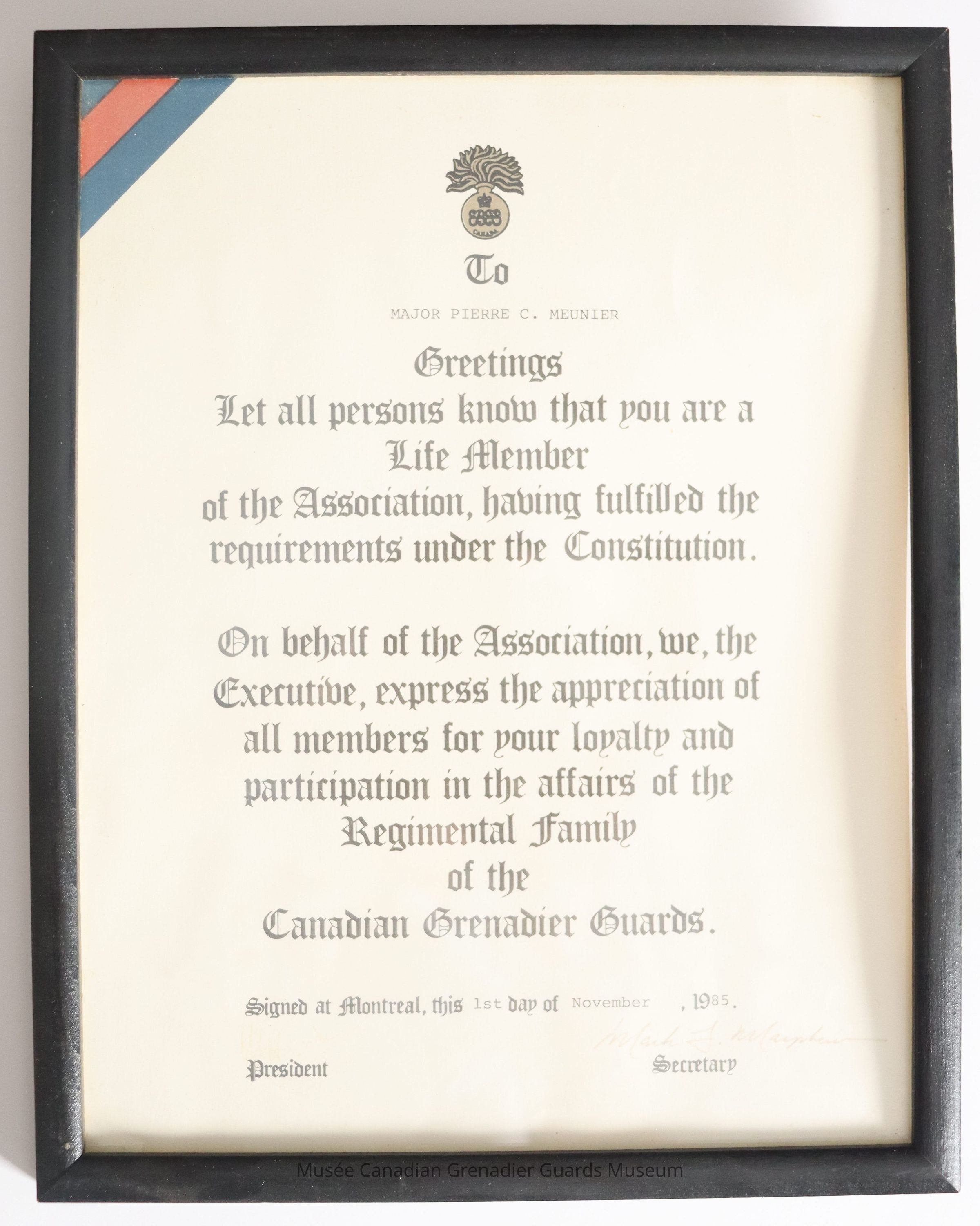
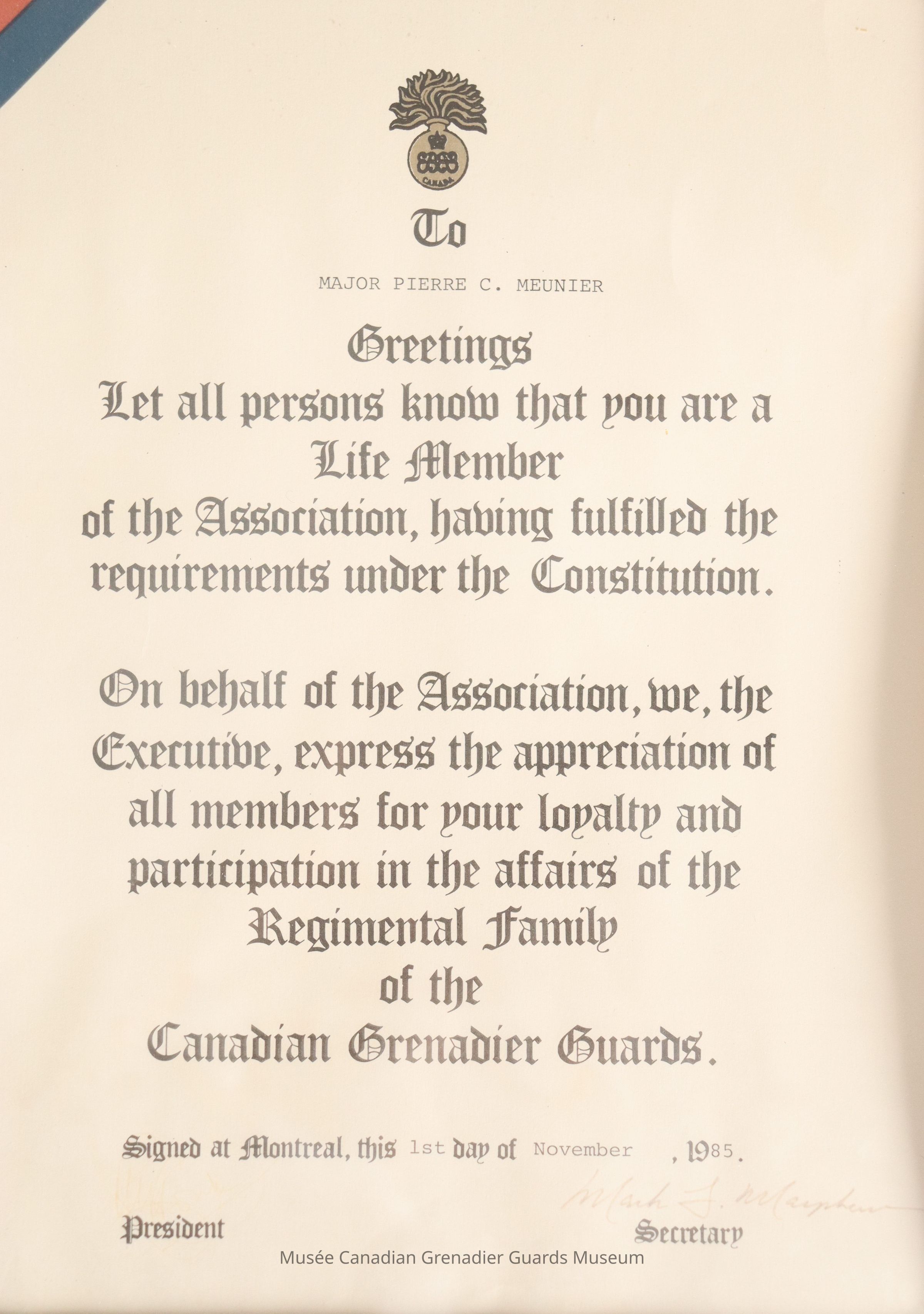
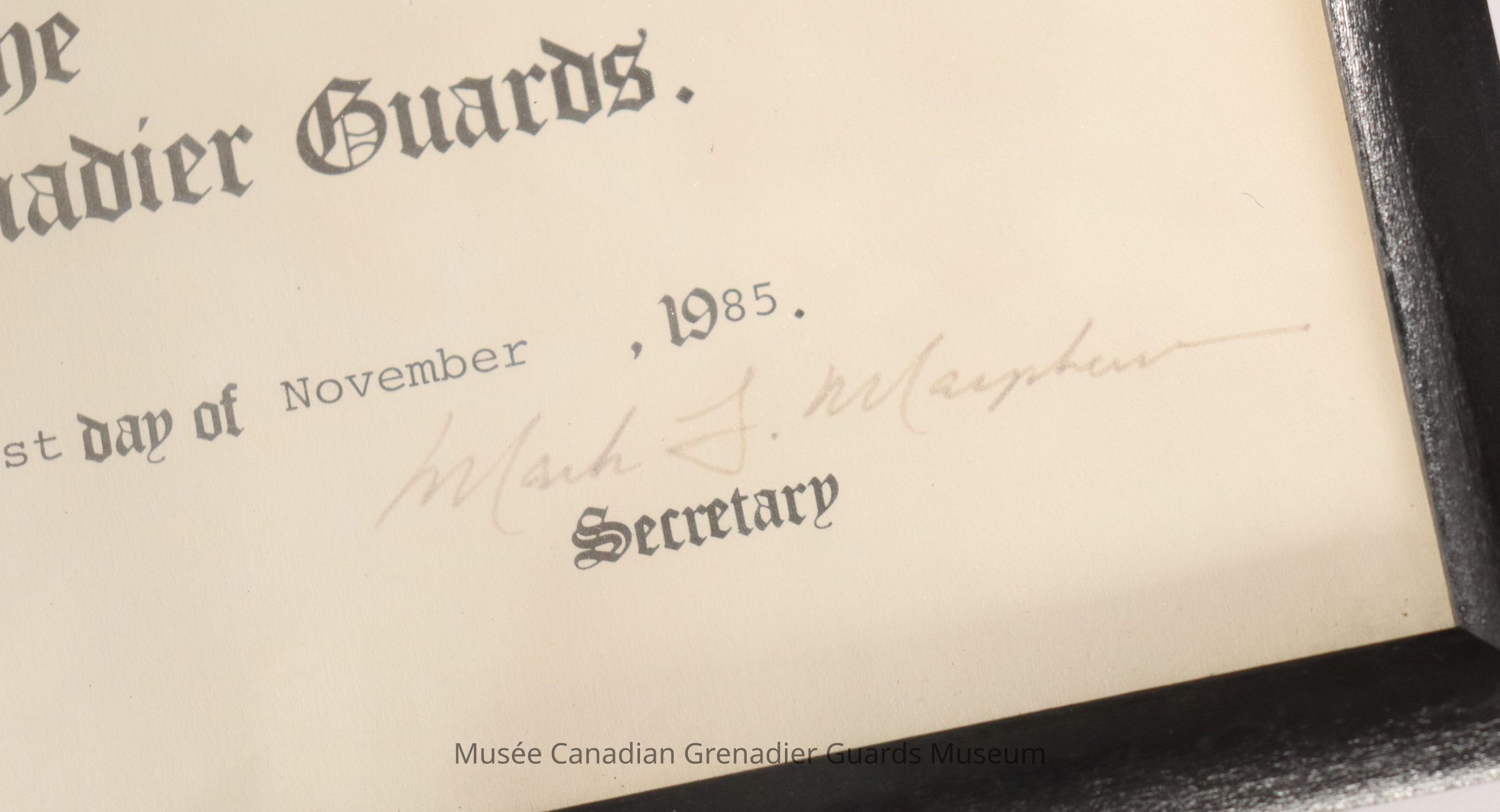
November 1st 1985 - Colonel Jean Pierre C. Meunier - Certificate of Life Membership to the Canadian Grenadier Guards Association - presented by Lt.-Col Mark MacPherson, CD, AdCDescription
1985 - Colonel Jean Pierre C. Meunier - Certificate of Life Membership to the Canadian Grenadier Guards Association - presented by Lt.-Col Mark MacPherson, CD, AdC
ABOUT THE RECIPIENT:
Jean Pierre Charles Meunier was born Paris, France during WW1 to a Canadian father, and a French mother who moved to Montreal, Quebec, Canada when age 3. He joined The Canadian Grenadier Guards in 1939 and underwent Officers' Training School in Brockville, Ontario. Initially assigned to DND Defence HQ, in Ottawa, he proceeded overseas in August 1942 attached to the Fusiliers Mont-Royal. He joined F Section of the SOE in 1944 as codename Edouard and rose to become a Director of a Circuit. Colonel Meunier also used the alias, Pierre Mornet. He later returned to the UK and lead SOE's Force 136.
ABOUT Special Operations Executive (SOE):
The Special Operations Executive (SOE) was a secret British World War II organization. It was officially formed on 22 July 1940 under Minister of Economic Warfare Hugh Dalton, from the amalgamation of three existing secret organizations. Its purpose was to conduct espionage, sabotage and reconnaissance in occupied Europe (and later, also in occupied Southeast Asia) against the Axis powers, and to aid local resistance movements. After WW2 most members returned to their Peace-time roles, however 280 agents went on to join M16 of British Intelligence.
ABOUT FORCE 136:
As early as 1940, SOE was preparing plans for operations in Southeast Asia. As in Europe, after initial Allied military disasters, SOE built up indigenous resistance organizations and guerrilla armies in enemy (Japanese) occupied territory. SOE also launched "Operation Remorse" (1944–45), which was ultimately aimed at protecting the economic and political status of Hong Kong. Force 136 engaged in covert trading of goods and currencies in China. Its agents proved remarkably successful, raising £77m through their activities, which were used to provide assistance for Allied prisoners of war and, more controversially, to buy influence locally to facilitate a smooth return to pre-war conditions.Created By
Bertille L. HurelCreate Date
July 6, 2022Updated By
Lieutenant Michael Hayes-Rivet, retired.Update Date
October 27, 2024