Fishhook / Hameçon
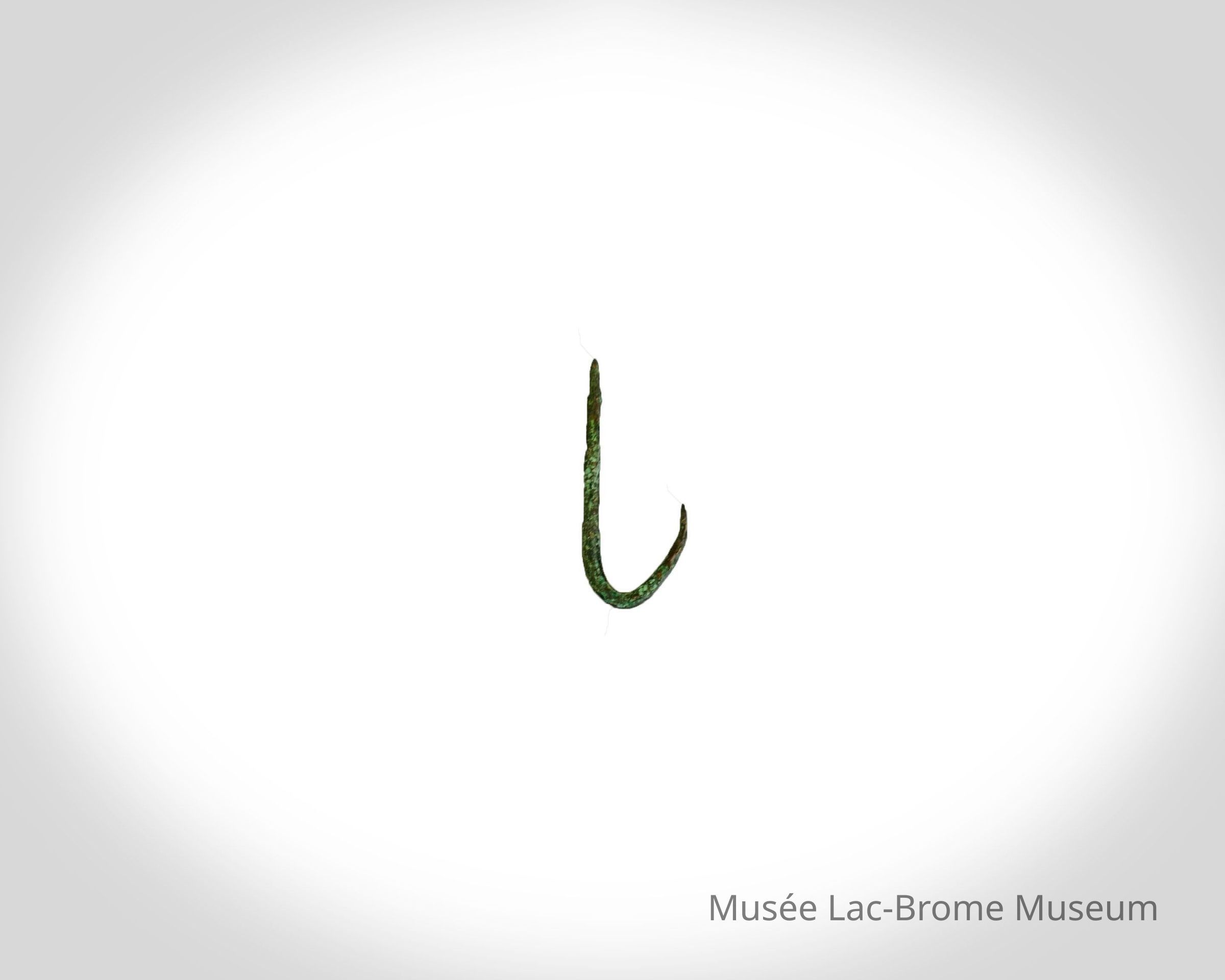
The image shows a greenish metal hook centred on a plain, white background. / L'image montre un hameçon métallique verdâtre centré sur un fond blanc uni.
Name/Title
Fishhook / HameçonEntry/Object ID
328.1Description
A short black copper fishhook with a slight bend on the lower tip. The fishhook has blue-green patches across the surface. / Un hameçon court en cuivre noir avec une légère courbure sur la pointe inférieure. L'hameçon présente des taches bleu-vert à la surface.Context
Found on Round Island in Lake Memphremagog along with two ulus, this fishing hook was most likely used by Indigenous individuals to fish in the lake. The Indigenous people of this area do not have a history of copper production; it is therefore believed that this hook was traded from another area in North America. Similar fishhooks have been found in New Brunswick, Maine, the Outaouais River, and the Great Lakes region. It is therefore theorized that the fishhook came from one of those regions. Research shows that North American Indigenous peoples began mining copper around 9,500 years ago. However, the process was labour-intensive and did not significantly improve upon the tools made from more widely available materials. The practice was therefore mostly stopped around 3000 years ago. - - - - Retrouvé sur l'île Ronde, dans le lac Memphrémagog, en même temps qu'une arme en cuivre, cet hameçon était probablement utilisé par les personnes autochtones pour pêcher dans le lac. Les peuples autochtones de cette région n'ont pas d'histoire de production de cuivre ; nous pensons donc que cet hameçon a été échangé depuis une autre région d'Amérique du Nord. Des hameçons similaires ont été trouvés au Nouveau-Brunswick, au Maine, sur la rivière Outaouais et dans la région des Grands Lacs. On suppose donc que le hameçon provient de l'une de ces régions. Les recherches montrent que les peuples autochtones d'Amérique du Nord ont commencé à extraire du cuivre il y a environ 9 500 ans. Toutefois, ce procédé nécessitait beaucoup de main-d'œuvre et n'apportait pas d'améliorations significatives par rapport aux outils fabriqués à partir de matériaux plus répandus. Cette pratique a donc été abandonnée il y a environ 3 000 ans.Collection
IndigenousCategory
Fishing Equipment
Acquisition
Accession
328Source or Donor
Unknown / InconnuAcquisition Method
Donation / DonMade/Created
Time Period
Pre-Contact / Pré-contactEthnography
Culture/Tribe
First Nation / Première Nation
Lexicon
Nomenclature 4.0
Nomenclature Secondary Object Term
FishhookNomenclature Primary Object Term
Tackle, FishingNomenclature Sub-Class
Fishing EquipmentNomenclature Class
Fishing & Trapping T&ENomenclature Category
Category 04: Tools & Equipment for MaterialsDimensions
Height
0.3 cmWidth
2.3 cmLength
6 cmMaterial
Metal / MétalCondition
Notes
Pitting along the whole thing. Some small rust at both extremities. Green colouring in the pitting due to weathering and oxidation.Notes
See CR2024.15 for more informationWeb Links and URLs
Mihalicz, Michael G.; Jeremie Caribou; Cody Anthony; and Dr. Sean Wise. Native Copper - Pre-contact Trade Goods. From "Indigenous Entrepreneurship Subtitle:A community-driven approach to new venture creation." 2022. Toronto Metropolitan University. (anglais seulement) , Malakoff, David. Ancient Native Americans were among the world's first coppersmiths. Science. 19 March 2021. (anglais seulement)Exhibitions
2025 Reception Display
2026 Reception Display