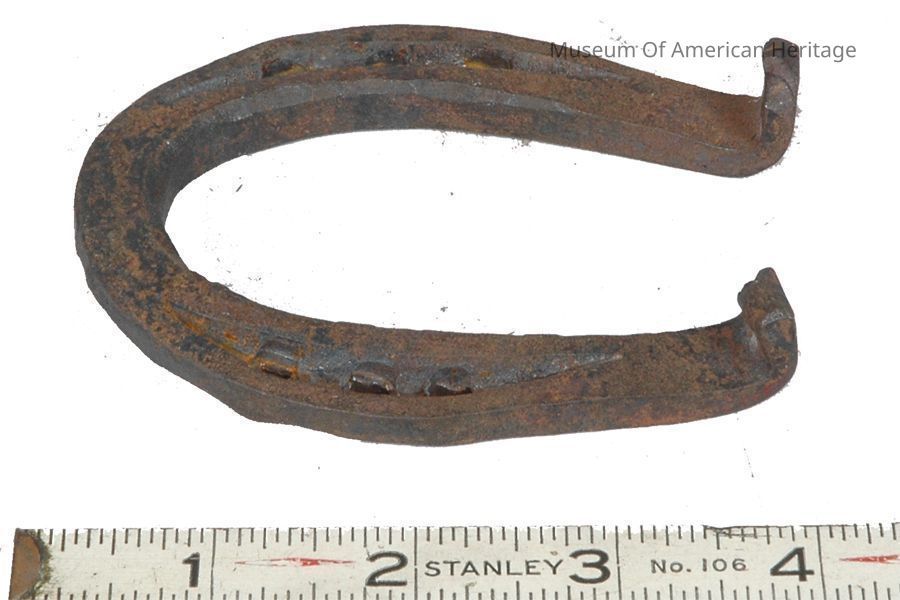
Note
APPEARANCE – DESIGN & WEAR
- Signs of wear and corrosion
- Shape and thickness are consistent, which could indicate skilled hand-forging or machine production
- Nail holes somewhat irregular, perhaps indicative of hand-punching
- Machine-made horseshoes became more common mid 1800s-early 1900s, so a worn-down machine shoe might look hand-made. However, machine-made shoes from the time also often had hand-finishing work done on them.
- Thus, the appearance of this shoe suggests that it was likely machine-made but hand-finished.
HEEL CALKS
- Turned-up ends of horseshoes are called “heel calks” or “calkins”
- These are integral calkins rather than screw-in, attachment calkins. Integral calkins were an earlier design type, but their manufacture never entirely ceased, so the date of this shoe cannot definitively be determined beyond the likely range of 19th-early 20th century.
- Calkins:
(1) Provided traction and grip, especially on slippery surfaces like ice, mud, or hard-packed ground
(2) Protected against wear, helping the shoe last longer through more even weight distribution and impact protection at the heel
(3) Aided the animal in specific work conditions. Animals pulling heavy loads, performing farm work, or working in winter conditions were more likely to have shoes with heel calks.
- Thus, this shoe was probably meant for a working animal rather than a pet or leisure animal.
SIZE
- The small size of this shoe (2” x 3.75”) indicates that it was made for a pony, not a horse.
- Given the size and the calkins, this shoe could have served…
(1) A Shetland pony or other small working pony—perhaps a mine pony, a farm pony, or a light cart / transportation pony
(2) A mountain/pack pony used in rough terrain
(3) A riding or pet pony in winter conditions
(4) A pony in a region where calkins were standard practice