Label Type
Object LabelLabel
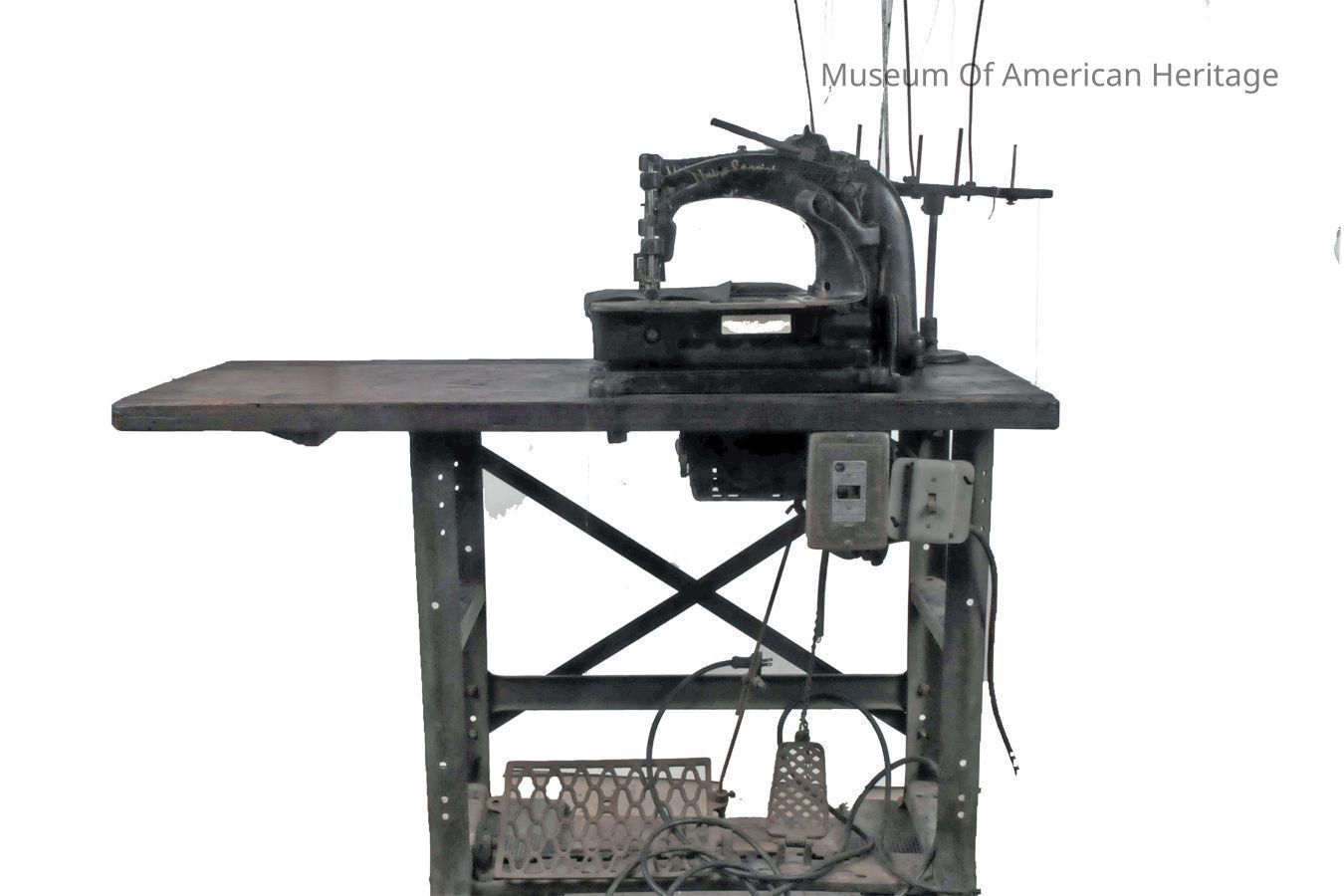
Union Special Dual-Needle Industrial Sewing Machine
This sturdy-looking sewing machine dates from 1920 and, judging from an inspection sticker glued on it, was operable as late as 1994. It was made by the Union Special Machine Company, which was founded in 1881 and still is in business as Union Special Corporation. The machine rests solidly on the original wooden table.
The machine features adjustable side-by-side needles that created a very tight and flexible double chain stitch produced by a zigzag motion of the thread from the bobbin. The stitches could be produced on all kinds of material, including woven fabrics, stretch knits, embroidery, and denim. In fact, according to one self-described online “denim head,” this model is the go-to device for belt loops. The stitches also are used in pintucks, parallel rows of topstitching, simulated coverstitch hems for T-shirts, and with free motion quilting.
So how exactly does a sewing machine work? There are many parts, some with descriptive names and some with names that are bit more evocative (utility grinder, throat plate, street elbow, looper eccentric sponge holder, feed lift eccentric, double lap seam feller), but in general there are four mechanisms, simplified as follows:
Needle: Two wheels connected to a crankshaft convert the motor’s rotary motion into the needle’s up-and-down motion.
Bobbin and shuttle: A bobbin is a spool of thread. The shuttle contains a hook and oscillates back and forth between the thread and the bobbin.
Feed dog: These little teeth driven by a cooperating wheel and crank simultaneously pull the fabric upward and forward at a steady rate to ensure evenly spaced stitches.
Stitch: A stitch comprises a top thread fed from the spool through the needle eye and a bottom thread fed from the bobbin.
After the needle pierces the fabric, it feeds the top thread through the material to create the next stitch. The needle then carries the top thread through a new hole in the material, taking the top thread with it.
Although the first patent for a mechanism that could be used in sewing was granted in England in 1755, historians tell us that the first recognizable sewing machine appeared in 1790 and was designed for leather and canvas (including sails). The first practical and popular sewing machine dates to 1829 and could make straight seams using a chain stitch. Improvements eventually enabled sewing machines to drastically reduce the time required to make clothing and thus aided migration of the skill from the home into factories, which led to lower prices and more uniform quality for ready-to-wear clothing and shoes.
Union Special Corporation had its roots in Chicago as the Union Bag Company, which had a machine that made secure bags using a straight needle to create a double-locked stitch.
Eventually, efforts to demonstrate the machine’s sewing productivity led company management to realize that the machines themselves were where financial success lay. Thus the company name changed to Union Special Sewing Machine Company. Two decades later, in 1901, the company expanded into Stuttgart, Germany, where MOAH’s machine was made. Today it is still going strong. In fact, in trumpeting the quality of its machines, the company’s website says, “When they say, ‘they don’t make them like that anymore’ they are not talking about Union Special because WE STILL DO!”
Fun sewing- and company-related facts:
The International Organization for Standardization (ISO) formally recognizes nearly 40 stitch formations (not including strictly decorative aspects), involving one to seven separate threads to form the stitch.
Needle types from company catalogs that go as far back as 1927 include round shank, round point, extra short, cross point, narrow cross taper point, double groove, nickel plated, chromium plated, taper blade, spotted, ball point, ball eye, under-size eye and grooves, government, stay point, rocked point, spear point, and twist centered point.
Sewing machine supplies include taps, reamers, belting, belt hooks, belt fasteners, screw drivers, wrenches, and powdered oil stone.
The Smithsonian collections include company documents from the 1920s that detail the manufacture of athletic underwear (including “detailed descriptions of material, thread, number of stitches to inch, etc. of each type of underwear”) and the manufacture of shoe uppers (the part of the shoe that is not part of the heel or sole). Other documents apparently are associated with the company’s presence at the United States of America Panama-Pacific International Exposition in San Francisco in 1915. In addition to boasting of the company’s high-quality machines and practices, one brochure even goes as far as to recommend the size of a building to be used for manufacturing shoes. It describes “time saving instructions, sequence of operations performed, machines, needles and threads, machine speeds, average hourly production and similar data.” It traces the history of the shoe industry, and notes the “number of pairs of shoes and boots (exclusive of rubber)” made in 1919: 330,593,974.
The company’s website lists some of the industries it services outside of the clothing world: “Non-Apparel & Hosiery industries. Bag Making & Closing, Carpet Overedging, Mattress Tape Edging, Canvas Seaming, Geosynthetics, Panty Hose Toe Closing & Gusset Seaming and Napkins & Table Cloth Serging.” Major parts of a sewing machine are as follows (see if you can figure out where they are on our model): bobbin, bobbin case, presser foot, needle and needle clamp, throat plate and needle plate, feed dogs, tension regulator, take-up lever, bobbin winder, spool pin, flywheel, stitch selector, reverse stitch button, feed controller, and motor and motor housing.