Cupping Glass
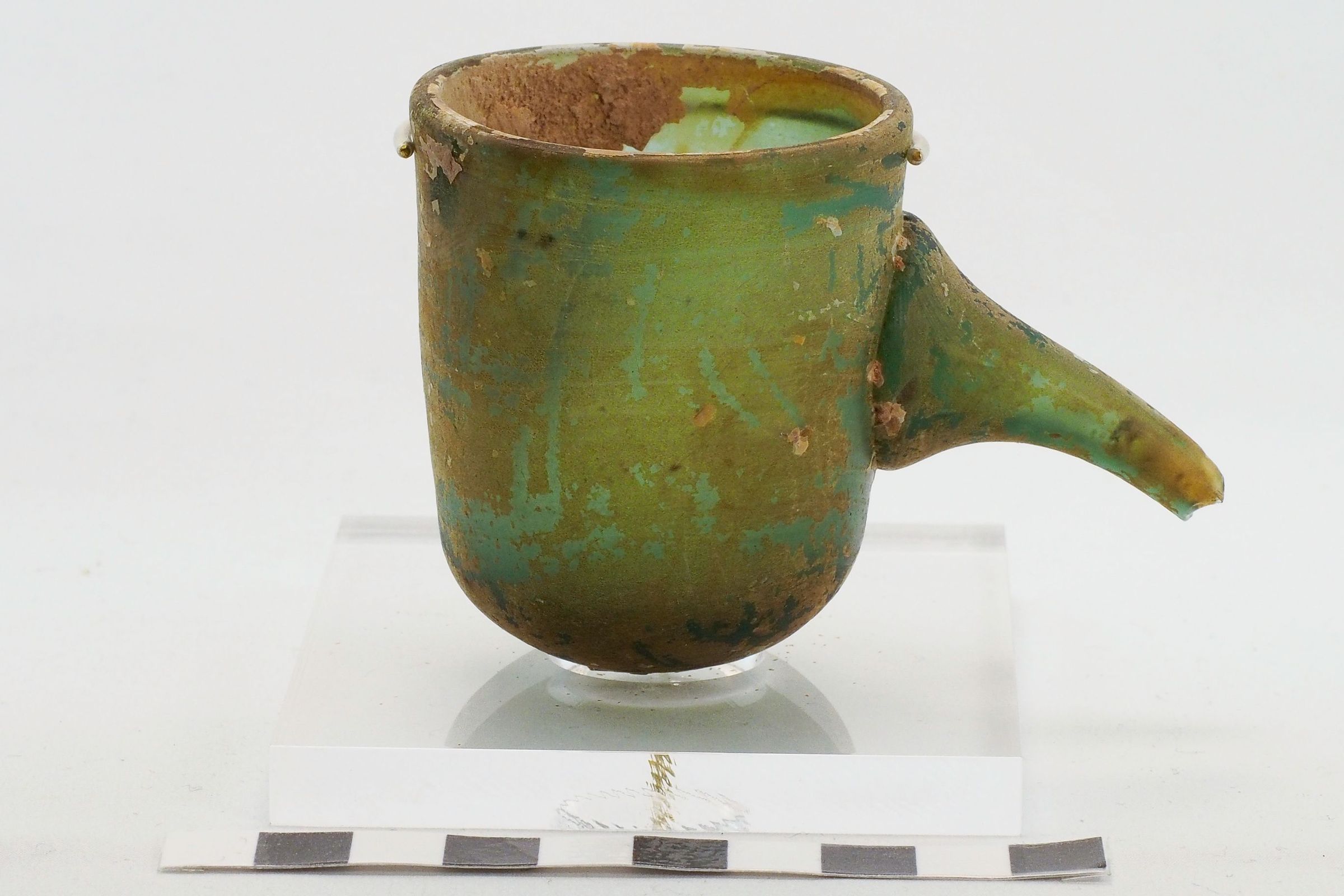
Front
Cupping Glass 2019-08-12
Name/Title
Cupping GlassEntry/Object ID
11NE-Mi14-152Description
The rounded flat rim extends vertically into a cup-like cylindrical body that rounds off at the bottom. Applied to the side is a curved spout curving in the opposite direction of the opening of the cup. The base is flat with a pontil mark. The spout of the vessel is broken, there is one short crack to the body, and some iridescence.Use
Medicine, BloodlettingContext
Used by physicians for bloodletting, the pipe had to be long and curved in the opposite direction of the opening of the cup to allow the physician to suck the air out of the cup. In doing so, when the vessel was placed on a person's skin, the suction would pull the blood to the surface. The cup would then be removed and a small incision would be made on the same spot to let the blood flow. Cupping glasses are often confused with alembics, which are part of a distillation apparatus. Whereas a cupping glass curves away from the opening, an alembic's spout curves in the same direction as the opening of the vessel to allow the vapour to gather in the alembics body and flow out the spout into a receiving bottle. Cupping glasses also have a deep cup-like body, whereas alembics have a vase-like body.Made/Created
Date made
800 CE - 1200 CETime Period
Islamic Golden AgeEthnography
Culture/Tribe
Near Eastern - Islamic