Double Unguentarium with Twin Handles
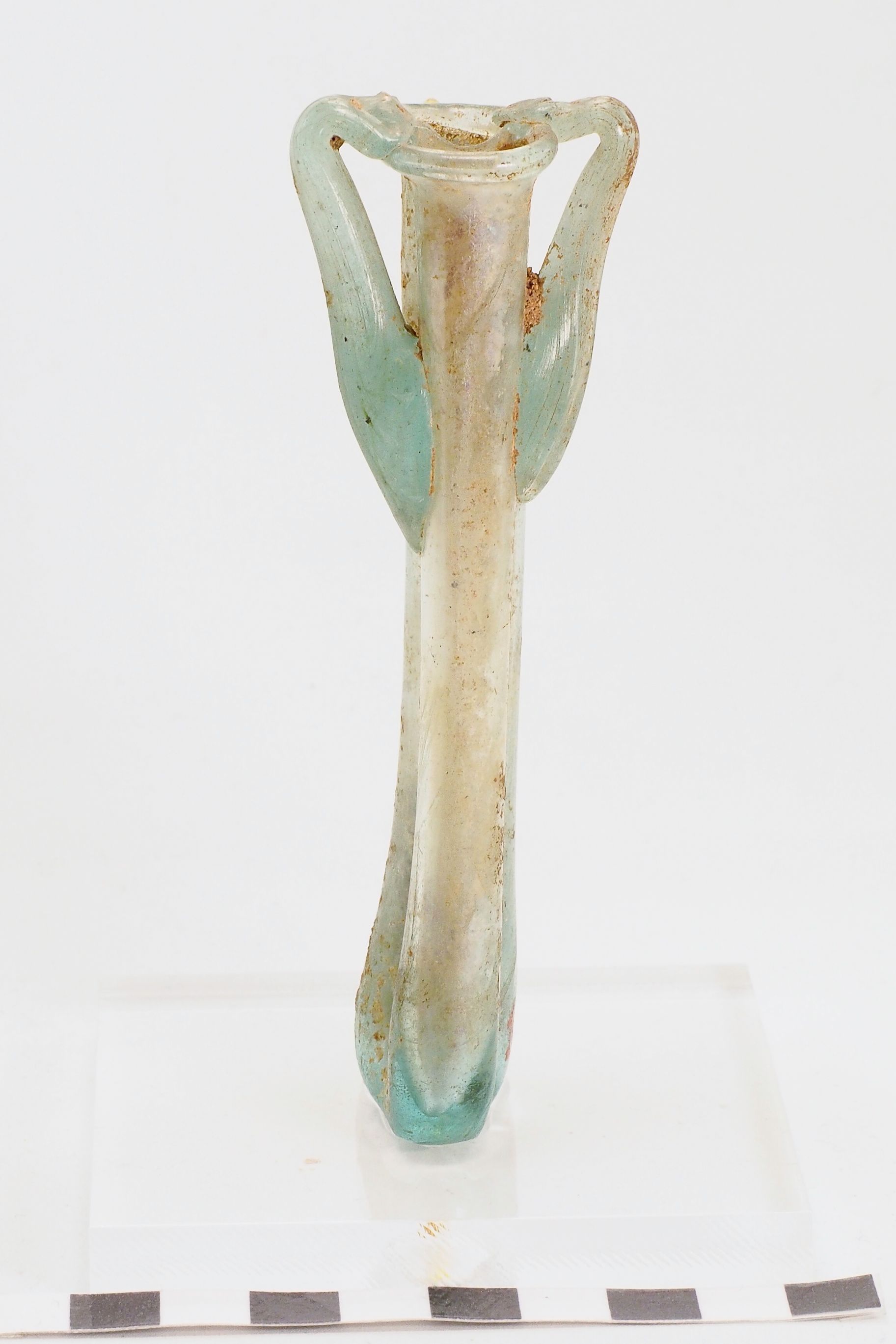
Front
Double Unguentarium with Twin Handles 2019-08-14
Name/Title
Double Unguentarium with Twin HandlesEntry/Object ID
11NE-Mi46-183Description
The rim is tubular and folded inwards, creating a rounded lip. The double-tubed vessel was made by pinching a cylindrical parison to form a vertical diaphragm between the two bodies. Trailed handles were applied to the top half of the diaphragm on either side of the vessel then pulled up to attach to the rim where the excess glass was cut off. The walls are vertical, widening at the base to create a small bulbous base with a pontil mark. The vessel is intact with iridescence, encrustation, and the number "162" in red to the base.Use
CosmeticContext
The vessel's handles are in a different position than any source dealt with; this vessel's handles are an irregularity. This vessel was likely used as a kohl tube. Kohl was most commonly a black cosmetic powder made from pulverized lead ore. Another popular kohl pigment in ancient Egypt and the Near East was green, made from malachite ore. Kohl was commonly applied as a powder or paste with a rod applicator; some glass vessels have even been found with their applicator rods made of bronze, glass, or bone. These vessels could also be sealed by stoppers made of wax or linen. As a cosmetic, kohl was applied by both men and women to the eyebrows, eyelashes, or to outline the eyes, giving a smoky eye appearance. Kohl was not only used for cosmetics but also as a medical salve for eye infections. Kohl is still used in modern times, mostly by cultures in North Africa and the Middle East. The earliest kohl tube first appeared in the third century CE as a singular tube. In the fourth to sixth centuries CE, these cosmetic vessels typically consisted of more than one tube, typically two. Most of the multiple kohl tubes appear with ornate glass trails, applied loops to the side of the body, and ornate basket handles. In this vessel, the handles being placed on the junction of the two tubes is irregular. Additionally, throughout the Byzantine period handles became increasingly complex, leading some to appear bulky. However, the handles were likely used to suspend the vessels as many appear without bases.Collection
Near EastMade/Created
Date made
300 CE - 400 CETime Period
Late AntiqueEthnography
Culture/Tribe
Near Eastern - Syro-Palestine