Etruscan Bucchero Kantharos
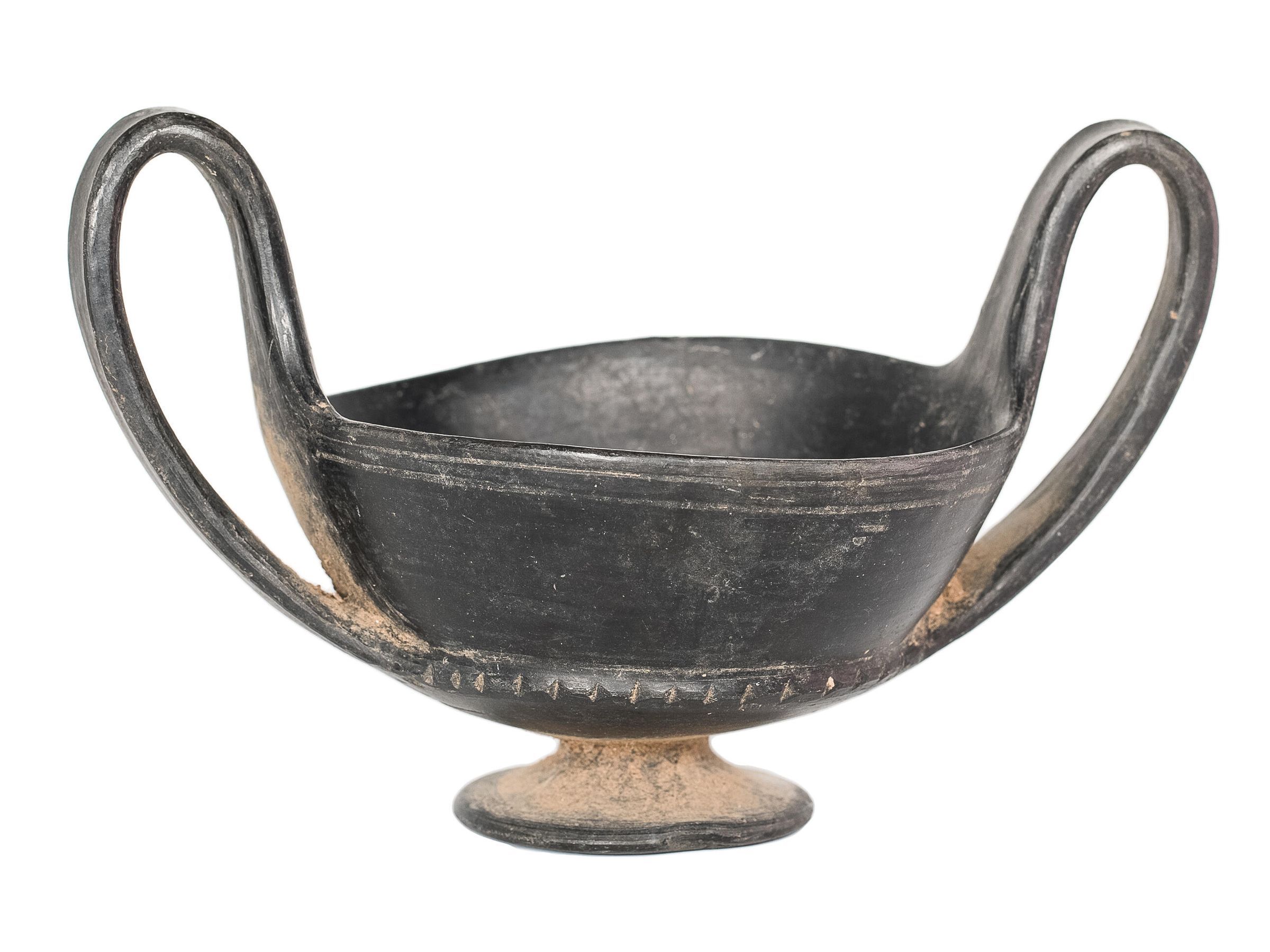
Name/Title
Etruscan Bucchero KantharosEntry/Object ID
21E09248Description
A complete Etruscan bucchero kantharos with a burnished surface. The rim appears to be plain and rounded, and has two horizontal grooves incised just below the lip. Two large arched handles are attached to opposing sides of the rim, extending far above the lip and curving down dramatically before attaching to the bottom of the body. The body itself is hemispherical, and features a small carinated section where there are short incised lines that encircle the vessel. From the body, the vessel narrows down into a small pedestal base.Use
Tableware – drinking.Context
This kantharos, a type of drinking cup, is an example of bucchero ware. Originating with the Etruscans, bucchero ware is a unique pottery style likely designed to imitate expensive metal vessels, a purpose reflected in its characteristic metallic sheen and forms. This type of pottery is distinct from other black ceramic wares, as the deep black colour was produced not by a slip or glaze, but during the firing process by creating a reduction atmosphere (cutting off the oxygen) in the kiln. As a result, the pottery, which would start out as a reddish brown colour, would turn black all the way through. Bucchero ware began being made in the 7th century BCE, with the earliest examples of it coming from the site of Caere (modern-day Cerveteri), a major Etruscan city located in the Lazio region of Italy. Over time, bucchero ware grew in popularity and was exported to many sites across the Mediterranean, including those in Egypt, Cyprus, Turkey, and Greece. In fact, bucchero kantharoi have been found in Greek temples, which reinforces the ritual importance that symposiums (social events where aristocratic men would drink together in a relaxed setting) had during this period. However, bucchero ware eventually started to disappear by the beginning of the 5th century due to shifting preferences, competition with Greek imports, and the decline of Etruscan civilization under Roman rule.Made/Created
Date made
circa 700 BCE - circa 550 BCETime Period
Iron AgePlace
Country
ItalyEthnography
Cultural Region
Country
ItalyCulture/Tribe
Etruscan