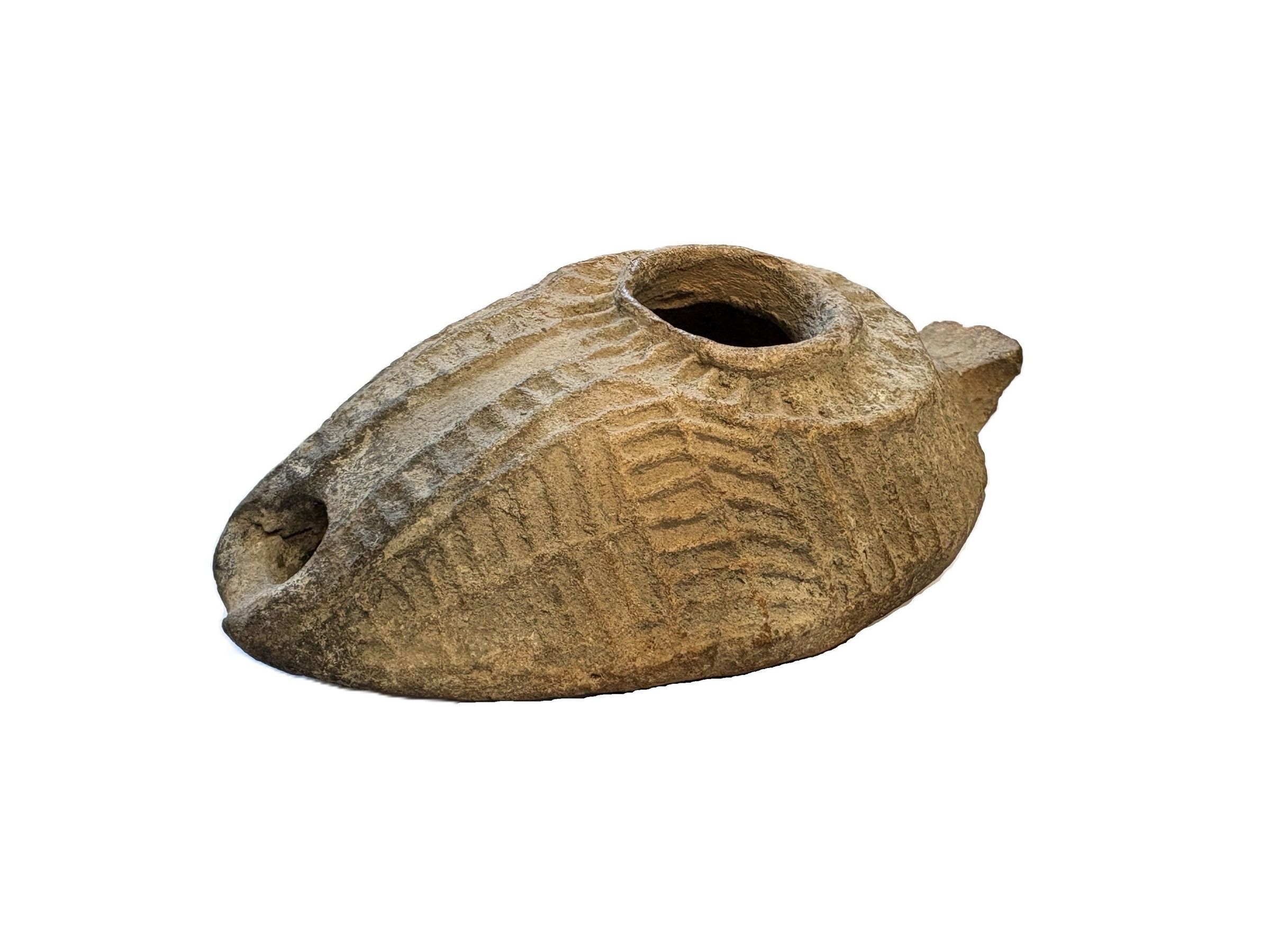
Late Samaritan Oil Lamp
Name/Title
Late Samaritan Oil LampEntry/Object ID
11NE-Mi40-178Description
A geometric oil lamp that is oval/egg-shaped featuring raised geometric designs and a short knob handle that was broken in antiquity. The discus surrounding the fill-hole is flat and decorated with a radial pattern. There is a flat channel from the discus to the wick-hole that is flanked with a ladder like pattern on either side. A chevron or branch pattern separates the apex/front of the lamp from the body/back of the lamp. The nozzle has a grid-like geometric design, while the body/back of the lamp features radial strokes from the discus to the edge of the shoulder. Beneath the shoulder, the lamp features no moulded design and gently slopes to the base. The base is flat and roughly egg-shaped, following the shape of the lamp. The area around the fill-hole is marked with soot from use.Use
Olive oil would have been poured through the centre hole to fill the body of the lamp. A wick (made of organic rope) would have been placed in the wick hole on the spout. The wick would then have been lit to provide light indoors and at night.Context
This lamp is an example of a geometric Samaritan lamp dating to the Late Byzantine period. Samaritan lamps were first discovered at Kafr Qara and typically date to the end of the Byzantine period, with many lamps continuing, albeit with a few changes, to the beginning of the Umayyad period (661–750 CE). These types of lamps are mould-made and feature a plain channel running from the fill-hole to the wick-hole with a variety of different designs covering the rest of the surface. However, ladders and herringbone patterns are the most common designs, with the latter even being considered an identifying mark of Samaritan lamps. This style of Samaritan lamp was widely used by many communities and the general geometric patterns are not associated with any religious symbolism. In fact, despite the complexity of the designs on some Samaritan lamps, there is an impression that they were usually made with less attention to their aesthetic appearance. This resulted in them being much coarser and plainer than other contemporary lamps. This lamp can be identified as a type V.B24 due to the overall oval shape, flat base, short and narrow handle, flattened channel between the fill- and wick-hole, and the double rim surrounding the wick-hole.Collection
Near EastMade/Created
Date made
500 CE - 599 CETime Period
ByzantineEthnography
Cultural Region
Area
Eastern MediterraneanCulture/Tribe
Byzantine