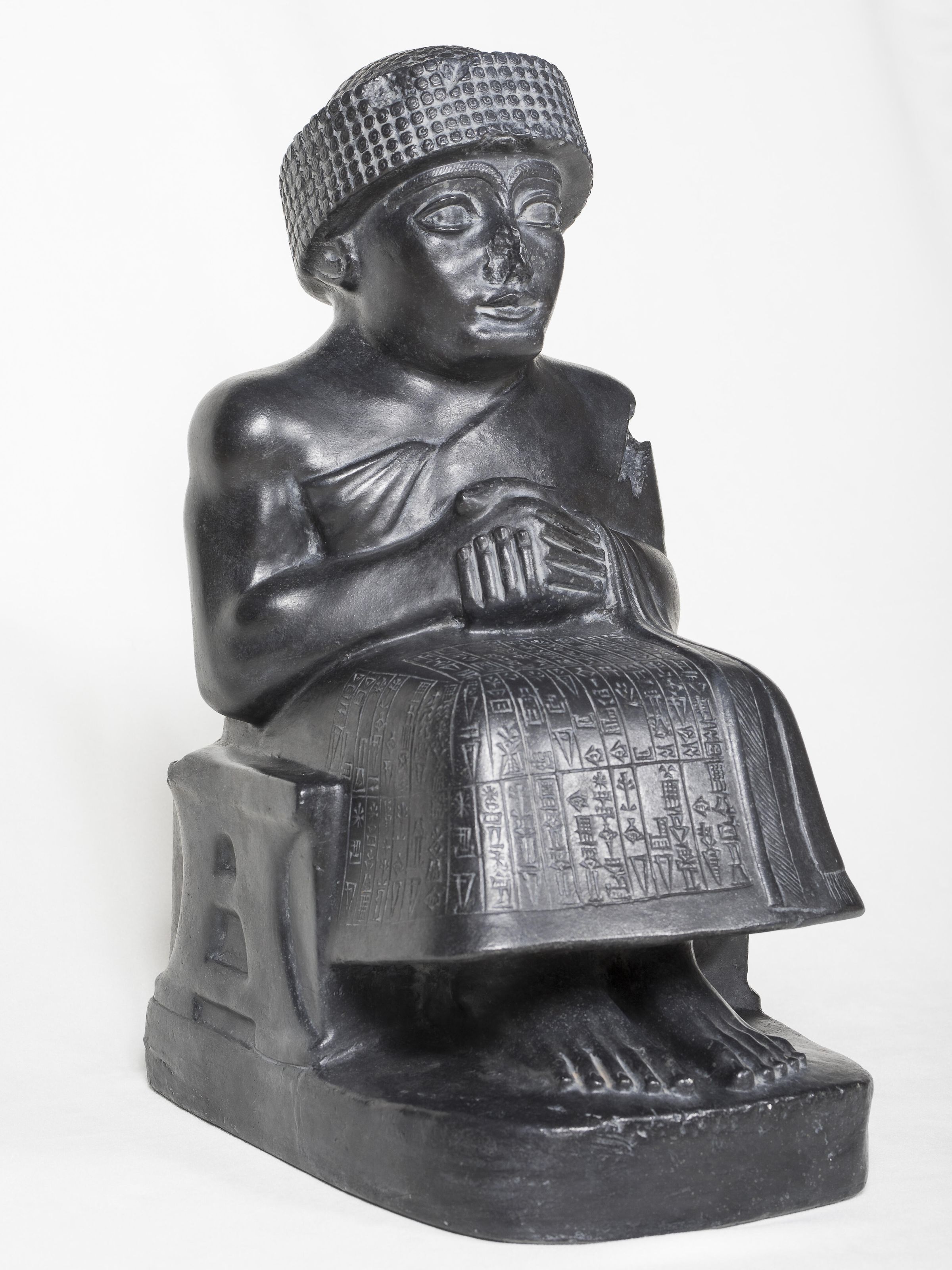
Gudea, Prince of Lagash
Name/Title

Gudea, Prince of Lagash

Entry/Object ID

06NE13108

Description

Statue depicting a man seated on a backless throne. Gudea, ruler of the city-state of Lagash, is depicted with his hands joined. His clean-shaven face is calm and smiling; large eyebrows arch above his eyes. He is wearing a broad brimmed cap with stylized wool or fur curls and an Akkadian draped/fringed robe inscribed with cuneiform. His muscular right arm uncovered. Damage is seen on the right brim of the cap, the nose, and the left upper arm. Plaster copy of stone original.

Type of Sculpture

Statue

Artwork Details

Medium

Diorite

Subject Person

Gudea

Subject Place

State/Province

Lagash

County

Iraq

Region

Mesopotamia

Context

Gudea was the ensi or ruler of the small, independent Sumerian city-state of Lagash from 2144 to 2124 BCE, holding both political and religious power. He built and restored many temples to gods of his kingdom. He also made many votive statues of himself from valuable imported stones, dedicated to these gods. More than 20 statues of Gudea have been found, often life-sized, depicting him as deeply pious. In this small statue, his hands are clasped in a conventional gesture of devotion and his feet are bare. The statue was inscribed with cuneiform in the Sumerian language, dedicating the statue to Gudea’s personal deity, the god Ningishzida, a deity of vegetation and of the underworld. Gudea was a trend-setter. His votive statues are the earliest evidence of Mesopotamian royalty wearing a broad brimmed hat. Later Neo-Sumerian and Babylonian kings, ruling far bigger and more powerful lands, depicted themselves wearing Gudea’s cap. Babylonian King Hammurabi wears Gudea’s cap almost four hundred years later, on Presumed Head of Hammurabi and on Code of Hammurabi. Replicas of these artifacts are also held by the Museum of Antiquities.

Collection

Near East

Made/Created

Artist Information

Attribution

Neo-Sumerian

Date made

2120 BCE - 2110 BCE

Time Period

Bronze Age

Ethnography

Culture/Tribe

Near Eastern - Sumerian

Inscription/Signature/Marks

Type

Inscription

Language

Sumerian

Translation

When Ningirsu, the mighty warrior of Enlil, had established a courtyard in the city for Ningišzida, son of Ninazu, the beloved one among the gods; when he had established for him irrigated plots(?) on the agricultural land; (and) when Gudea, ruler of Lagaš, the straightforward one, beloved by his (personal) god, had built the Eninnu, the White Thunderbird, and the ..., his “heptagon,” for Ningirsu, his lord, (then) for Nanše, the powerful lady, his lady, did he build the Sirara House, her Mountain rising out of the waters. He (also) built the individual houses of (other) great gods of Lagaš. For Ningišzida, his (personal) god, he built his House of Girsu. Someone (in the future) whom Ningirsu, his god — as my god (addressed me) — has (directly) addressed within the crowd, let him not, thereafter, be envious(?) with regard to the house of my (personal) god. Let him invoke its (the house’s) name; let such a person be my friend, and let him (also) invoke my (own) name. (Gudea) fashioned a statue of himself. “(Ningišzida) gave life to Gudea, the builder of the house” — (this is how) he named (the statue) for his sake, and he brought it to him into (his) house.

Type

Seal

Language

French

Dimensions

Dimension Description

Overall

Height

47 cm

Width

23 cm

Depth

32 cm

Research Notes

Research Type

Researcher

Notes

Price, Ira Maurice. "The Topography of the Gudea Inscriptions" Journal of the American Oriental Society, 1923. 41-48. Public: No

Research Type

Researcher

Notes

Benoit, Nicolas. "Gudea, Prince of Lagash, seated statue dedicated to the god Ningishzida." Louvre Museum, www.louvre.fr. Public: No

Research Type

Researcher

Notes

Edzard, Dietz Otto. The royal inscriptions of Mesopotamia. Early periods, Vol. 3/1. Gudea and His Dynasty (RIME 3/1), Toronto, University of Toronto Press, 1997, E3/1.1.7.Statue I, 51-53. Evans, Jean M. “Approaching the Divine: Mesopotamian Art at the End of the Third Millennium B.C..” Art of the First Cities: The Third Millennium B.C. from the Mediterranean to the Indus. Ed. Joan Aruz. New York: Metropolitan Museum of Art, 2003, 417-424. Note pages 419-20.

Research Type

Researcher

Notes

Johansen, Flemming. Statues of Gudea Ancient and Modern. Copenhagen: Akademisk Forlang, 1978. Note pages 5-6, 11-12, and plates 37-40.

Research Type

Researcher

Notes

Werr, Lamia al Gailani. “A Note on Sumerian Fashion.” The Sumerian World. Ed. Harriet Crawford. London: Routledge, 2013, 378-394. Note pages 390-1.