'Type 3' Herodian Lamp
Name/Title
'Type 3' Herodian LampEntry/Object ID
11NE-Mi38-176Description
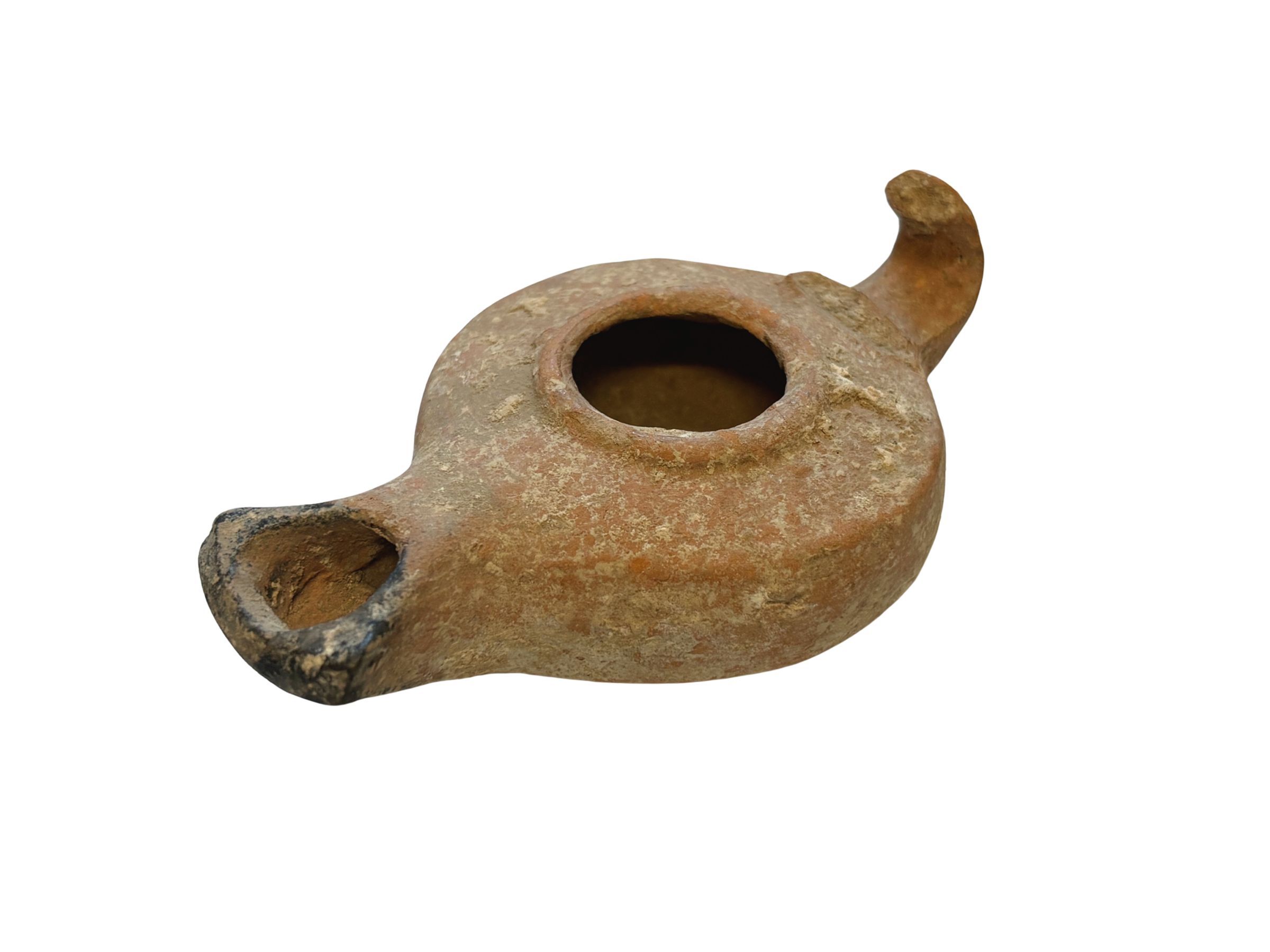
A complete 'type 3' Herodian lamp, with a thick raised rim around the fill-hole, straight sides, and flat bottom. The loop handle, opposite the wick hole, was broken in antiquity and only the bottom portion of the handle remains. On the underside of the nozzle a 'v' shape is incised. A large amount of soot is still present surrounding the edge of the wick hole and tip of the nozzle. Small patches of calcification cover the lamp.Use
Olive oil would have been poured through the centre hole to fill the body of the lamp. A wick (made of organic rope) would have been placed in the wick hole on the spout. The wick would then have been lit to provide light indoors and at night.Context
The Herodian lamp was one of the most common and widespread household lamps of the 1st century CE and has become perhaps the most well-known lamp in Palestinian archaeology today. Originally named for the Herodian dynasty, recent excavations in Jerusalem’s Jewish Quarter actually suggest that the manufacturing of these lamps began closer to the turn of the era. This means that despite the name of the lamp type, Herod himself may not have actually encountered any Herodian lamps. In general, these lamps are very simplistic in style, with a wheel-made body and handmade spout void of any (detailed) decoration. Once attached to the body, the spout was shaped further with a knife, which gives these vessels their alternative name of “knife-pared” lamps. Some Herodian lamps, like this one, feature a loop handle opposite the spout, while larger examples often have multiple spouts. Additionally, although none of the Herodian lamps in our collection do, some feature simple circles, dots, or lines as a means of light decoration. The lack of flange and the presence of an Ephesus-style loop handle indicate that this lamp is part of the 'type 3' subcategory of Herodian lamps. Less common in Jerusalem than types 1 or 2, type 3 lamps typically date between 70–135 CE.Collection
Near EastMade/Created
Date made
circa 70 CE - circa 135 CETime Period
Roman ImperialPlace
Region
IsraelEthnography
Cultural Region
Region
IsraelCulture/Tribe
Near Eastern - Roman Jewish