Islamic Bottle
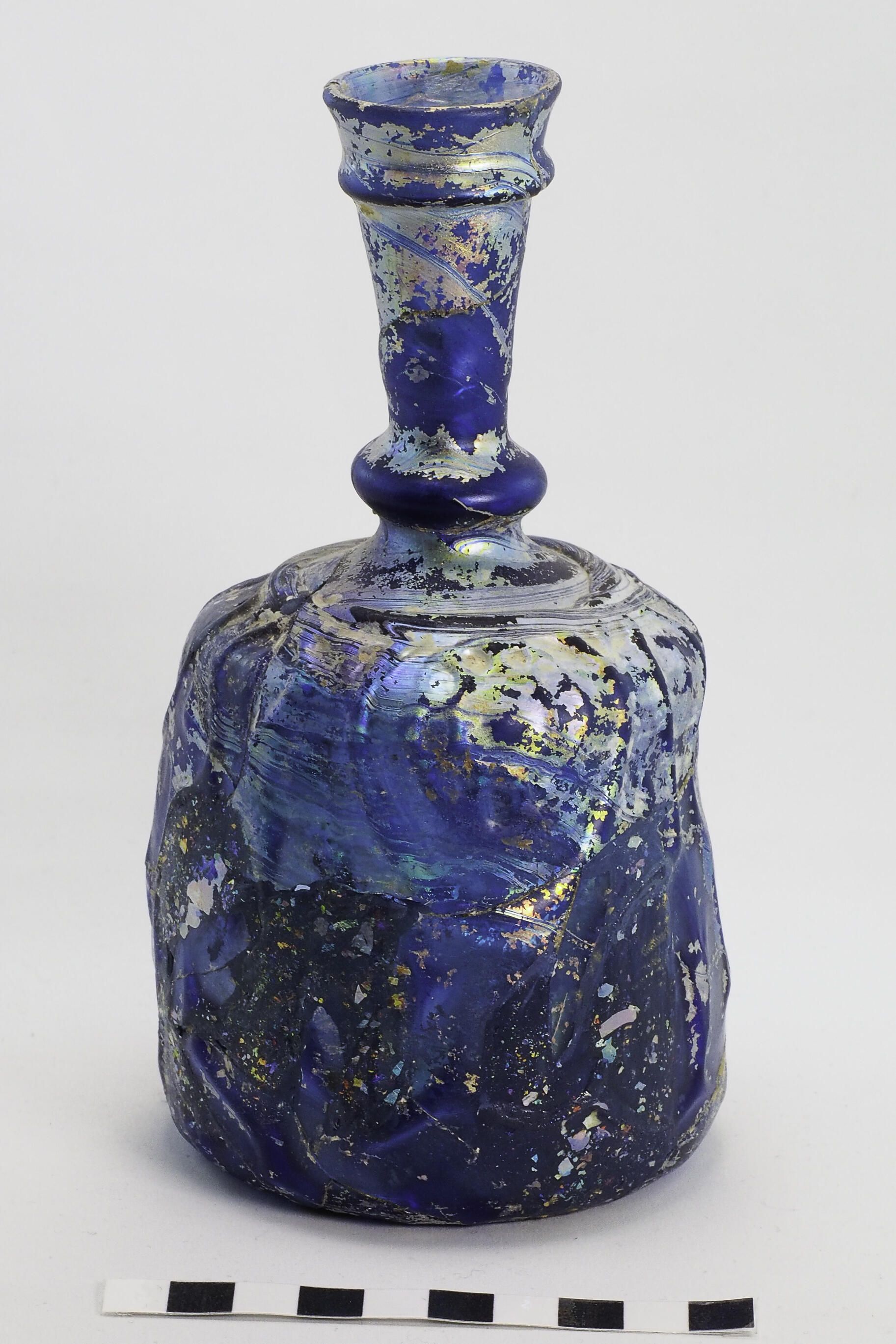
Front
Islamic Bottle 2019-08-12
Name/Title
Islamic BottleEntry/Object ID
11NE-Mi18-156Description
The rounded rim is everted. Two mold-blown rings protrude from the funneled neck, the first at the top of the neck and the second, which is thicker and more protruded, is near its base. There is a constriction between the last ring of the neck and the top of the shoulder. On the flat shoulder there is a raised ring with a circular relief and vine-like decorations which extend onto the body from the raised ring. The body is cylindrical and contains worn relief decorations in a ringed pattern. The pattern consists of a thin protruding outer ring which surrounds a thicker inner ring containing circular equidistant negative reliefs; in the center is a protruding bose, creating a 'concentric rosette' pattern. The base is concave with a pontil mark. The vessel is intact but was recomposed from fragments with several large areas of reconstruction, large areas of the the relief are worn, and there is some iridescence.Use
TablewareContext
The design and shape were popular between the eighth to thirteenth centuries CE, especially the tenth century CE and later. The decorative motif of 'cellular' or 'concentric rosettes' was favoured by Iranian glassblowers. The curly vegetal motifs are known as Gurgan motifs as bottles with this motif were first discovered in Gurgan, Iran.Made/Created
Date made
900 CE - 1100 CETime Period
Islamic Golden AgeEthnography
Culture/Tribe
Near Eastern - Islamic