Attic White-Ground Lekythos
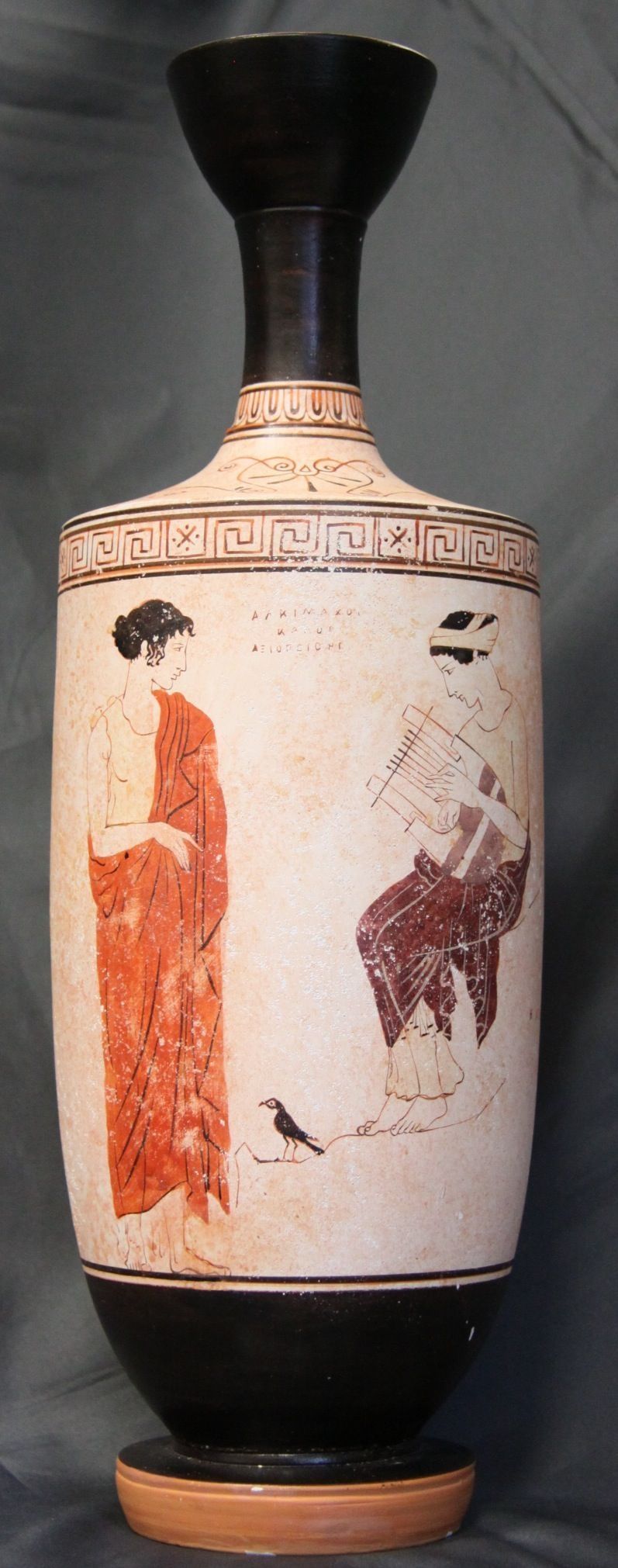
Front View
2015-00-00
Name/Title
Attic White-Ground LekythosEntry/Object ID
93G0253Description
An Attic white-ground lekythos decorated with two female figures painted with black and red outlines. The rim has a funnel-like shape, but has a wider mouth that does not extend smoothly into its narrow neck. From the neck, the vessel flares out into the shoulder, which then sharply bevels into a straight body. Near the base, the body starts to round off before the start of its large foot.Use
White-ground lekythoi are oil flasks that were primarily used for Athenian funereal rites.Context
This vessel is referred to as a lekythos, which is a special type of oil flask that was used in ancient Greece during the Archaic and Classical periods (750 BCE–323 BCE). While these vessels were generally used for sepulchral purposes throughout these periods, white-ground lekythoi in particular rose in popularity during the 5th century BCE. The original of this specific lekythos was made by the famous ‘Achilles Painter', the leading decorator of these types of vessels during this time. Being that white-ground lekythoi are isolated to the funerary sphere, the imagery on them tends to follow certain motifs and themes. One of the most common images is that of the ‘Mistress and Maid', which, as is evident from its name, depicts two women engaging in some sort of activity or exchange. On this lekythos, a young woman is softly strumming a kithara while seated on a rock. Across from her is another young woman (possibly a muse) who appears to be listening, as well as a small bird standing between the two. Focusing on the woman playing the kithara, her appearance does not differ from the women seen on other white-ground lekythoi or even her companion across from her. However, as emphasized by Giudice (2026), her bowed head isolates her, and the reference to Mount Helicon (the birthplace of the Muses) seems to elevate her to the rank of a Muse—with death acting as the cause of this transformation. The small bird at the base of the rock, understood to be a nightingale, expresses its sorrow as a threnos (a lyrical lament over a victim of the catastrophe in a tragedy).Collection
Classical GreeceMade/Created
Date made
circa 445 BCETime Period
ClassicalPlace
Institution
World Treasures, USAEthnography
Cultural Region
Country
GreeceCulture/Tribe
Greek - Classical