Minoan Stirrup Jar
Back
2015-00-00
Name/Title
Minoan Stirrup JarEntry/Object ID
88A0150Description
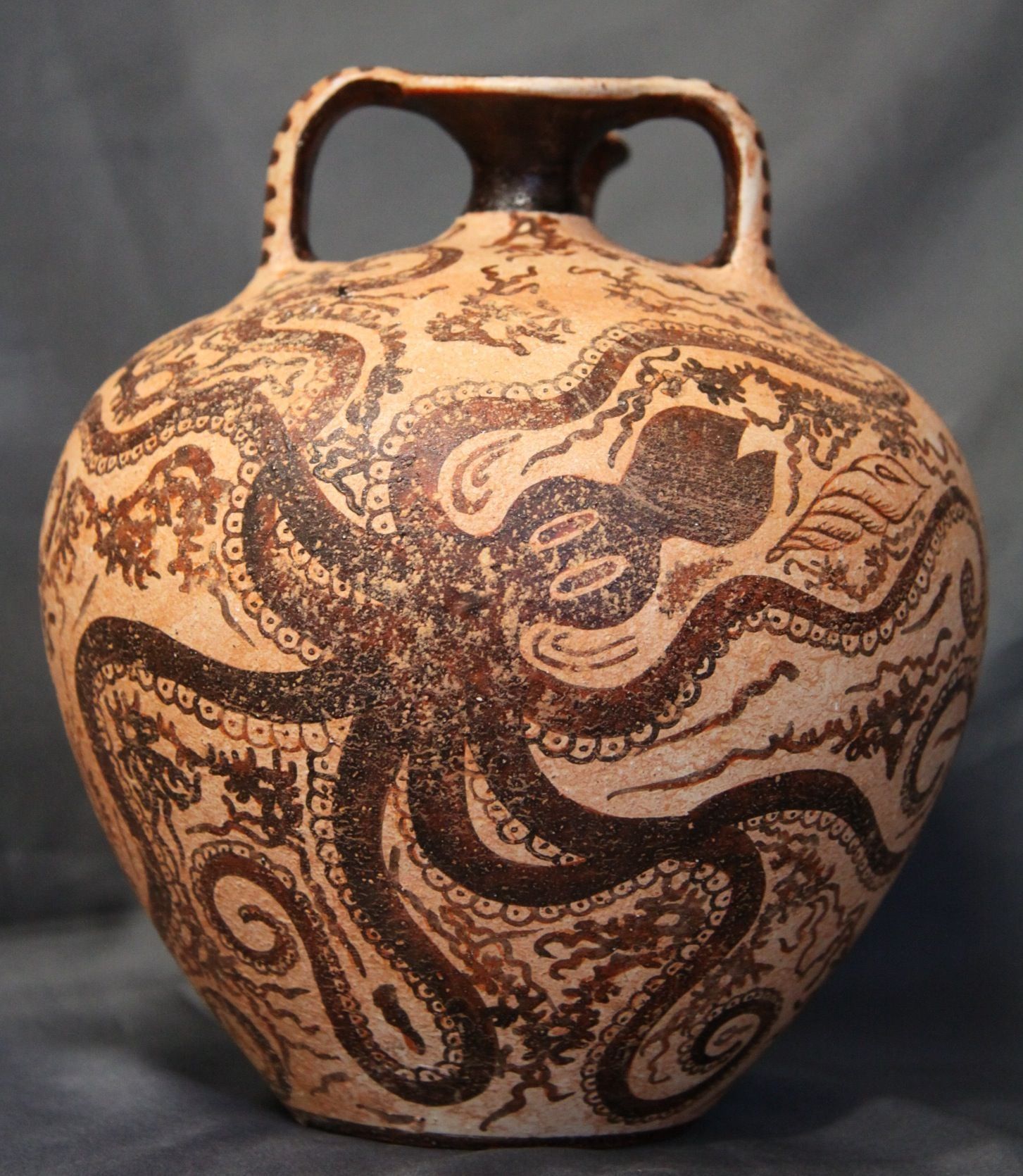
A Minoan stirrup jar decorated with octopuses and other marine life across the entire outer surface. The opening on this jar is quite small in relation to the rest of the jar, having a flared rim that narrows into a short, constricted (false) neck. Two small handles are attached to the side of the rim and arch down to connect to the shoulder of the vessel. A small spout with a flared rim is also attached to the shoulder in front of the handles and opening of the vessel. In general, the body has a somewhat squat, urn-like shape. From the wide shoulders it narrows significantly before it reaches its flat base.Use
Storage/Serving.Context
The detailed oceanic artwork on this stirrup jar is symbolic of one of the most iconic and well-known art styles of the ancient Mediterranean: Marine Style. Notably, Marine Style is just one of the major subdivisions that made up what is referred to as the ‘Special Palatial Tradition’, the other three being Floral Style, Geometric and Abstract Style, and Alternating Style. Despite being the most well-known today, Marine Style was not the most popular out of these four in antiquity, though it is still found in a variety of different contexts and was used to decorate many kinds of vessels. Focusing on the artwork itself, this stirrup jar features an octopus, the most common Marine Style motif. When looking at Minoan Marine Style art, it is important to draw attention to the artist’s understanding of their environment. Although stylized, they clearly painted the octopus with a deep understanding of how it exists in its natural habitat. Its twisting tentacles writhe across the surface of the pot in a way that imitates their movement across a shallow seabed, which is represented on the vessel through the presence of tritons, sea urchins, coral, and marine vegetation. Outside of just representing Crete’s culture and natural environment, the images of octopuses and other marine life on Minoan ceramics may have connections to a few different concepts. For example, some scholars believe that the octopus may have been a symbol of death or the journey into the afterlife. This is based on the fact that octopuses are often painted on larnakes (small coffins) of the Postpalatial period (1470 BCE–1075 BCE), and the animal’s ability to regrow cut off limbs made it a suitable symbol for a set of religious beliefs linked to regeneration, life after death, and cyclical transformations. Other interpretations of the octopus and Marine Style motifs—which centre on the power of the ocean, the power of the elite, and the economic importance of the ocean—clearly show a link to ritual activities and beliefs. However, it’s the strength of this association and the exact meanings that are still disputed amongst scholars today. In antiquity, stirrup jars were specialized storage vessels used for containing oil or wine. It is likely that they were originally intended to serve the same purpose as amphorae, but had the advantage of featuring a spout, making pouring the contents of the jar far more convenient.Made/Created
Date made
circa 1500 BCE - circa 1450 BCETime Period
Bronze AgePlace
Institution
World Treasures, USAEthnography
Cultural Region
Island
CreteCulture/Tribe
Minoan