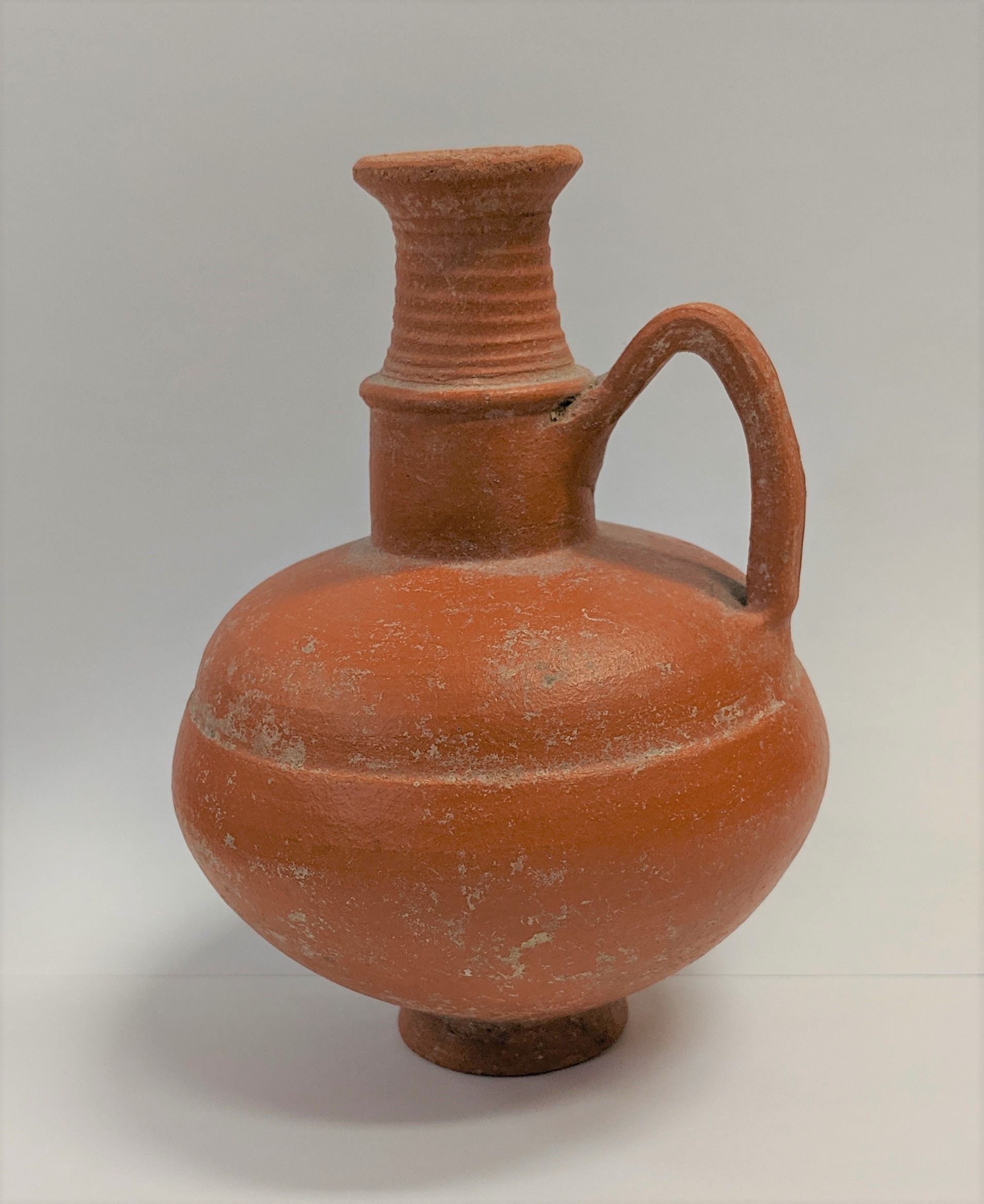
African Red Slip (ARS) Flagon

Name/Title

African Red Slip (ARS) Flagon

Entry/Object ID

19R02233

Description

An African Red Slip Ware (ARSW) flagon from North Africa. The rim is slightly flared and leads into a tall screw-neck. The lower part of it is vertical and plain, while the upper part has spiral grooving. Just under where the two parts of the neck connect, there is a small, high-flaring handle that connects to the shoulder of the vessel. The body has a double-convex shape, with the upper bulge being smaller than the lower one. The base consists of a small foot-ring.

Use

Tableware.

Context

Although the form of this vessel has some interesting features, the vibrant orange-red slip is most important for identifying it as African Red Slip Ware (ARSW). ARSW is a category of terra sigillata (a type of fine red ancient Roman pottery), which is one of the most long-lived Mediterranean fine wares in antiquity. The production of ARSW is thought to have first emerged in the northern region of modern Tunisia, particularly around Carthage, one of the most important trading hubs of the ancient Mediterranean. It first started being produced on a large scale in the 2nd and 3rd centuries CE, though a second distribution flow occurred in the 5th–6th centuries that continued well until the end of the 7th century. Due to its popularity throughout the later periods, ARSW has been crucial for better understanding the ceramological bridge between the ancient east and west, as well as the general distribution of ceramic tableware throughout the Mediterranean. Based on the orangey colour of the slip on this flagon and its granular texture, it is likely that this vessel was made sometime between the late 1st to the mid-4th century CE. This dates it to what scholars refer to as ‘ARSW A’, the earliest phase of ARSW production. Generally, flagons were used across the Roman empire for storing and serving liquids, including wine, water, beer, and oil. Typologically, this example aligns with Hayes’ (1972) form 160 for ARSW.

Collection

Near East

Made/Created

Date made

circa 200 CE - circa 400 CE

Time Period

Roman Imperial

Place

Country

Tunisia

Region

North Africa

Continent

Africa

Ethnography

Cultural Region

Country

Tunisia

Region

North Africa

Continent

Africa

Dimensions

Dimension Description

Overall

Height

13.5 cm

Diameter

9.9 cm

Dimension Description

Rim

Diameter

3.1 cm

Research Notes

Research Type

Reference

Notes

Bes, Philip. Once Upon a Time in the East: The Chronological and Geographical Distribution of Terra Sigillata and Red Slip Ware in the Roman East. Archaeopress, 2015. Note pages 90-91.

Research Type

Reference

Notes

Bonifay, Michel. "Ceramic Production in Africa During Late Antiquity: Continuity and Change." In Technology in Transition A.D. 30–650, edited by Luke Lavan, Enrico Zanini, and Alexander Sarantis. Brill, 2007. Note page 147.

Research Type

Reference

Notes

British Museum. "Flagon." Accessed July 7, 2026. https://www.britishmuseum.org/collection/object/G_1814-0704-676.

Research Type

Reference

Notes

Hasenzagl, Carina. North Tunisian Red Slip Ware from Production Sites in the Salomonson Survey (1960–1972). Peeters, 2019. Note page 7.

Research Type

Reference

Notes

Hayes, John. Late Roman Pottery. British School at Rome, 1972. Note pages 189-190 (Form 160).

Research Type

Reference

Notes

Teixeira-Bastos, Marcio. "Emerging Distribution Networks of Roman Pottery in the Ancient Mediterranean: The Sigillata Clay Lamps of Proconsular Africa." Heródoto 3, no. 2 (2018): 132-157. Note pages 140-143.