Cypriot Red Polished Spouted Jug
Name/Title
Cypriot Red Polished Spouted JugEntry/Object ID
11NE-Mi64-200Description
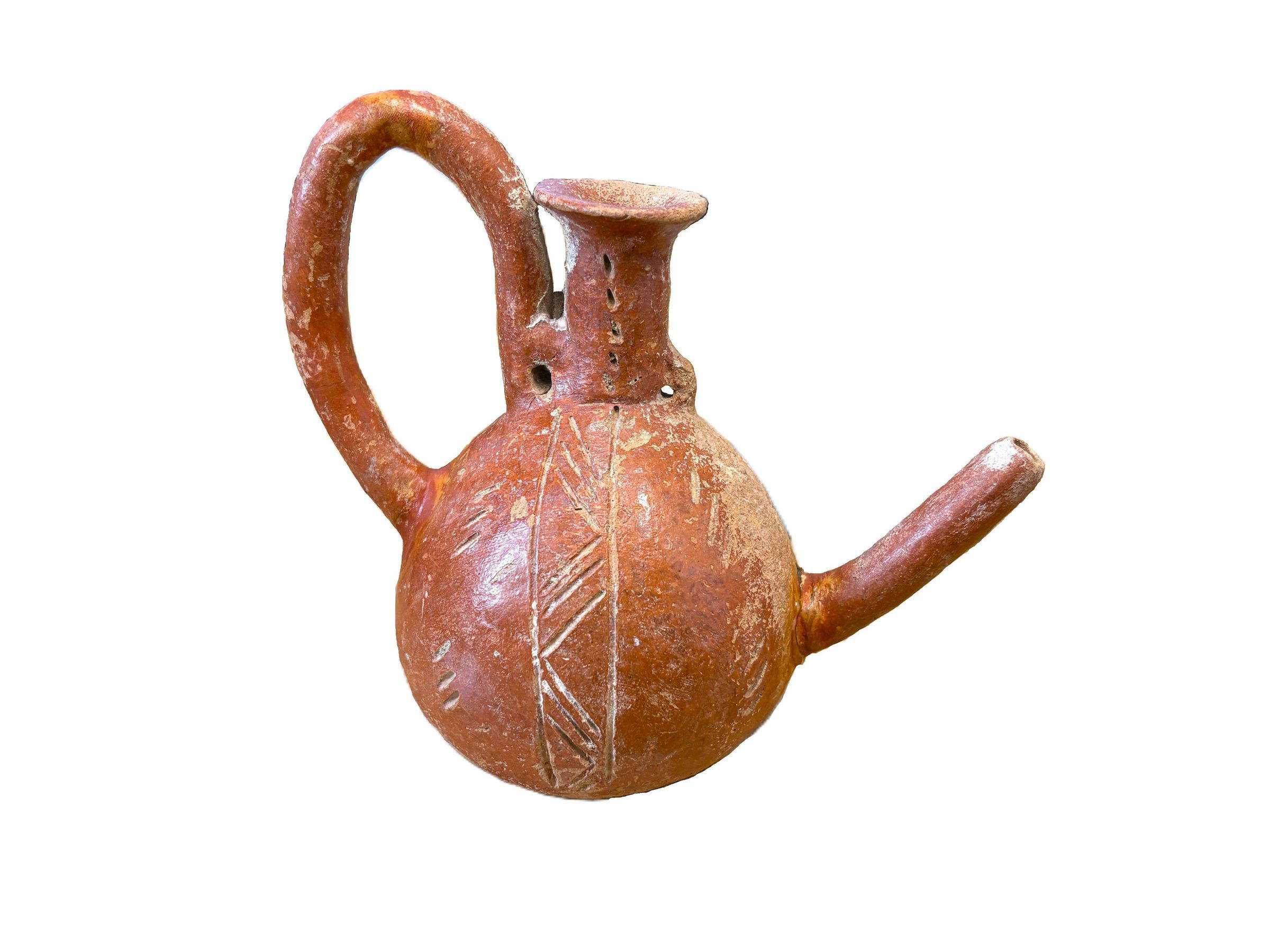
A complete Cypriot Red Polished spouted jug with a burnished red slip. The rim appears to be flattened and flares out quite dramatically. From the rim, the vessel narrows into a tall, vertical neck. Just next to the neck, a large arched handle is attached to the shoulder, which curves upwards before reaching down again and connecting to the body. In line with the handle are two small decorative lugs on either side of the neck. Additionally, a long, thin spout is attached to the bottom half of the body opposite to the handle. Overall, the body has a spherical shape with a rounded base, the surface of which is covered with incised geometric patterns that may have been filled in with white lime.Use
Tableware - serving.Context
Red Polished Ware, characterized by a vibrant red slip polished to a shiny finish, is a hallmark of the Early Bronze Age (ca. 2500 BCE–2000 BCE) in Cyprus. During this time, most of the island was inhabited by small communities with a solid agricultural base made up of legumes and cereals, as well as livestock like goats, cattle, and sheep. Being that these communities were villages or small towns at most, the majority of their everyday pottery was made in the household. As such, Red Polished Ware, like much of the pottery produced at this time, was handmade rather than wheel thrown. Notably, this style has similarities to Anatolian wares, which has led scholars to suggest that it may have been introduced to the island by Anatolian emigrants earlier on in the Bronze Age, though Cypriot potters were quick to make Red Polished Ware according to their own regional preferences. Although quite diverse, Red Polished Ware was primarily used for serving and consuming food and drink, as reflected in most of the shapes and forms of vessels associated with this type. Pitchers like the one displayed here were likely used to serve either water or wine, and the rounded bottom suggests that meals were not eaten on a table, but rather on the ground. This is further supported by other archaeological evidence from Bronze Age Cyprus, such as the layouts of houses and the lack of furniture.Collection
Near EastMade/Created
Date made
1800 BCE - 1701 BCETime Period
Bronze AgePlace
Region
CyprusEthnography
Cultural Region
Region
CyprusCulture/Tribe
Aegean/Mediterranean