Thick-Necked Islamic Bottle
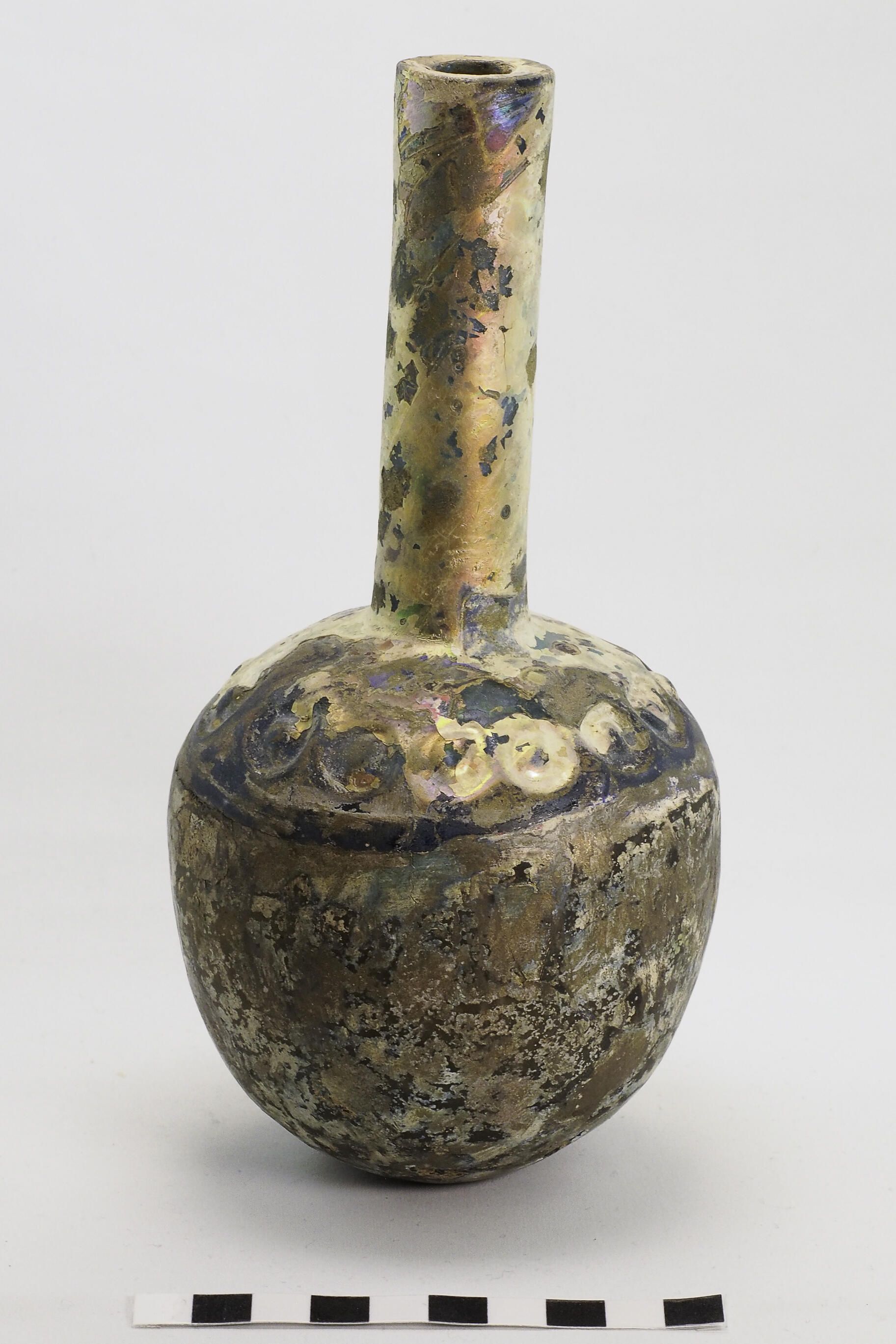
Front
Thick-Necked Islamic Bottle 2019-08-12
Name/Title
Thick-Necked Islamic BottleEntry/Object ID
11NE-Mi19-157Description
The rim is plain, thick, and flat, continuing vertically into the cylindrical neck. The neck is plain, thick, and descends vertically joining with the rounded shoulder which is decorated with a horizontal row of impressed circles with bosses in their centers. The shoulder is attached horizontally to a globular body as this bottle was made in two parts, joined right below the ring of impressed circles at the shoulder. The top portion of the vessel is blue and the bottom portion is green glass but both are very worn appearing dark yellow. The base is small and flat with a pontil mark. The vessel is intact with iridescence.Use
Household WareContext
The decoration of this vessel may have originated in the Sassanian Empire which continued to be used in Western Asia and Egypt until the eleventh century CE. The most common feature of these workshops was use of the technique called hot-worked glass where the glass would be impressed with repeated geometric patterns with hot tongs before the vessel cooled. The separate portions of the vessel would also be joined using this technique. To show off their hot-worked glass skills, glass blowers would make the separate portions in two different colours, as the best examples of this technique are presented in differently coloured sections.Made/Created
Date made
800 CE - 900 CETime Period
Islamic Golden AgeEthnography
Culture/Tribe
Near Eastern - Islamic