Name/Title
CharmEntry/Object ID
1994.028.0231Description
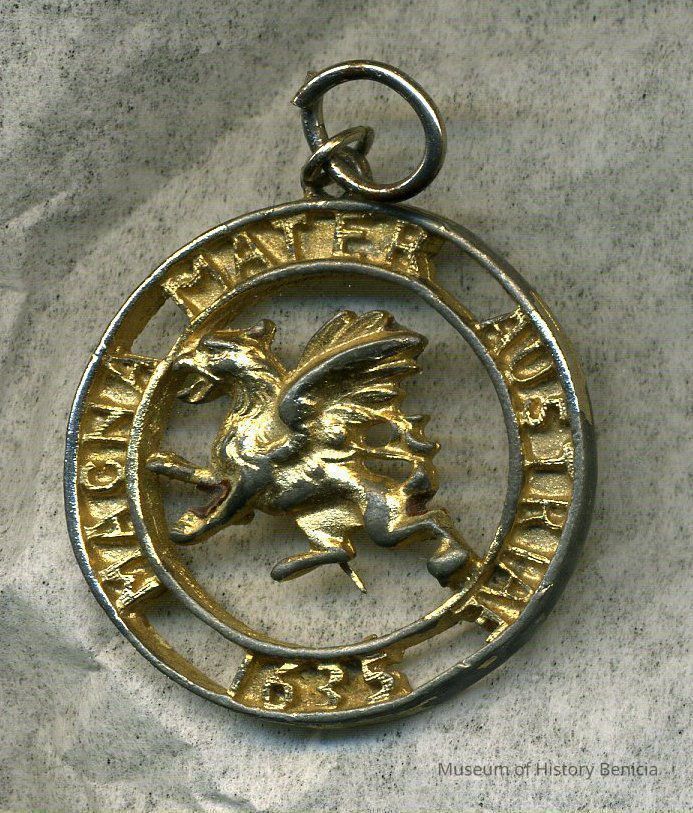
Medallion/Charm - 1-3/8" diameter; round, gold painted metal; winged dragon in center; around the edge: Magna Mater Austriae 1635
Magna Mater Austriae - the veneration of the Virgin as the Habsburg state cult
Emperor Leopold I called himself 'the lowest and least worthy servant of the Blessed Virgin Mary' and the Mother of God his liege lady who had endowed him with his sovereignty. Mary, the Magna Mater Austriae, was the patron saint of the dynasty and the lands over which it ruled.
Magna Mater Austriae (Latin for Great Mother of Austria), refers to the Virgin Mary to whom the Austrian territory was dedicated several times and who is therefore regarded as Austria´s special patron saint. For these reasons the Virgin Mary is also called "Alma Mater Austriae" (Kind Mother of Austria), as well as "Venerable Patron Saint of Austria". A representation of the Magna Mater Austriae in the shape of a Byzantine/Late Romanesque sitting statue (13th century) with splendid garments is to be found in the town of Mariazell (an important place of pilgrimage in the province of Styria). Other old churches dedicated to the Virgin Mary are situated at Wilten (in the Tirol, 1140), at Maria Saal (9th century), at Maria am Gestade in Vienna and at Maria Taferl. Literary texts bear witness to the praise of the Virgin Mary in medieval monasteries. The Jesuits founded a lay movement called Marian Congregation. The 17th century has been considered the "Marian century". Karl II of Innerösterreich (one of the four territories into which Austria was split during the 16th century) promoted pilgrimages; Ferdinand II worshipped the Magna Mater Austriae at Mariazell. Emperor Ferdinand III declared the Virgin Mary the "Patrona et Domina Austriae" (a column dedicated to the Virgin Mary was set up on the square "Am Hof" in Vienna, restored by order of Leopold I in 1667). During the reign of Emperor Joseph II pilgrimages were restricted, religious fraternities in honour of Mary the Virgin and votive plaques were forbidden and many churches destroyed. Some, however, were saved from destruction (e.g. the church of Straßengel in the province of Styria). Since the 19th century Pilgrimages have again become popular.
Legend has it that Klagenfurt was founded after a couple of brave men had slain the abominable "Lindwurm", a winged dragon in the moors adjoining the lake, the staple diet of which is said to have been virgins, but which did not spurn the fat bull on a chain that the men had mounted on a strong tower. The feat is commemorated by a grandiose 9-ton Renaissance monument in the city centre.
Legend has it that long ago, the marshes near Klagenfurt, Austria, were haunted by a fearsome Lindwurm--a serpentlike dragon. It devoured all the people and livestock who ventured its way. Finally, a local ruler called on his knights to destroy the dragon, and after many attempts it was slain. To commemorate the event, a "dragon" skull was placed in the town hall. In 1582, an artist borrowed the skull--really the fossil remains of an Ice Age woolly rhinoceros--to use as a model in shaping a massive sculpture of the Lindwurm, which still stands in the city today.Collection
Benicia Historical Museum Collection