Name/Title
Print, PhotographicEntry/Object ID
2010.017.0011Description
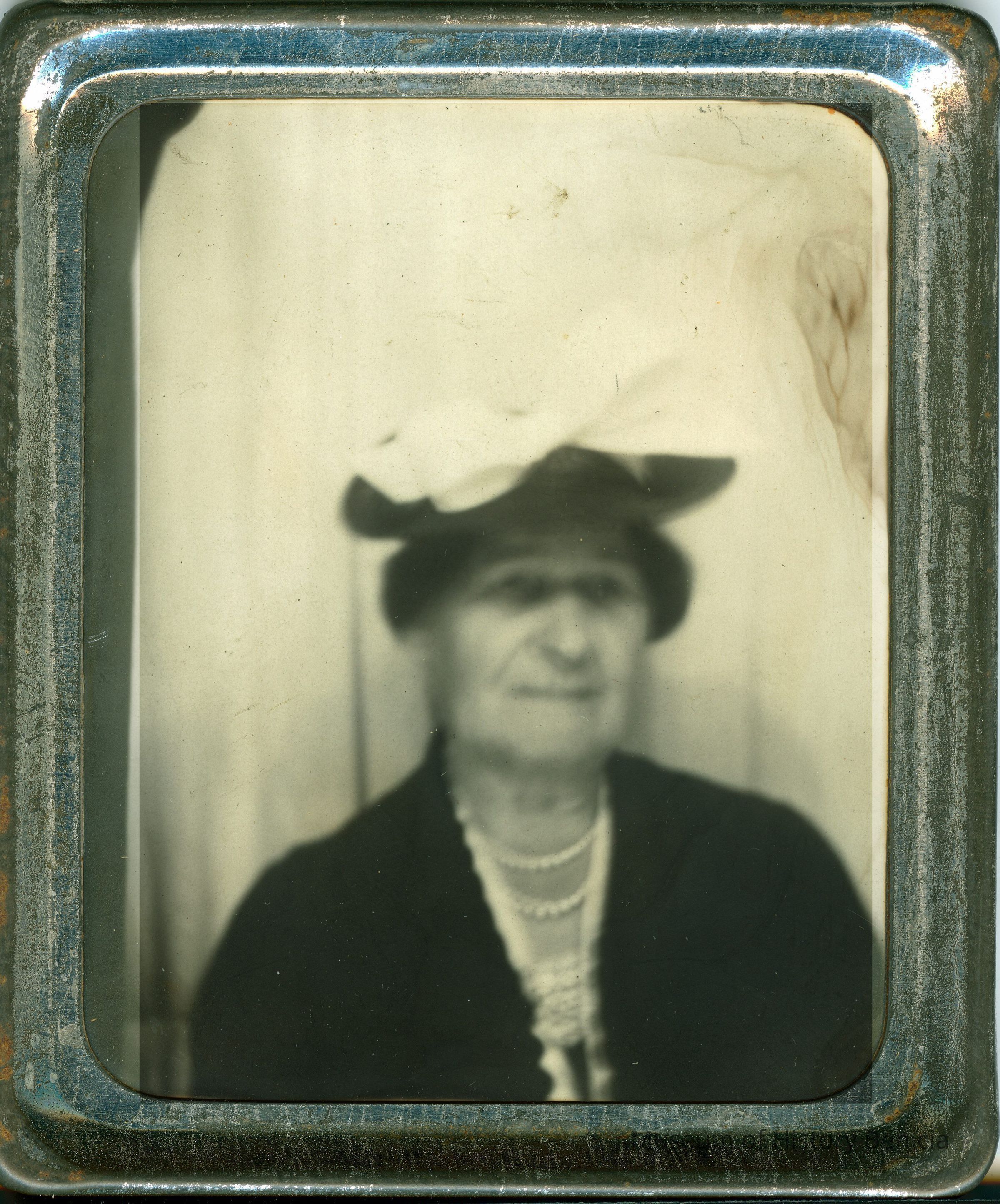
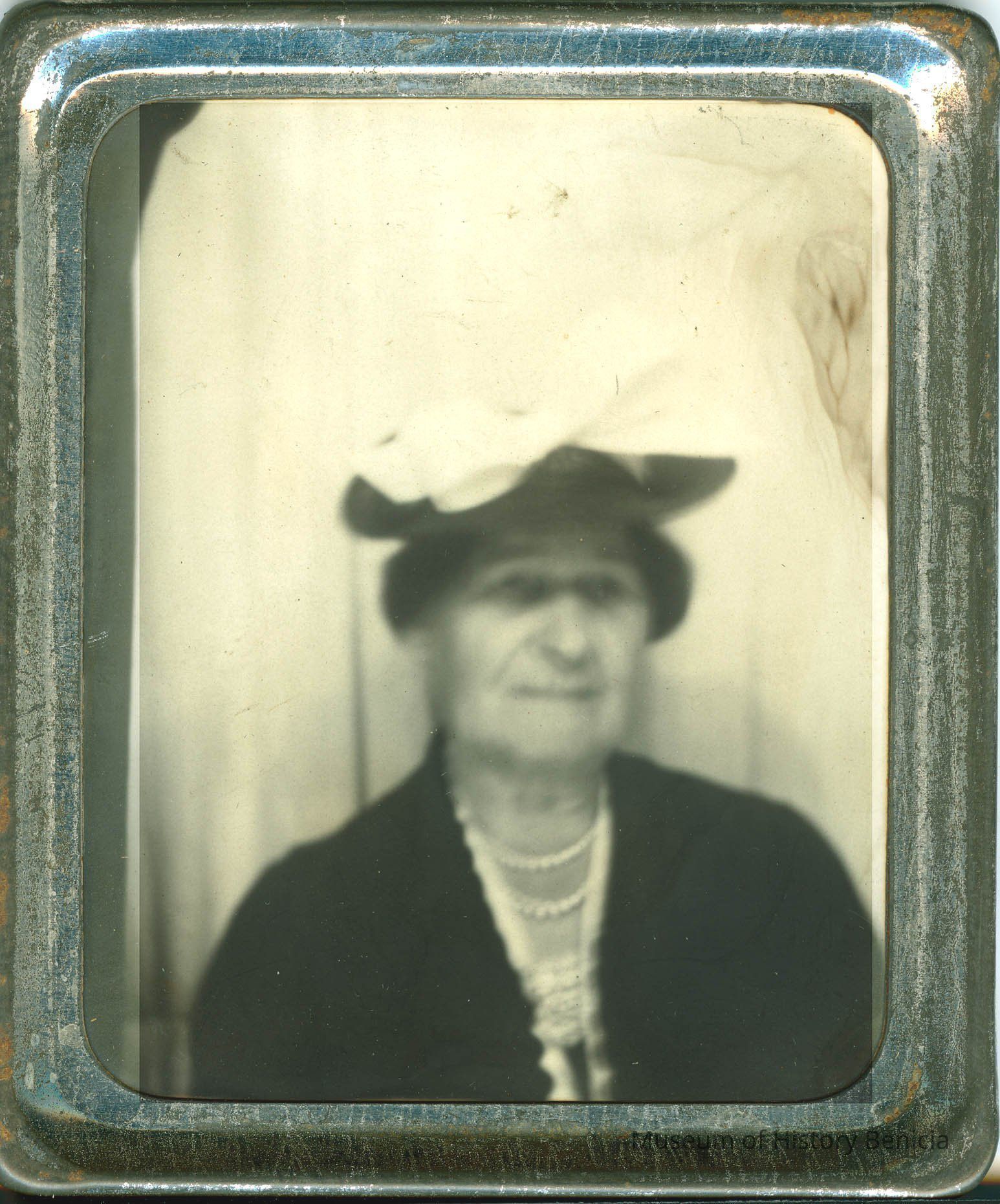
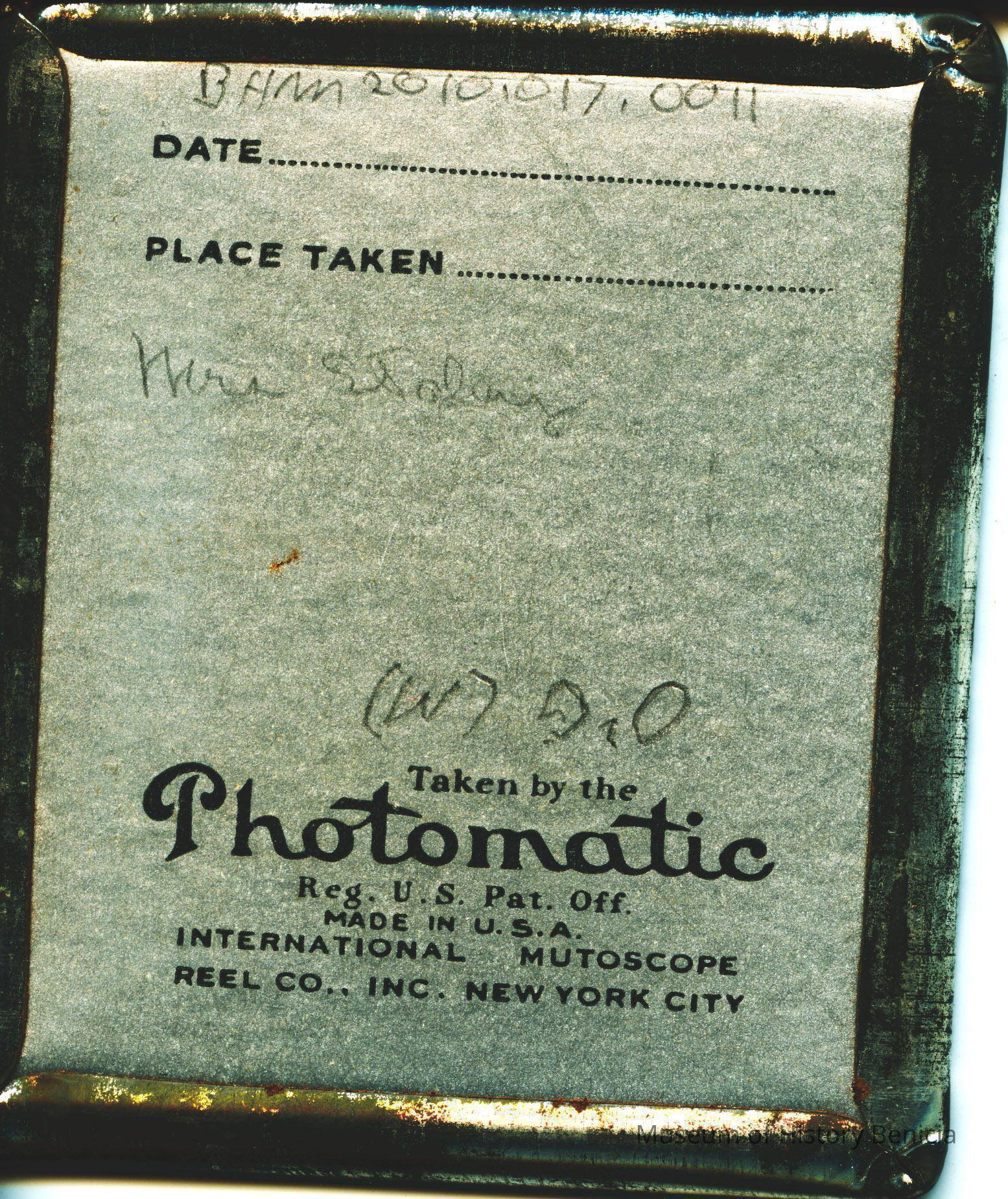
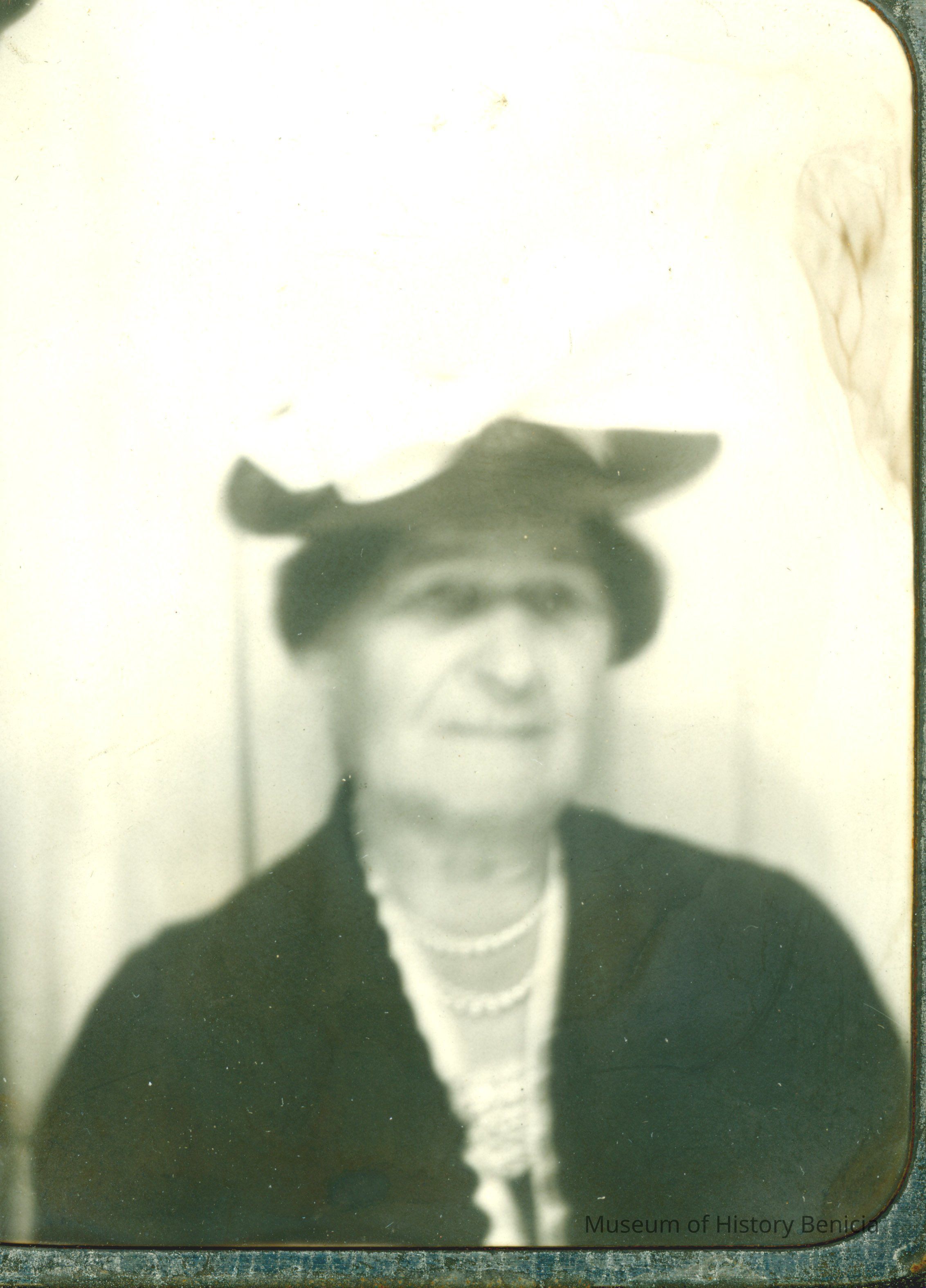
Photo of a woman in a metal frame. On the back is written Mrs Staley(?). On back the name Mrs Staley is written. There was a Staley family in Benicia. He was mayor at one time. Per Harry Wassmann.
This photo on the back identifies the company as Photomatic. Made in USA by the Mutoscope Reel Co. Inc New York City.
The Mutoscope company made the reels for arcade machines that flipped photos by the viewer to simulate motion. In late 1930's the also had photo booth machines to let people take their own photo. This was popular at the 1939 New York World's Fair.
This type of photograph was taken from a photo booth. Usually these were located in old arcades, in old Amusement Parks, on Boardwalks, and other popular amusement locations.
The "PhotoMatic" Photo Machines
May 1st, 2004
In the 1930s a company called the International Mutoscope and Reel Company of New York City, a manufacturer of penny arcade games, nickelodeons, weight and fortune dispensers, and other coin-operated entertainment devices, developed a machine capable of taking a photograph and dispensing a black & white print in just a few minutes time. The machine was called a "Photomatic", and they were frequently installed at larger railroad passenger stations, where for fifteen cents departing friends or family members could make a farewell portrait on-the-spot.
The Photomatic machines used a wet photo developing process similar to what would have been used by a conventional photographer at that time. Basically, the Photomatic machine took a picture with a built-in camera, then a motor driven mechanism took the photo frame, which had photographic paper attached to it, through a series of chemical and water baths that developed the photograph. This explains the tray-like shape of the Photomatic photo frames. Photomatic photographs can be found today imprinted with advertising for the New Haven and other railroads. All items from the collection of Marc Frattasio.
Type of the machine : Photo Booth
Photomatic Deluxe © 1936 International Mutoscope Reel Co., Inc.
The mutoscope was an early form of motion picture device. Like Edison's kinetoscope it did not project on a screen, and provided viewing to only one person at a time. Cheaper and simpler than the kinetoscope, it quickly dominated the coin-in-the-slot "peep-show" business.
The mutoscope worked on the same principle as the "flip book." The individual image frames were conventional black-and-white, silver-based photographic prints on tough, flexible opaque cards. Rather than being bound into a booklet, the cards were attached to a circular reel, rather like a huge Rolodex. A reel typically held about 850 cards, giving a viewing time of about a minute. The reel with cards attached had a total diameter of about ten inches (25 cm); the individual cards had dimensions of about 2-3/4" x 1-7/8" (7 cm x 4.75 cm).
Mutoscopes were originally manufactured from 1895 to 1909 by the American Mutoscope and Biograph Company, then revived and manufactured from 1926 until 1949 by the International Mutoscope Reel Company (a completely different organization which purchased the manufacturing rights).
The International Mutoscope Reel Company also produced coin-operated self-portrait "Photomatic" booths as early as the 1930s.
What you have there is picture taken in a Photomatic Photobooth. Sometimes the photos had writing on the back saying "photomatic" and the location where the photomatic booth was placed.
Here's link to a site with excellent information on the photomatics.
"In the 1930s a company called the International Mutoscope and Reel Company of New York City, a manufacturer of penny arcade games, nickelodeons, weight and fortune dispensers, and other coin-operated entertainment devices, developed a machine capable of taking a photograph and dispensing a black & white print in just a few minutes time. The machine was called a "Photomatic", and they were frequently installed at larger railroad passenger stations, where for fifteen cents departing friends or family members could make a farewell portrait on-the-spot."
The average price for a typical photomatic photograph is around ten dollars. The ones that get better prices have unusual subject matter, are from the worlds fair or railroad stations. The color of the metal frame can also affect the value. The higher priced photomatics can sell in the fifty dollar range. Your soldier should sell in the fifteen dollar range.Collection
Benicia Historical Museum Collection