Palestine Traditional Costume Map (2003)
Name/Title
"Palestine Traditional Costume Map" (2003)Entry/Object ID
2022.010Tags
On View, Map, Bayt wa BaladDescription
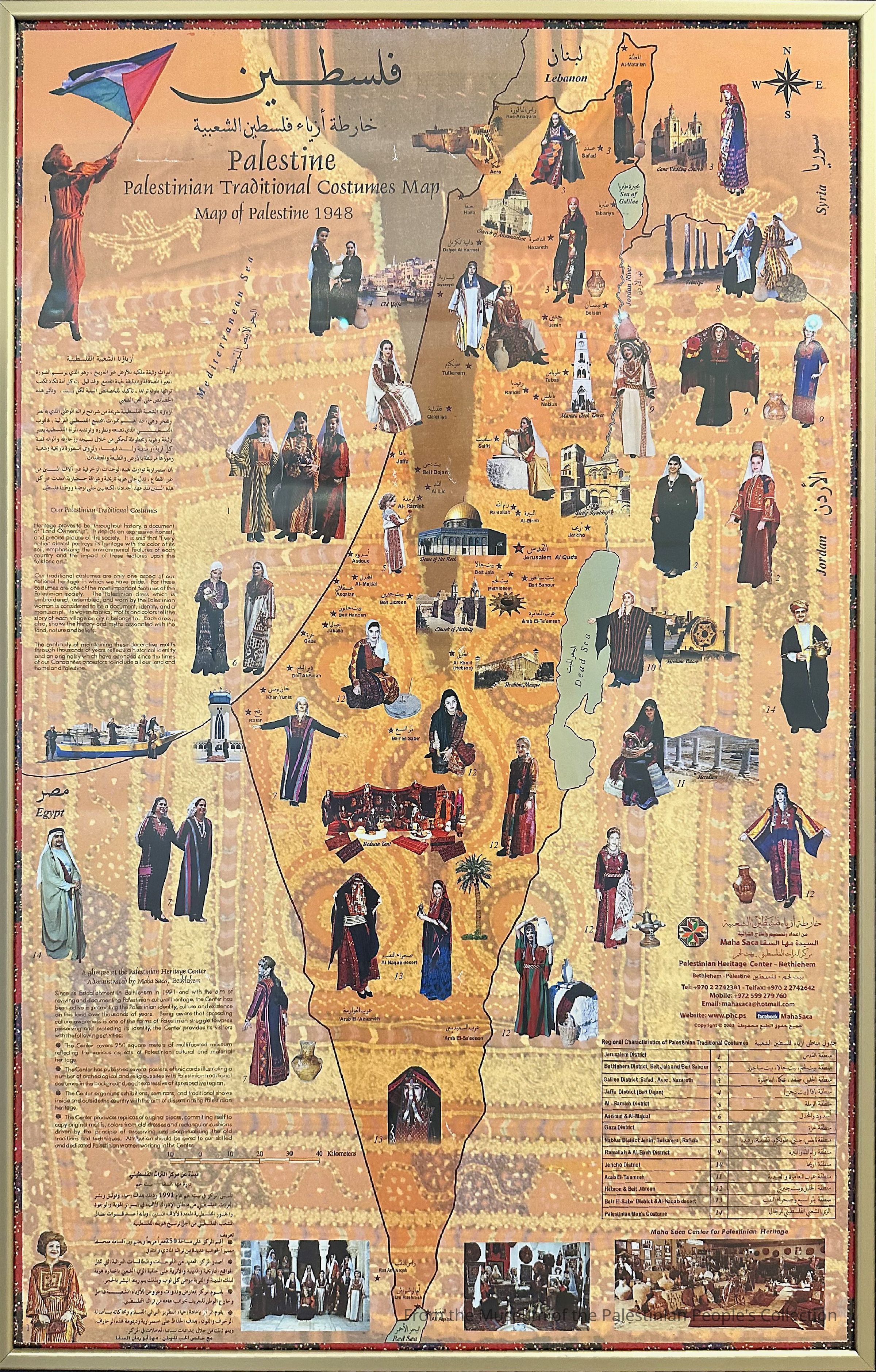
During the 1990s, Palestinian Heritage Center (PHC) produced and distributed materials illustrating regional dress traditions across historic Palestine prior to the 1948 Nakba, including maps, posters, and postcards. These educational materials circulated extensively throughout the Palestinian diaspora and became fixtures in homes, community spaces, and cultural institutions. This poster is entitled “Palestine, Palestinian Traditional Costumes Map, Map of Palestine 1948” and features images of Palestinian women and men modeling traditional dress positioned across the map, situating them within the village or region where each dress ensemble originated and was worn. The Bethlehem chest panel, where founder Maha Saca is from and where the center was established, is superimposed behind the map. On the left side of the map appears the following text in Arabic and English, transcribed below: “Our Palestinian Traditional Costumes: Heritage proves to be, throughout history, a document of “Land Ownership”. It depicts an expressive, honest, and precise picture of the society. It is said that “Every nation almost portrays its heritage with the color of its soil,” emphasizing the environmental features of each country and the impact of these factors upon the folklore arts. Our traditional costumes are only one aspect of our national heritage in which we have pride, for these costumes are one of the most important features of the Palestinian society. The Palestinian dress, which is embroidered, assembled, and woven by the Palestinian woman is considered to be a document, identity, and a manuscript. Its woven motifs and colors tell the story of each village or city it belongs to. Each dress, also, shows the history and myths associated with the land, nature and beliefs. The continuity of maintaining these decorative motifs through thousands of years reflects a historical identity and an originality which have extended since the times of our Canaanite ancestors to include all our land and homeland Palestine.” The PHC was established in 1991 in Bethlehem by Mrs. Maha Saca (also featured in the poster to the left carrying the flag), a pioneering figure in the preservation and documentation of Palestinian embroidery and dress traditions. The poster also shares the following about the center: “A glimpse at the Palestinian Heritage Center, Administrated by Maha Saca, Bethlehem: Since its Establishment in Bethlehem in 1991 and with the aim of reviving and documenting Palestinian cultural heritage, the Center has been active in promoting the Palestinian identity, culture and existence on this land over thousands of years. Being aware that spreading culture awareness is one of the forms of Palestinian struggle towards preserving and protecting its identity, the Center provides its visitors with the following activities: ● The Center covers 250 square meters of multifaceted museum reflecting the various aspects of Palestinian culture and material heritage ● The Center has published several posters, ethnic cards illustrating a number of archeological and religious sites with Palestinian traditional costumes in the background, each expressive of its respective region. ● The Center organizes exhibitions, seminars, and traditional shows inside and outside the country with the aim of disseminating Palestinian heritage. ● The Center produces replicas of original pieces, committing itself to copy original motifs, colors form old dresses and rectangular cushions driven by the principle of preserving and perpetualising the old traditions and techniques. Attribution should be owed to our skilled and dedicated Palestinian women working in the Center.” Through decades of research dedicated to the origins, meanings, and regional variations of Palestinian clothing, Saca positioned PHC as a leading institution in the safeguarding of Palestinian material heritage. In collaboration with her daughter, Iman Saca, she co-authored “Embroidering Identities: A Century of Palestinian Clothing” (2016, Oriental Institute Museum Publications), a foundational scholarly resource on the subject. Through both research and dissemination, PHC played a significant role in shaping contemporary understandings of Palestinian dress heritage.Collection
Permanent CollectionCataloged By
Wafa GhnaimCategory
Posters