Stone from the Killing of 12-year-old Mohammad Al Durrah (2000)
Summary image
Compiled by Wafa Ghnaim
Name/Title
Stone from the Killing of 12-year-old Mohammad Al Durrah (2000)Entry/Object ID
2020.901Tags
On View, Graphic ViolenceDescription
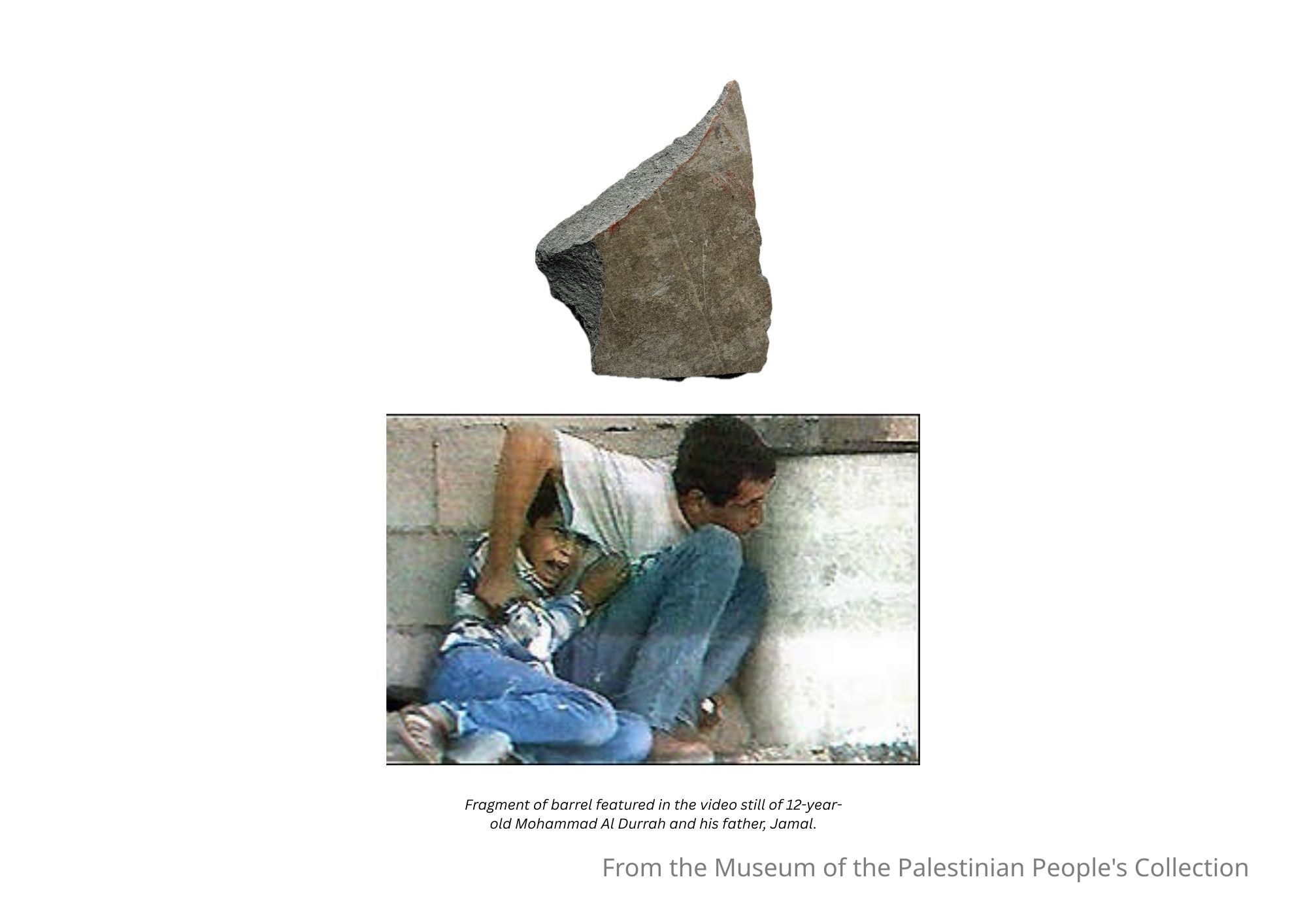
On 30 September 2000, the second day of the Second Intifada, a period of widespread protests, unrest, and violent clashes across the Palestinian territorie, the world was forever changed by a horrific moment captured on camera in the Netzarim Junction area of the Gaza Strip. At the center of that moment were Jamal al-Durrah and his 12-year-old son, Mohammad. A Palestinian freelance television cameraman from Gaza, Talal Abu Rahma, working with the French public television network France 2, was positioned nearby when a clash erupted between Israeli military forces and Palestinian fighters and demonstrators. Amid the exchange of gunfire, Jamal and his young son became pinned down behind a concrete cylinder or barrel that offered scant cover from the bullets. Abu Rahma’s camera recorded the scene. In the footage later broadcast around the world, the boy can be seen screaming in terror while the father crouches over him, desperately trying to protect him with his own body. At one point, Jamal appears to shout toward the camera and then turns to gesticulate toward the nearby Israeli military position, seemingly imploring them to stop firing. Then came a sudden burst of heavy gunfire. The image on the screen goes momentarily blurry as dust and smoke fill the frame. When the camera refocuses seconds later, Jamal is seated upright, wounded, and his son lies lifeless across his legs. The boy’s small hands are shown covering his face; as they fall away, the footage shows that he was killed. France 2 aired 59 seconds of this footage that evening with a voice-over by bureau chief Charles Enderlin, who reported that father and son had been targeted by fire from the Israeli military and that Mohammad was tragically killed in his father’s arms. The killing of Muhammad al-Durrah and the wounding of his father Jamal became one of the most defining and painful symbols of life under Israeli military occupation. Unlike many moments of Palestinian suffering that remain undocumented, this killing was filmed in real time, witnessed by the world, and described by multiple eyewitnesses who were physically present at Netzarim Junction. The image of a child sheltering behind his father, raising his elbow to shield his face in his final living moments, became a universal visual statement on the vulnerability and horror Palestinian families face everyday under illegal Israeli military occupation. Despite the existence of video evidence—despite the cameraman, the broadcaster, the father who survived, and independent witnesses all confirming that Israeli soldiers fired the shots—Israel has repeatedly denied responsibility. This denial began immediately and has continued for decades. Instead of acknowledging the killing of an unarmed child, Israeli officials attempted to challenge the footage, question angles, propose alternative shooters, and even suggest fabrication. The denials intensified long after the world had already seen Muhammad's murder, revealing the extent to which state power can work to erase Palestinian life and testimony and undermine even the most documented global truths. The day after the killing, donor Tom Getman stood at the site and watched the Israeli forces destroy physical evidence. He collected part of the ruptured barrel behind which the father and son had taken shelter before it was removed. That fragment, preserved in the museum, stands as evidence at the scene of Mohammad's tragic killing.Collection
Permanent CollectionCataloged By
Wafa GhnaimCategory
Ethnographic Collection