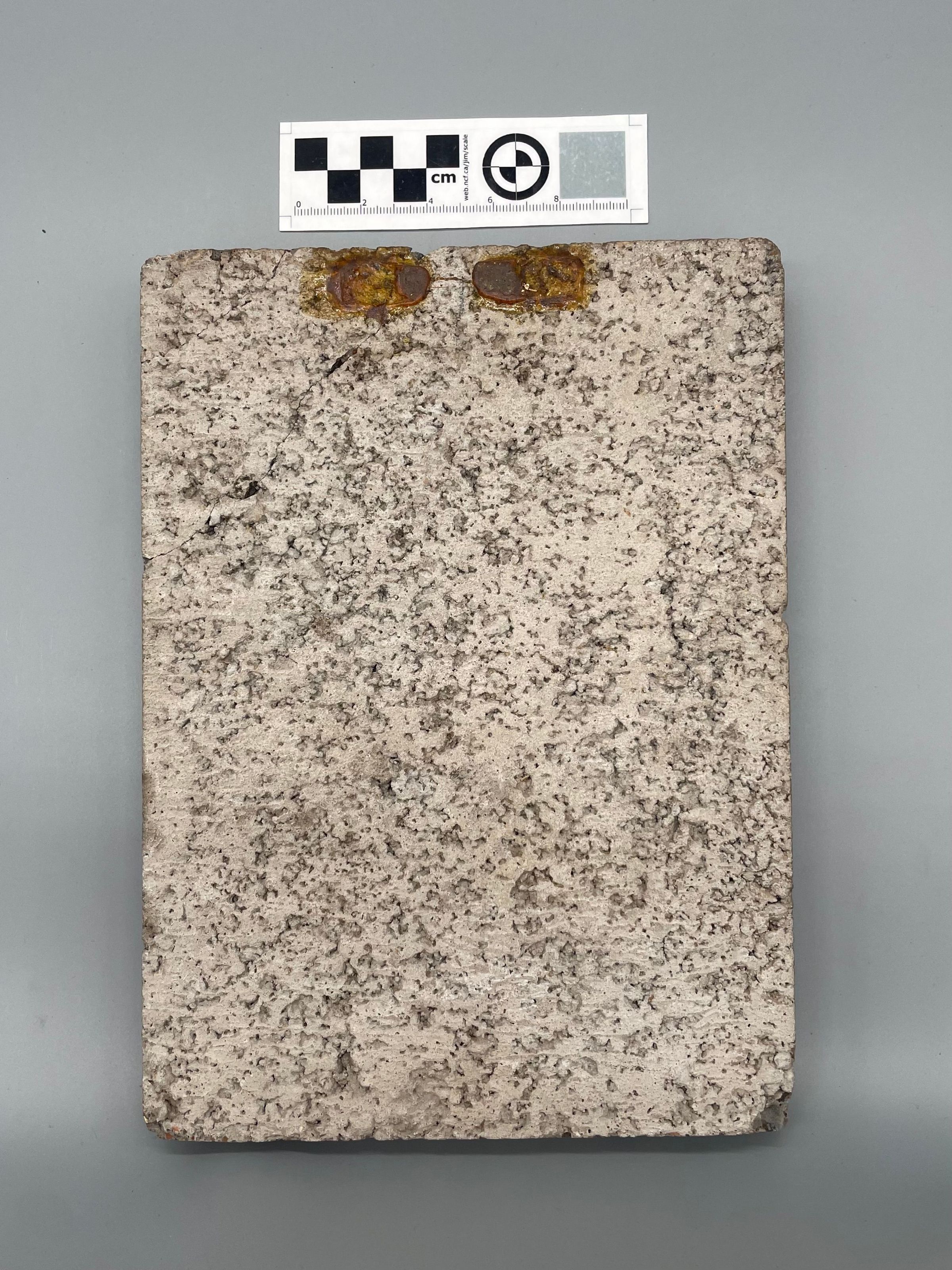
Front of HPB / Expanded Shale Institute commemorative plaque
Front of a grey, brown, and gold commemorative plaque, with gold lettering and showing some scratches on the plaque's surface.
Name/Title
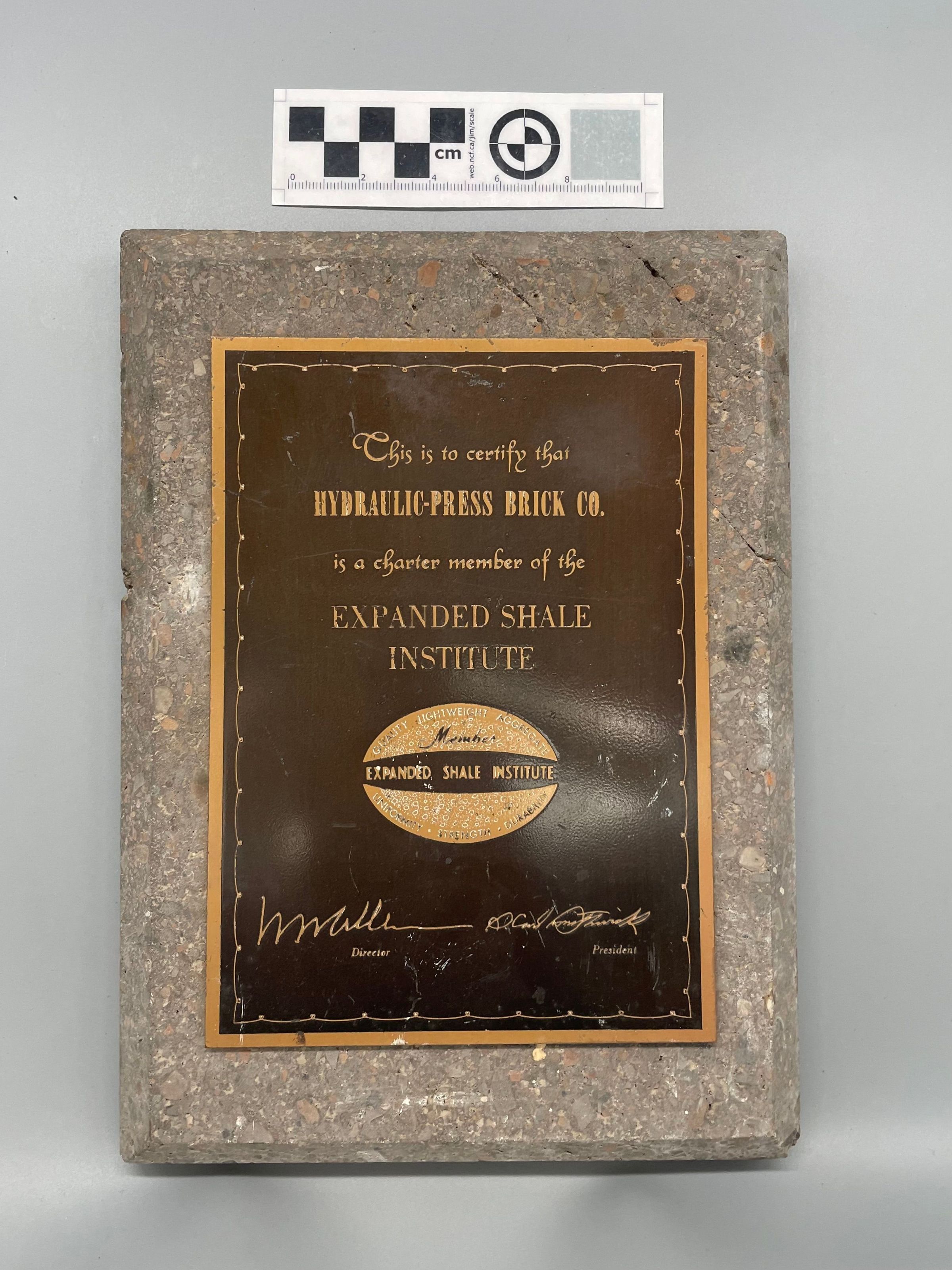
Hydraulic-Press Brick Co. / Expanded Shale Institute commemorative plaque
Description
A grayish, speckled concrete/shale sheet with a brown and gold metal plaque affixed, with gold lettering denoting the membership of the Hydraulic-Press Brick Co. with the Expanded Shale Institute (later the Expanded Shale Clay and Slate Institute), and the signatures of the president and director of the Expanded Shale Institute.
Use
Promotional object, used to commemorate the certification of the Hydraulic-Press Brick Co. as a charter member of the Expanded Shale Institute.
Collection
Promotional object displays
Made/Created
Date made
circa 1952
Time Period
20th Century
Notes
The Expanded Shale Clay and Slate Institute was formed in the spring of 1952, and HPB is a "charter member" that joined the institute in a meeting that established the institute as a functional non-profit. Thus, it can be assumed that this plaque was manufactured sometime in early 1952 and then presented to HPB at, or directly after, that spring 1952 meeting.
Lexicon
Nomenclature 4.0
Nomenclature Primary Object Term
Plaque
Nomenclature Sub-Class
Organizational Objects
Nomenclature Class
Ceremonial Objects
Nomenclature Category
Category 08: Communication Objects
Getty AAT
Concept
terrazzo
LOC Thesaurus for Graphic Materials
Concrete products industry
Dimensions
Height
17.5 cm
Width
24.3 cm
Depth
2.6 cm
Parts
Count
1
Parts
Plaque
Materials
Material
Terrazzo, Metal
Material Notes
May not be terrazzo exactly, but the body of the plaque is made of some kind of concrete with stone or slate pieces mixed throughout. The brown plaque in the middle is made of metal.
Color
Gray, Gold, Brown
Condition
Overall Condition
Good
Condition Type
Chip / Chipping, Scratch, Adhesive Residue
Date Examined
Jul 22, 2026
Examined By
Elena Marshall
Surface
In good condition, but the concrete body of the plaque has a few chips on the corners, while the brown metal plaque in the middle has some scratches. The back of the plaque has two spots at the top where there is some yellowed, resinous adhesive that has hardened and stuck to the concrete material of the plaque.
(See Made/Created) "In the Spring of 1952, acting on the invitation of a producer active in the field, expanded shale producers from the United States and Canada met in St. Louis to discuss a plan to form an organization of producers. The meeting resulted in the formation of the Expanded Shale Clay and Slate Institute as a non-profit, technical organization supported by the producers of expanded shale, clay or slate by the rotary kiln process" (Page 12).