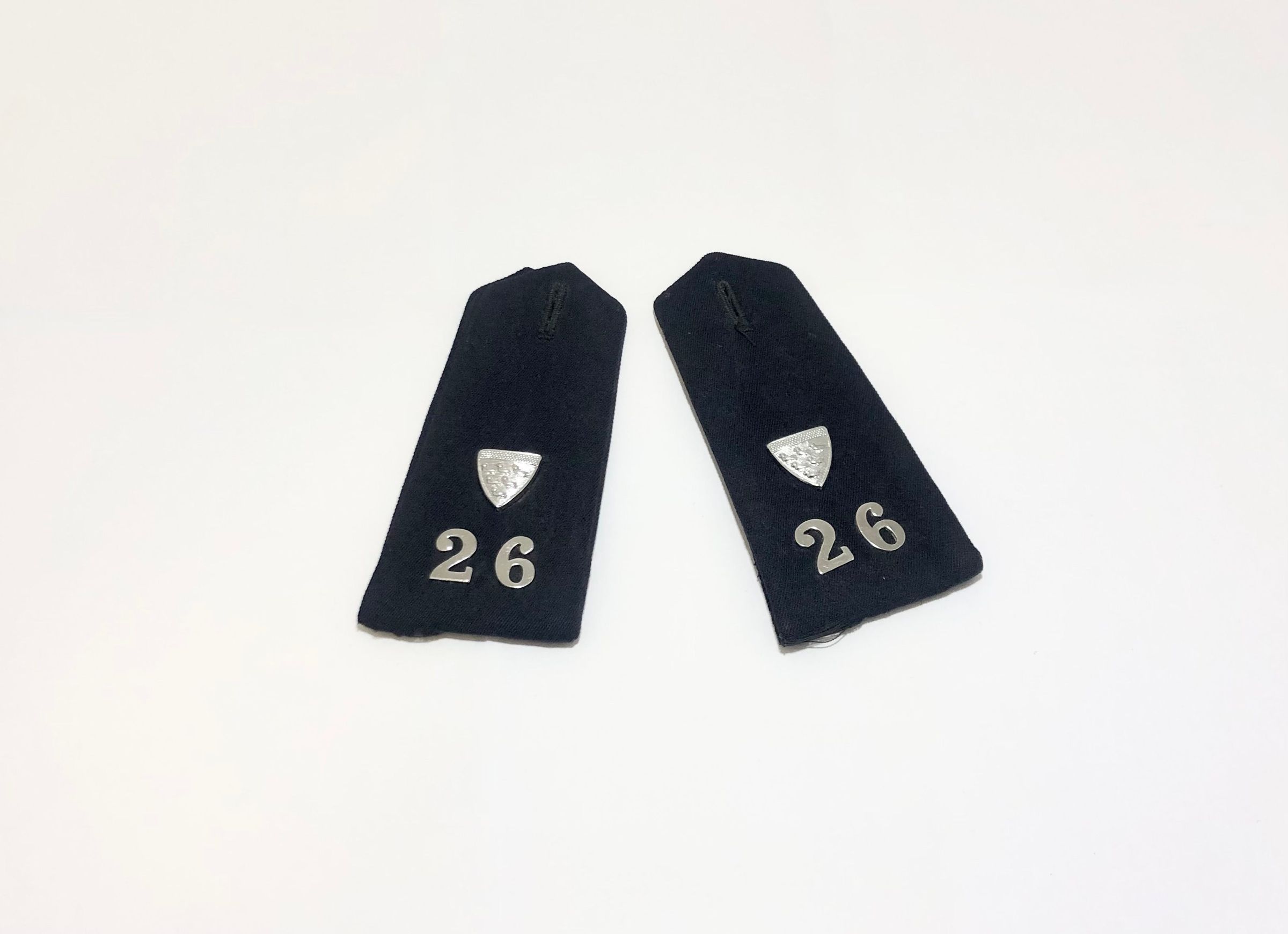
Name/Title
A pair of West Sussex Constabulary epaulettes c1957 - 1967Entry/Object ID
2446Description
A pair of blue/black lightweight cotton epaulettes, with chrome plated metal numbers "26" and West Sussex Constabulary shield badges displaying six Martlets within a shield.Use
For displaying an officer's number on a shirt.Context
Until the 1950's standard police uniform for constables and sergeants consisted of a high necked tunic, though the actual styles and cuts of the tunics varied between police forces. The officer's number was displayed on the collar, as had been the case for the very first Metropolitan Police officers in 1829. This is where the term collar number comes from, a term often used for an officer's number even after the adoption of open necked tunics.
In the 1950's police forces began to adopt open necked tunics, West Sussex Constabulary doing so in March 1950 (Barrett 2008 page 198). This necessitated the wearing of a shirt with a collar for sergeants and constables, which for the first time gave a smart enough appearance for officers to not have to wear tunics in the summer. However epaulettes were needed to display an officer's number when just wearing a shirt, what is referred to as "shirt sleeve order". Removable epaulettes were also used to attach numbers to raincoats, though they were not needed for tunics which had fixed epaulettes. Interestingly even after the introduction of open necked tunics, some police forces did not allow officers to dispense with tunics in the summer for some time to come. West Sussex Constabulary, for instance only allowed officers to dispense with tunics during the summer in 1957, seven years after the open necked tunics were adopted. At least one photograph (Barrett 2008 page 266) from this period suggests, that to begin with shirt epaulettes were not worn, possibly because neither suitable shirts or epaulettes had been issued.
These particular epaulettes have the officer's number "26" on them and are clearly identified as coming from West Sussex Constabulary by the use of the West Sussex County coat of arms badge, a shield with six Martlet birds. This style of small shield badge was first used by the chief constable from 1912 to 1934 Captain Arthur Williams on the collar of his tunic, although they were not used on any other uniforms, the force instead using the letters "WS" to signify West Sussex, on tunic collars and later tunic epaulettes. Only when open necked tunics were introduced in 1950, were these badges widely used. They were placed on the tunic lapels because the old "WS" letters were removed from the tunic epaulettes to allow room for officer's numbers which had previously been worn on the collars.
The epaulettes pictured were believed to have been issued to ex West Sussex Constabulary officer Sam "Jimmy" James, who went onto serve in Sussex Constabulary and Sussex Police, retiring as a sergeant at Midhurst in 1976. The lack of sergeant's insignia indicates he would have used them as a constable. However the 1967/68 Sussex Constabulary Disposition document shows his West Sussex Constabulary number as being "76", and number "26' was in fact an officer from Chichester by the name of Briggs.
Officers in Sussex Police still used epaulettes with metal numbers and rank insignia until the 1990s when they were replaced with embroidered ones.