Name/Title
A single chief superintendent's epaulette c1953 - 1974Entry/Object ID
893Description
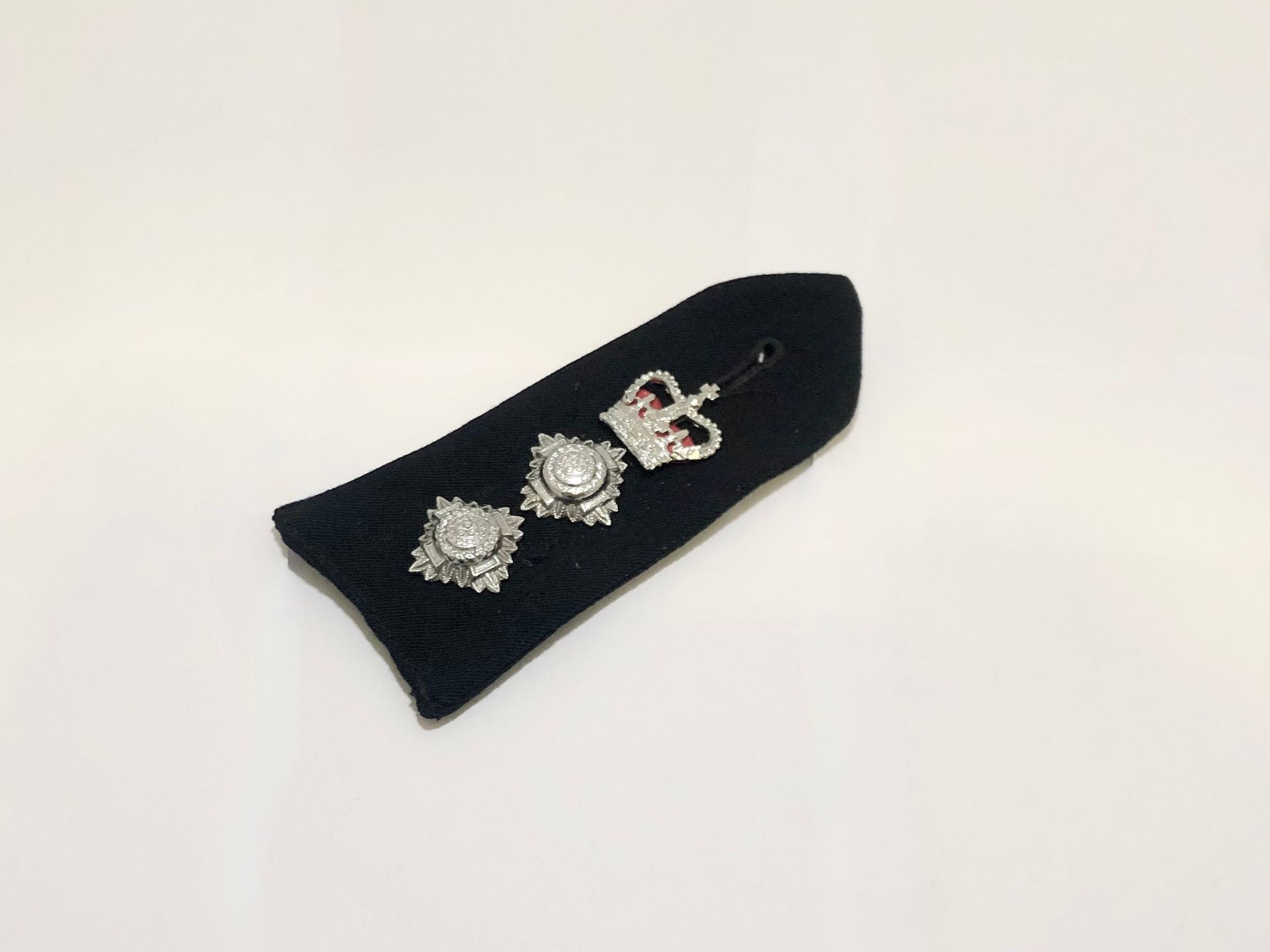
A single blue cotton epaulette with a chrome plated Queen's Crown with a red enamel insert, and two chrome plated Bath Stars, and no fixing button. The end appears to have been tailored into a curve, suggesting it may have been reduced in size. See general notes re this item.Use
For a chief superintendent or superintendent grade one, to wear on a shirt or other garmentContext
The use of shirt epaulettes for constables and sergeants only began from the late 1940s and early 1950s when police forces began to use open necked tunics, thus allowing them to wear proper collared shirts, and the possibility of not always having to wear a tunic.
More senior officers had been wearing open necked tunics much longer and would have needed epaulettes to denote their rank when not wearing a tunic. However in the past this would have been rare and confined to inside buildings. So called shirt sleeve order only became common once all ranks were wearing open necked tunics and, even then was confined to the summer months.
Detachable epaulettes were also used on outer garments to show rank and warrant numbers, such as raincoats and overcoats
This particular epaulette has been tailored at one end and is a large example, which may indicate that it was intended for an outer garment other than a shirt. It has a Queen's Crown which dates it from 1952 onwards. The rank insignia of a crown and Bath Star designates a chief superintendent from 1953 to 1974.
Between these dates there were two grades of superintendent. Grade ones used the insignia of a crown and Bath Star and grade twos just a crown. At this time a chief superintendent used the insignia of a crown and two Bath Stars. After 1974 the rank of superintendent grade one was abolished and a crown was used to designate a superintendent, and a crown and single Bath Star to designate a chief superintendent.
This example is thought to have been used somewhere in Sussex as it was donated by an ex Sussex Police officer. Prior to the 1968 amalgamation there were only seven chief superintendent's across all of the Sussex police forces and after there were only twelve within the new Sussex Constabulary (Sussex Police Forces Amalgamation Memorandum). Metal insignia and numbers on epaulettes was common in Sussex Police until they were replaced by embroidered ones in the mid 1990s