Name/Title
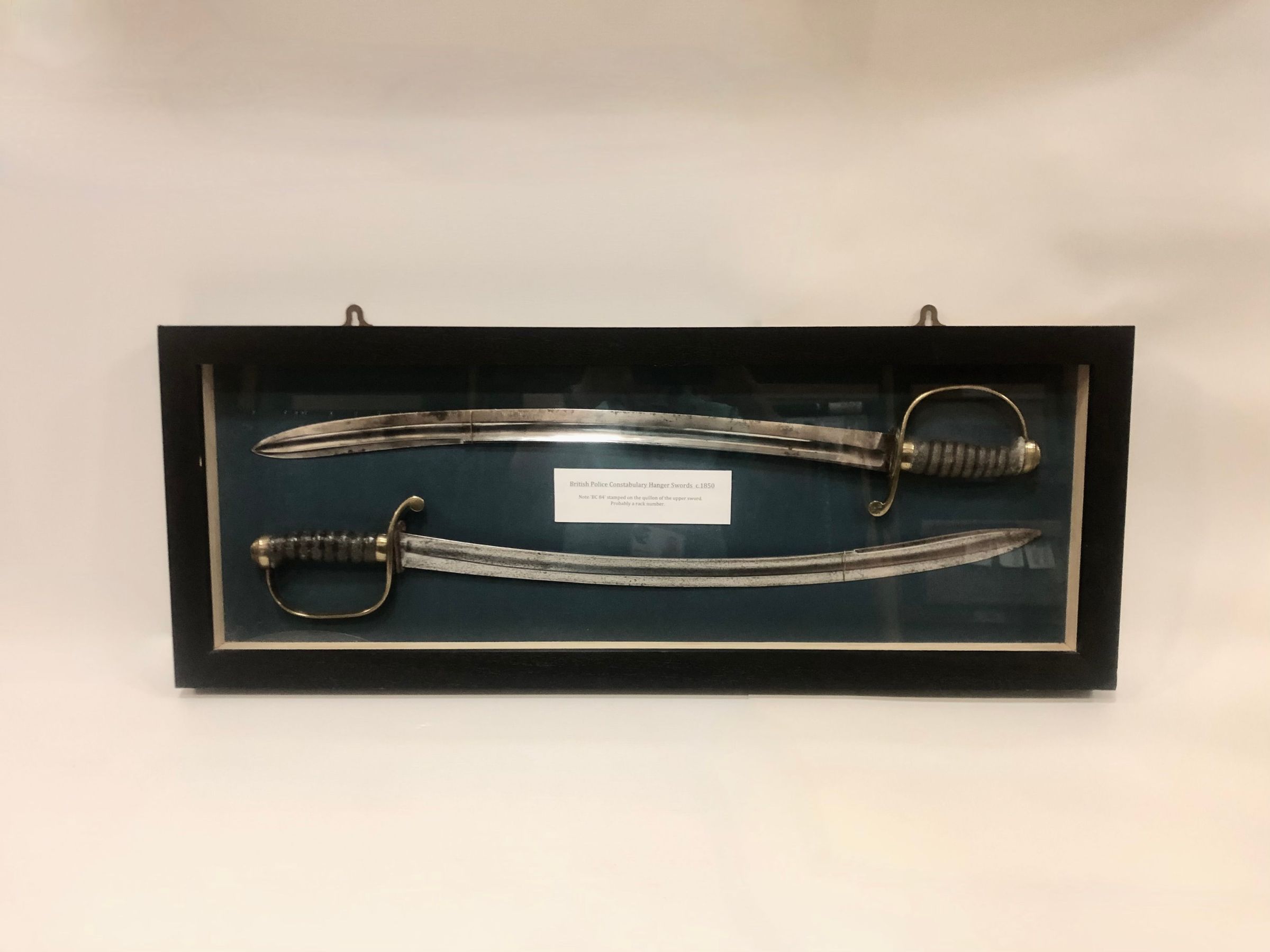
A wall mounted display case containing a pair of Victorian police "Hanger" swords c1850Entry/Object ID
2481Description
A large modern style wooden sealed display case with wall mountings, containing two Victorian police style swords, each with steel curved blades, brass hilts and shagreen covered grips. The upper sword is approximately 28 inches in length and is stamped on the quillion (the flat piece with a scroll at the bottom of the hilt) "BC 84". The lower sword is slightly longer, approximately 29 inches, and has no markings. There is a printed display card marked "British Police Constabulary Hanger Swords c1850 Note the "BC 84 stamped on the quillion of the upper sword. Probably a rack number". Size of case 86.5 x 33.2 cm.Use
For a Victorian police officer to carry for protection.Context
Victorian police officers not only carried wooden truncheons but also had limited access to both swords and occasionally firearms. Swords were issued in some areas for night duty or during times of public disorder and most police forces would have stocks of them for such use, though officers would not routinely carry them. The type of sword used was to a standard design, having a short slightly curved blade and a brass hilt, which was either "D" shaped or straight. These swords are normally called "Hangers" or "cutlasses" and were carried in leather scabbard's with metal mounts at both ends. Often they were marked to identify the police force they came from, in some cases the blade actually being etched. Later examples from the 1850s and 1860s tend to have spring catches attached to the hilts to prevent swords being removed from the scabbard's during a disturbance by anyone other than the officer. Short "hanger" swords were also used by prison officers, and customs officials but they are most commonly associated with the police. By the 1880s most UK police forces had stopped using swords.
Nothing is known about the origins of these particular swords which are not a true pair, one being shorter than the other. However very similar swords would have been used throughout the old police forces in Sussex throughout much of the 19th century. One of them is marked "BC 84", the number most likely being an asset number. The "BC" probably relates to the organisation that owned them and in a police context "C" would normally be short for "Constabulary" and the number "84" could indicate a reasonably large police force. It is not thought that these came from Brighton Borough Police, as it was not normally referred to by the term "constabulary". A possible contender is Bristol Constabulary, which was a particularly large Victorian police force. A number of swords from Bristol are known of, most being of the straight hilt design, but to date none have been found marked "BC", so the identity of the stamped one here is still a mystery.
Neither of these swords have spring retaining catches, indicating that they may be earlier rather than later in date. There is some debate as to when catches when generally fitted, some references being to after c1850, though it is known that the Metropolitan Police were retro fitting swords as late as 1867 (Wilkinson 2002 page 171). As mentioned above these swords would originally have had leather scabbard's with metal mounts.