Name/Title
Air Raid Precaution whistle c1938 - 1945Entry/Object ID
686Description
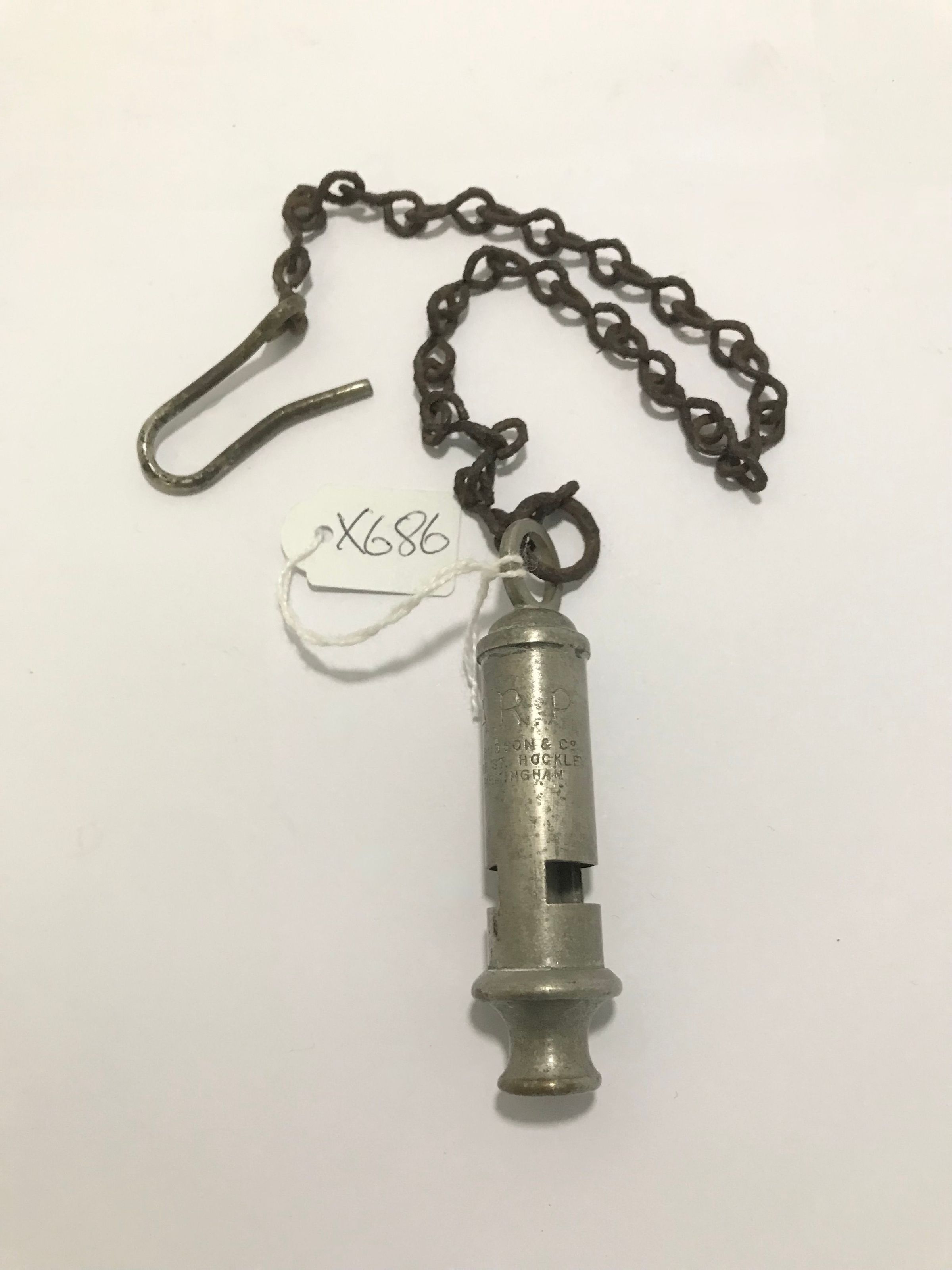
Nickel plated brass whistle with top loop and mouthpiece, marked "ARP' J Hudson & Co, Barr St. Hockley, Birmingham'. Attached to the top loop is a rusty whistle chain with button hook.Use
To raise the alarm in an emergencyContext
In 1938 as part of the on going civil defence preparations in case of war, the Home Office contracted the Birmingham whistle makers J. Hudson & Co. to produce whistles for Air Raid Precautions staff. Like other equipment for civil defence these whistles were marked "A.R.P.". By June 1939 some 221,000 had been procured, but a decision to issue them personally to all wardens required an additional 240,000. Whistles continued to be supplied throughout the war for use by all of the civil defence staff, not just the Air Raid Wardens. Most were manufactured by Hudson's but others made by another company Adie Brothers, although it was only the Hudson ones that were marked A.R.P.
Normally whistles marked to specific organisations are relatively scarce and sometimes very rare, with the one exception of A.R.P examples, because of the huge numbers made. Not surprisingly both during and after the war many found themselves being used by police forces to equip their officers. In fact it is believed that in June 1939, 73,000 of the original procurement of 221,000, were allocated by the Home Office to Police Constabulary Services. Given that local police chief constables were responsible for organising ARP services in their areas, it may be that these whistles were for ARP use. Alternatively it could be that they were for the police to issue to the large number of War Reserve and Special Constables that would need to be recruited should war break out. In either case many ARP whistles ended up being used by police officers.
This particular whistle has a whistle chain with a button hook as used by the police. When initially purchased these whistles did not have chains and were intended to be carried in pockets of civil defence staff as no uniforms were available. Later on in the war when boiler suits were issued, they were attached to corded lanyards. The fact that this whistle has a chain, suggests it may have been used by the police either during or after the war.