Name/Title
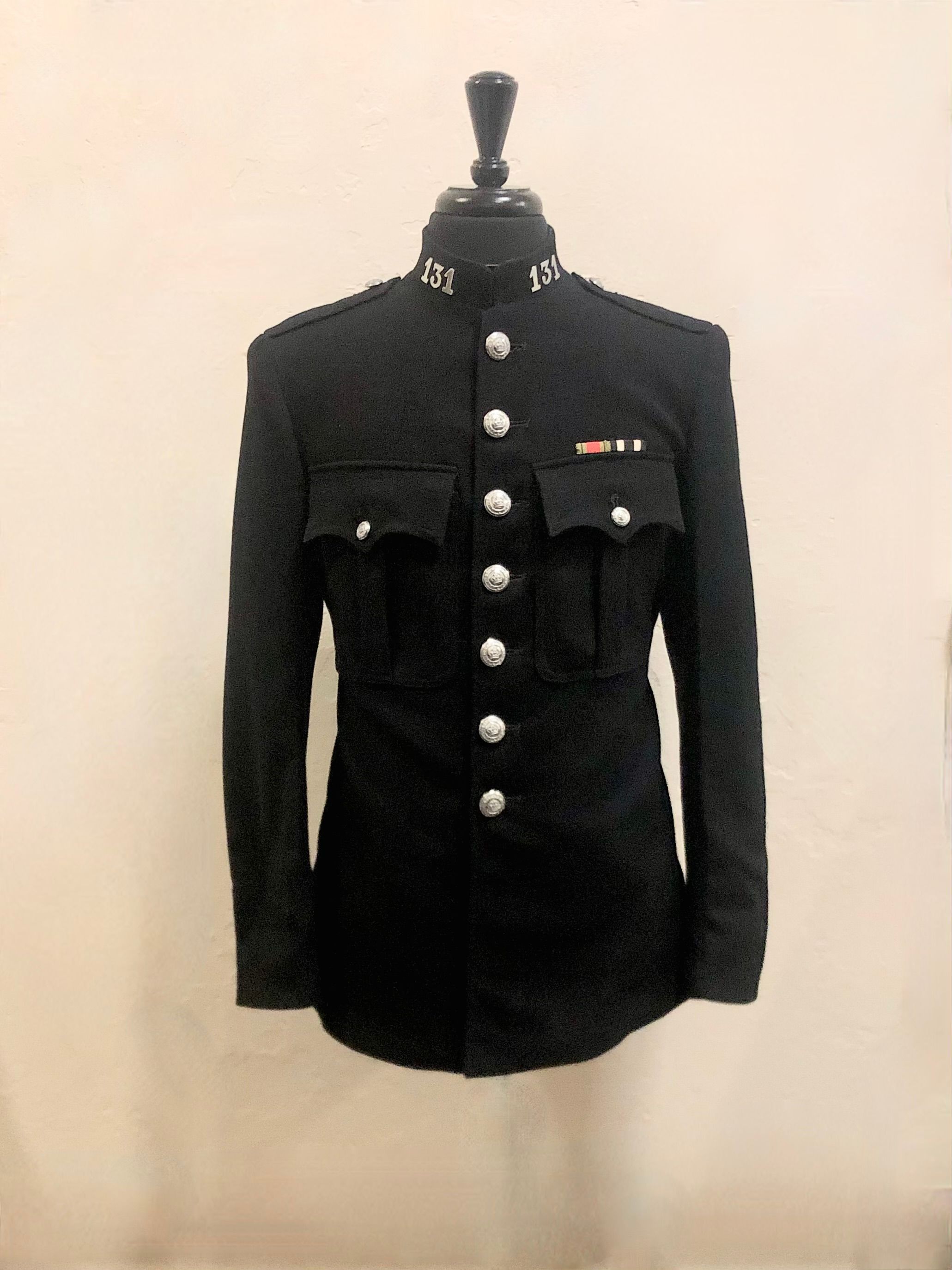
Brighton Borough Police closed neck constable's tunic c1950Entry/Object ID
15Description
Black wool constable's tunic with closed high collar, seven chrome plated buttons to the front, two breast pockets with small buttons and two small button fastened plain epaulettes on the shoulders. All buttons are marked "Brighton Police" with a King's crown. On each side of the collar are the metal chrome plated numbers "131". Over the left breast pocket are two medal ribbons, one for the World War Two Defence Medal and the other for what appears to be the Service Medal of the Order of St John. There is a maker's blue paper label attached to the inside marked "John Hammond & Co. (1922) Ltd., Newcastle Staffs. 107 Brighton Borough Police Constable". Handwritten on this are a number of sizes as well as "131 Burrows".Use
For a Brighton Police constable to wear before the introduction of open necked tunicsContext
Open necked police tunics for constables and sergeants were only introduced in the UK in the late 1940s and early 1950s, and prior to that closed high necked versions were used, normally with the officer's number displayed on the collar, hence the term "collar number" when referring to police warrant or ID numbers.
Tunics with two breast pockets and a closed neck were used by Brighton Police, with some variation from the late 19th century until 1952, when open necked ones were brought in at the same time that white helmets were reintroduced in the force. The earlier versions had five buttons, and seven buttoned tunics such as this were introduced in Brighton and throughout much of the rest of the country in the mid to late 1930s. Similar tunics with seven buttons tended to replace earlier styles with fewer buttons, as well as the unpocketed Victorian style tunics that in many police forces had been retained for night and winter use.
This tunic has buttons with a King's Crown, dating them to pre 1952 and the numbers on the collar and inside label, identify it as having been issued to PC 131 Burrows. When open necked tunics were introduced many police forces continued to use closed neck examples like this for night duty well into the 1950s. From 1933 to 1939 at least some Brighton Police tunics had special internal pockets designed to carry the personal radios then in use. This one does not.
This tunic has a matching pair of trousers (item 15.2).
The Defence Medal ribbon indicates that the officer was engaged in some form of war service 1939 - 1945, most likely as a serving police officer, though the medal was also awarded to other civilian services as well as non-operational military personnel. The St. John's Ambulance Medal ribbon shows that he was first aid trained and affiliated with the Order of St John. The various Sussex police forces were keen participants in first aid competitions including the the PIM Trophy, the national police first aid competition, and it was won by Sussex forces on several occasions.
PC 131 Burrows does not appear in the final role of Brighton Police in 1967, indicating that by then he had left the Borough Force, probably on retirement. He does however appear in the list of officers prepared for the 1938 centenary booklet, listed as "P.C. 131 J. Burrows". The museum also has another of PC Burrow's tunics, with Queen's crown buttons and missing collar numbers.