Name/Title
Brighton Borough Police pocket radio 1933 - 1939Entry/Object ID
73Description
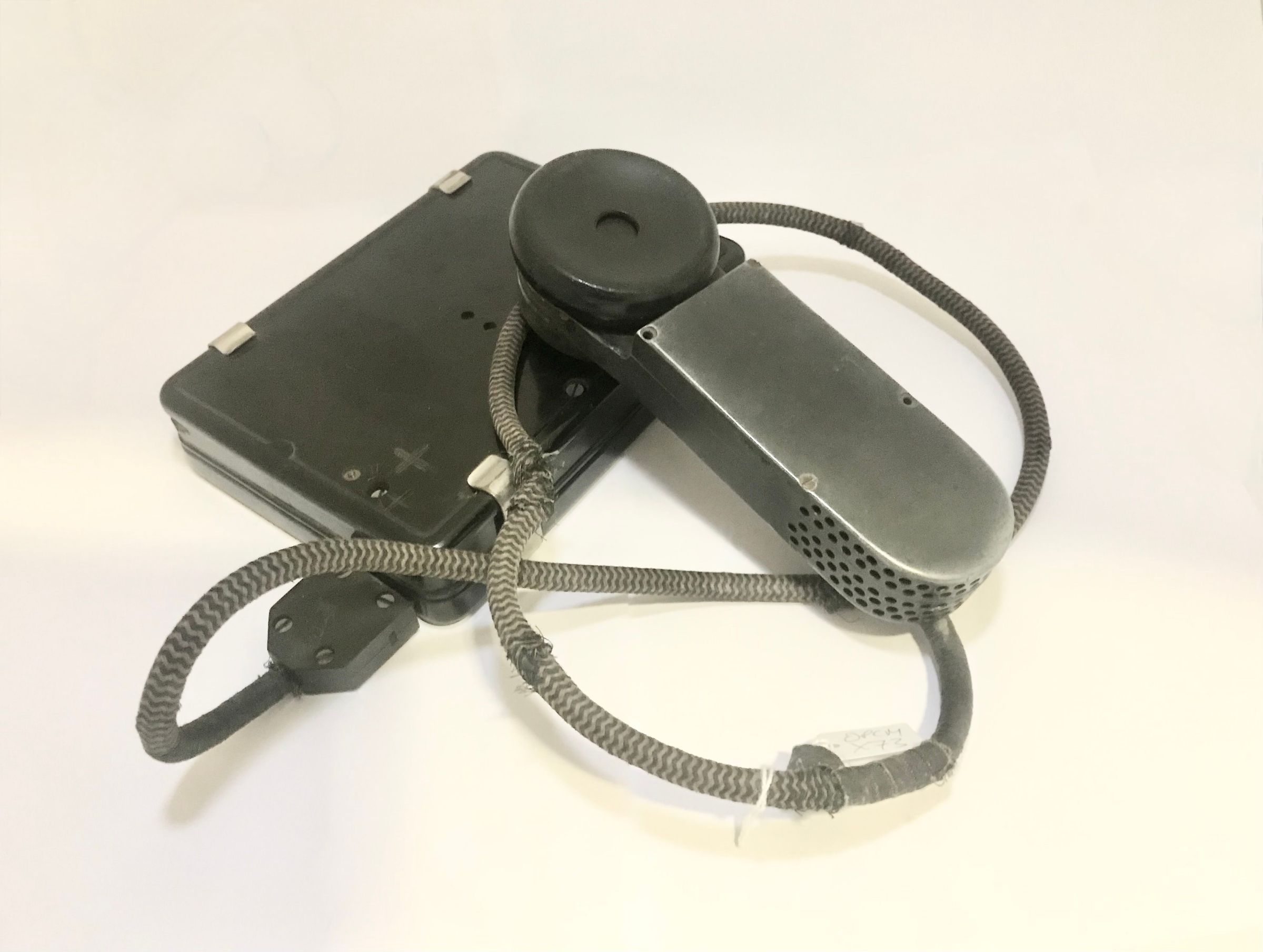
Brighton Borough Police pocket radio, consisting of bakelite box containing receiver and battery space, connected by cloth covered cable to a bakelite and aluminium earpiece. No marks on box but earpiece marked "Brighton Borough Police No.15, Relay Unit, Licensed Under Letters Patent No. 369983, Patent Applications No 4001/32 & 7869/32". Believed to have been manufactured by the Wireless Telephone Company Limited.Use
For Brighton officers to receive messages transmitted from Police HQ at Brighton Town Hall.Context
In the 1920s and 1930s various British police forces began experimenting with wireless communications. To begin with these were restricted to vehicles because of the size of the equipment required. In the 1930s the Chief Constable of Brighton, Charles Griffin became interested in the possibility of a device that could be carried by an officer on foot patrol. An officer with an interest in radio managed to produce a working but bulky prototype. This work was continued by a local resident and amateur radio engineer, Colin Begbie, who designed the model shown here. A transmitter was installed at Brighton Town Hall in 1932 and a "Wireless Room" set up on the top floor, next to the caretaker's quarters. The Brighton Police call sign was "GTN", and in 1933, the Borough Force purchased 30 of these pocket sets and spare batteries, at a cost of £443 10 shillings, equivalent to over £32,000 in 2021. Brighton became the first police force in the UK, if not the world, to use pocket radios on 14th September 1933 when the system went into general use.
This type of radio only receives transmissions, it cannot send them. When a radio transmission was made from Police HQ, a bell would ring in the earpiece, which was carried in one pocket, with the receiver box in another. or in a satchel. The officer would take out the earpiece and push a button, which would allow a voice transmission to be heard. It was possible for the general public to hear these messages on home radios, so messages were either passed in code, or an officer, or all officers, instructed to contact police HQ on a police telephone, for further information and instructions. The code consisted of words such as "monk" for murder, "hoax" for housebreaking, "brick" for burglary and "frog" for fraud. To instruct all officers to report to a police box the message "GTN box" was transmitted. To instruct a specific officer to contact HQ, say Constable number 24, the message, "GTN 24 box", would be transmitted.
Most of these radios were issued to specific police boxes, small brick or wooden kiosk type offices, located around Brighton, for the use of foot patrol officers on specific beats, though two were allocated to motor cycle patrols. This particular set numbered "15" was issued to Box 15 situated at Lewes Road Arches. Most radio numbers did not match a particular box or beat number, 15 appears to be an exception. These radios used rechargeable "accumulator" batteries which were collected and deposited at boxes every day.
Despite their limitations these radios were successful and in daily use until the outbreak of the Second World War in 1939, when the wavelength they used was discontinued. They were in use in Brighton at a time when most UK police officers had to rely on fixed telephones for receiving messages and were in many ways well ahead of their time.