Name/Title
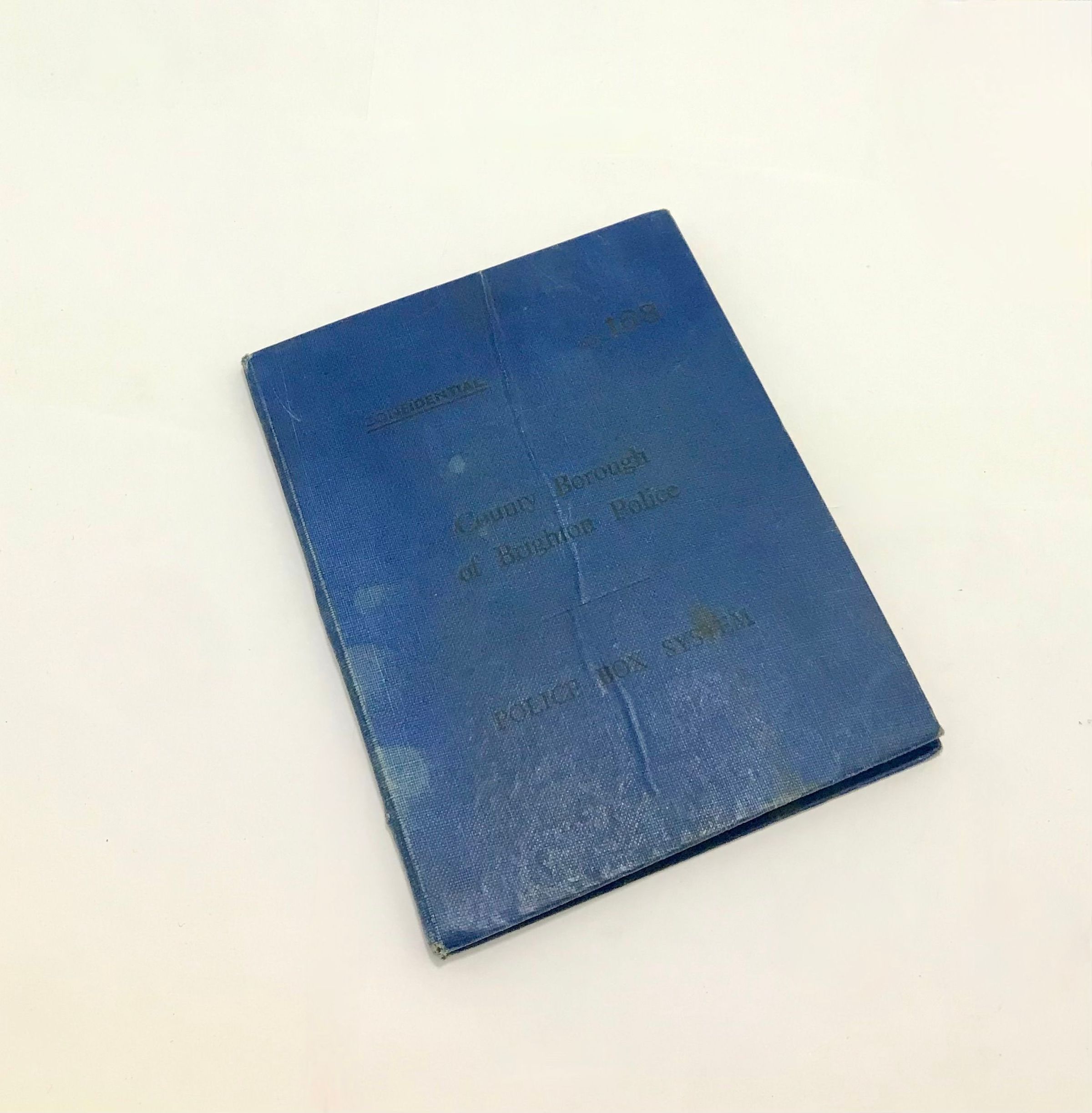
Brighton Borough Police - "Police Box System" booklet 1939Entry/Object ID
161Description
Small blue hardback booklet, approximately 142mm x 107mm, marked on front "Confidential 168 County Borough of Brighton Police - Police Box System", published January 1939, consisting of 72 pages, issued to 'PC 150 Frost', and before him, 'PC W.Ross 168', both sets of names and numbers written in pen.Use
Booklet for officers detailing the use of the Brighton Police box system and other aspects of work, including the working of fixed points and the use of the Brighton Police pocket radio scheme.Context
Throughout the early 20th century the British police began to rely more and more on telephone communication. In the late 1920s police forces began to introduce "Police Box systems", where officers in towns would not book onto duty at a police station but at a "Police Box" actually on their "Beat", the area they were designated to patrol. These 'boxes" would be small structures equipped with a telephone for the officer to contact a police station at the beginning and end of his duty, and at regular intervals throughout that duty. This was to check on his welfare and to relay to that officer any messages. The attraction for police forces of these systems was that they could reduce the number of police stations that they needed and that officers would spend more time on their beat, instead of having to walk to it from a police station at the beginning of their duty and back again at the end of it.
The type of police box used varied from police force to police force, but to begin with most were wooden structures similar to small sheds, usually furnished with a desk/table and a chair, as well as the all important telephone.
Brighton introduced its first "box system" in 1927 with 25 wooden "boxes" bolted to concrete bases (Bunker 2011). By the time that this booklet was produced in 1939, the Brighton system had developed and a total of 51 boxes were in use, covering 29 beats. By this time many of the boxes were more permanent structures or attached to other buildings. Most if not all had special telephones for the general public to use attached to the outside. These would consist of a special small door that when opened would automatically activate a speaker telephone that would connect to a central police station.
This booklet was personal issue to all officers and contains detailed information for each Beat in Brighton, such as where it was, which box was specifically assigned to it, and any other boxes that were also available. It also details which times on the hour an officer on any specific Beat was required to telephone Police HQ and also where that officer has to be at the end of his duty, the "going off point". This location varied every day over a month so that there was an element of randomness and would-be criminals could not predict where officers might be at the end of their duty. The book also details the working of "Fixed Duties"", specific smaller areas where an officer was to be throughout their duty to deal with particular issues associated with those locations. It also gives instructions for the use of the pocket radio scheme that Brighton introduced in 1933, as well as instructions for other sorts of duties.