Name/Title
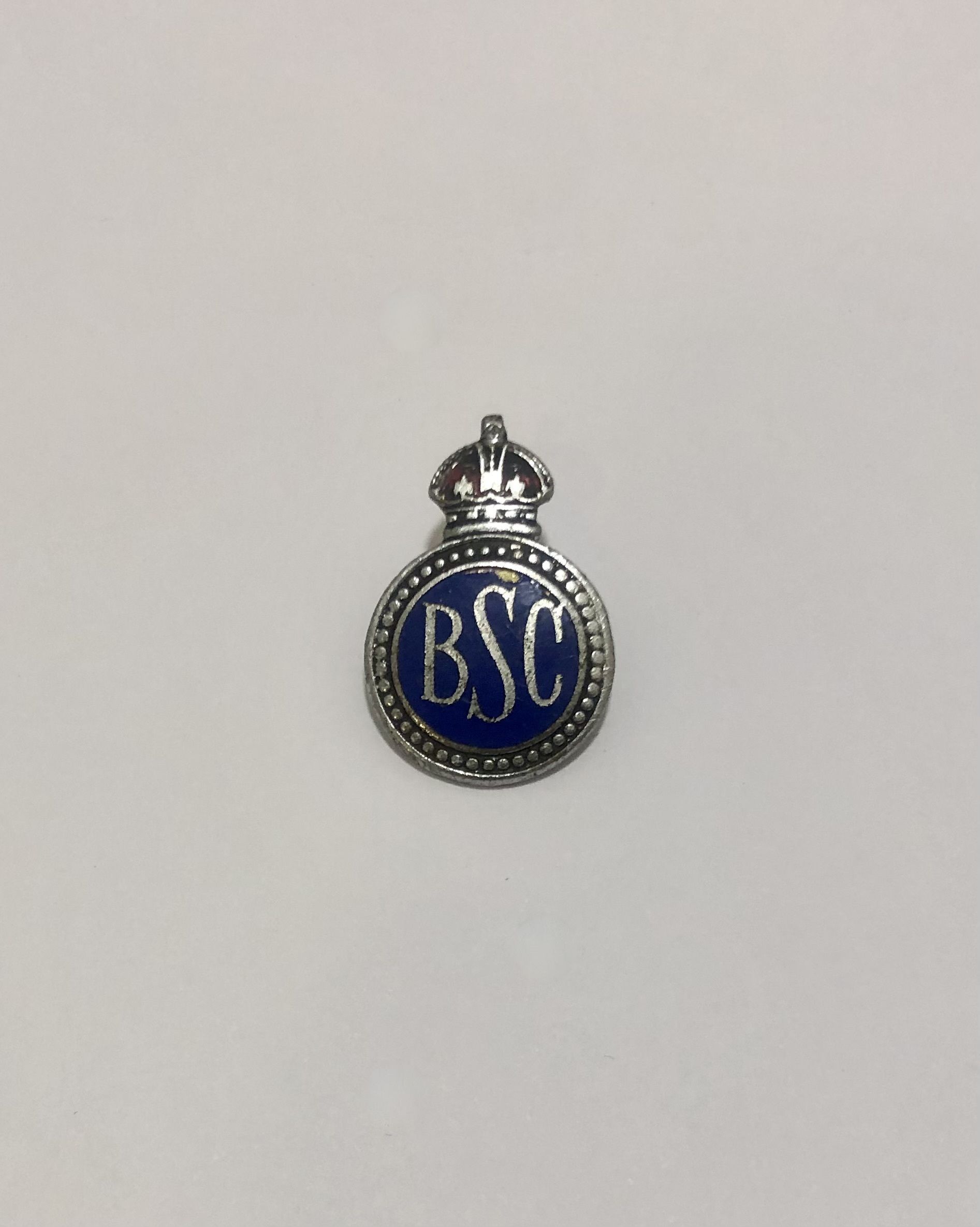
Brighton Borough Police special constable's lapel badge c1930Entry/Object ID
304Description
Small chrome plated lapel badge with King's crown, with blue enamel centre and letters "BSC". Stamped to rear "Thomas (unreadable but known to be 'Fattorini') Regent St. Birmingham". The original horseshoe fixing to rear is broken and a small piece of enamel to front is missing.Use
For use fixing to a buttonhole on a civilian jacket lapel by a special constable when not in uniform.Context
The Special Constabulary is made up of volunteers who carry out uniform police duties in their own time, and in its current form it dates from The Special Constable's Acts of 1914 and 1923. Until 1914 special constables could only be sworn in for very limited amounts of time if there was the threat of a riot or a serious disturbance and were not uniformed. The threat of war in 1914, and the likelihood that many police officers, being ex soldiers and therefore army reservists, would be "called up" to fight led to concerns that there would be a shortage of officers. To counter this the 1914 Act allowed special constables to be sworn in for the duration of the conflict. The 1923 Act made the temporary arrangement permanent.
With the 1914 Act and longer periods of service special constables were given uniforms for the first time, though in may areas shortages meant that most specials only had proper uniforms towards the end of the war. However by that time and in particular following the 1923 Act, similar uniforms to regular officers were in use, though helmets were not issued to specials, who wore caps. They also worn different rank insignia as the rank structure in the special constabulary is different to that for regular officers.
The use of lapel badges by special constables, originated during the first world war when uniforms were in short supply, and as well as armbands, some special constables were issued with simple badges to attach to their civilian outer clothing. The practice of issuing small lapel badges continued after the war despite uniforms being plentiful and the badges themselves became more elaborate and colourful. They appear to be more to affiliate the wearer to the special constabulary when off duty, than to act in lieu of a uniform and date to a period when club badges were commonly worn on jacket lapels. These badges were made for specific police forces and there is some considerable variety in the designs used. This particular one was produced for Brighton Borough Police, and the shape of the badge itself, is a more generic design, many different police forces using this style, but having different enamelled centres, in this case "BSC". It has a King's Crown which only dates it to pre 1952, though it probably dates to the 1930s. It was made by the badge maker Fattorini Ltd, who specialised in enamelled badges.