Name/Title
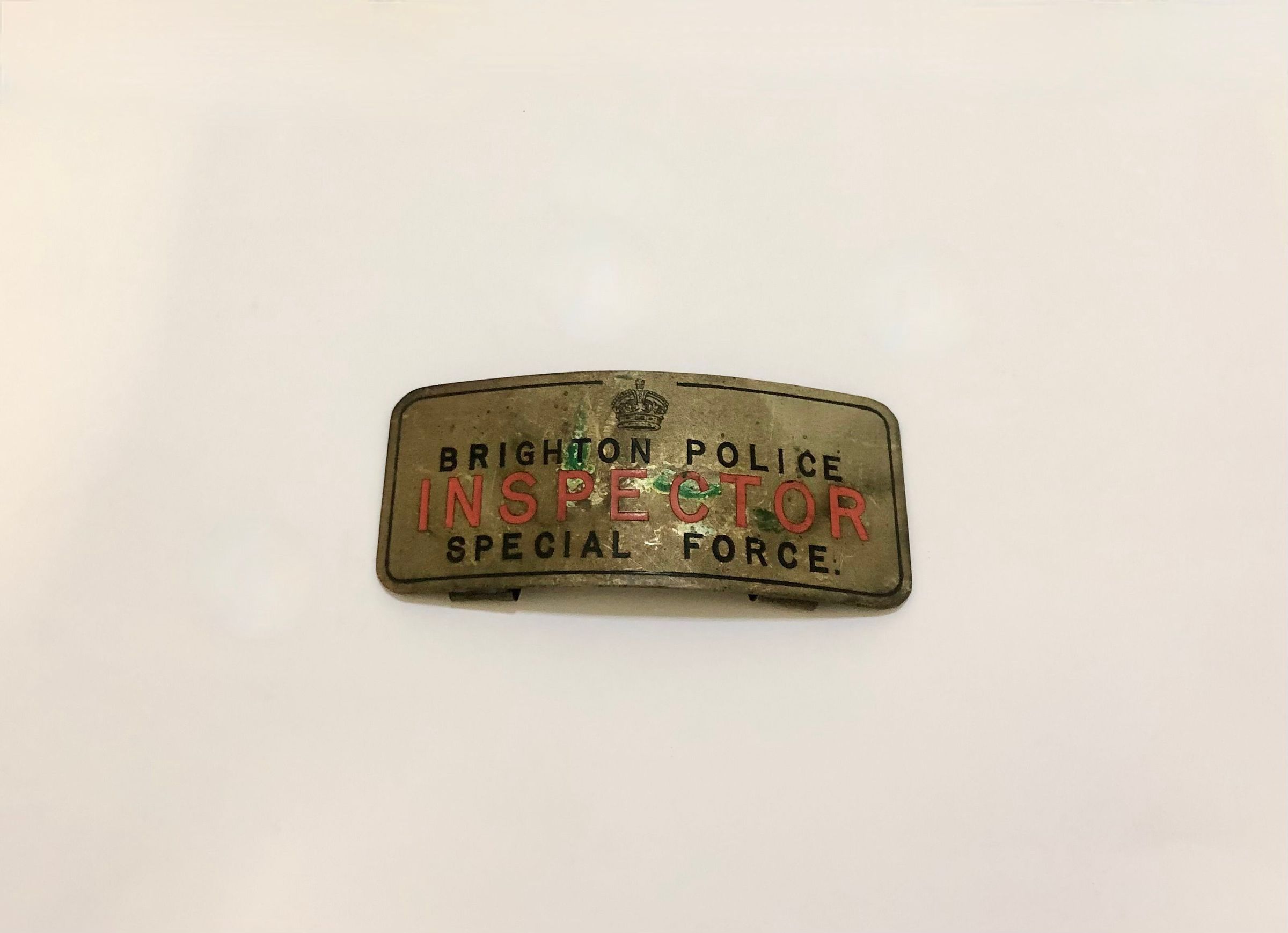
Brighton Borough Police Special Constabulary inspector's armband badge c1915 - 1916Entry/Object ID
2456Description
White metal rectangular badge (107mm x 45mm) with curved back and two rear metal loops for attaching to an armband. On the front it is stamped with a King's Crown and marked "Brighton Police Inspector Special Force", all the words being highlighted in black except "Inspector" which is in larger lettering and in red. The outside of the badge also has a back border.Use
For attaching to a special constable's armbandContext
The Special Constabulary is made up of volunteers who carry out uniform police duties in their own time, and in its current form it dates from The Special Constable's Acts of 1914 and 1923. Until 1914 special constables could only be sworn in for very limited amounts of time if there was the threat of a riot or a serious disturbance and were not uniformed. The threat of war in 1914, and the likelihood that many police officers, being ex soldiers and therefore army reservists, would be "called up" to fight led to concerns that there would be a shortage of officers. To counter this the 1914 Act allowed special constables to be sworn in for the duration of the conflict. The 1923 Act made the temporary arrangement permanent.
With the 1914 Act and longer periods of service special constables were given uniforms for the first time, though in may areas shortages meant that most specials only had proper uniforms towards the end of the war. However by that time and in particular following the 1923 Act, similar uniforms to regular officers were in use, though helmets were not issued to specials, who wore caps. They also worn different rank insignia as the rank structure in the special constabulary is different to that for regular officers.
At the beginning of the First World War large numbers of special constables were recruited and there was simply no uniform for them. Initially they were given plain printed cloth armbands and a truncheon. Police forces then began to issue lapel style badges that could be attached to civilian clothing, and subsequently purpose made armbands with cast metal badges attached, bearing the words "Special Constable" often with a number. As time went on more uniform and equipment became available but in many areas this only amounted to an overcoat and a cap, worn in conjunction with an armband, normally worn on the left arm. Often no force insignia was used and caps would only have a simple crown badge on them. There was though, considerable variety in both the type and amount of uniform issued by different police forces.
As mentioned, most police forces used cast metal "Special Constable" armband badges, made to generic designs by police equipment suppliers, such as Hiatt, which were fitted to blue and white armbands, usually with horizontal stripes. Though often supplied with unique numbers, these were not normally marked with the details of specific police forces. A few police forces did have their names or force crests/coats of arms applied to these cast badges, but most did not.
This particular badge is clearly intended for use on an armband being curved, with loops on the back to attach it to one. However it is not cast and of unique design, being made of white metal and having the lettering stamped and then coloured in. It is marked "Inspector" and other examples identical to it exist, as do others marked "Sergeant". Most photographs of Brighton Police special constables from the First World War show them wearing the simple generic style of cast badge, worn on an armband on the left lower sleeve. This suggests that Brighton specific armband badges such as the one pictured are either a later type of design or were only issued to supervisory ranks, with ordinary special constables having the simple cast badges. However there is known to be at least one rank specific cast badge thought to have come from Brighton, marked "Chief Special Constable" and numbered "4".
The pictured badge is known to have been issued to Charles Smith, who was a solicitor in Brighton and served as a special constable for many years from 1914 onwards. Newspaper reports show that by January 1916 he was serving as an inspector on "C" Division and that by January 1917 he was a chief inspector, a rank he still held in 1922. This suggests that this badge may date from 1915/1916, although it could be later. Charles Smith continued to serve in the Brighton Special Constabulary and was the Chief Special Constable from 1928 until he retired from the specials in October 1934. He went on to serve as a magistrate, having been appointed a Justice of the Peace in 1935.