Name/Title
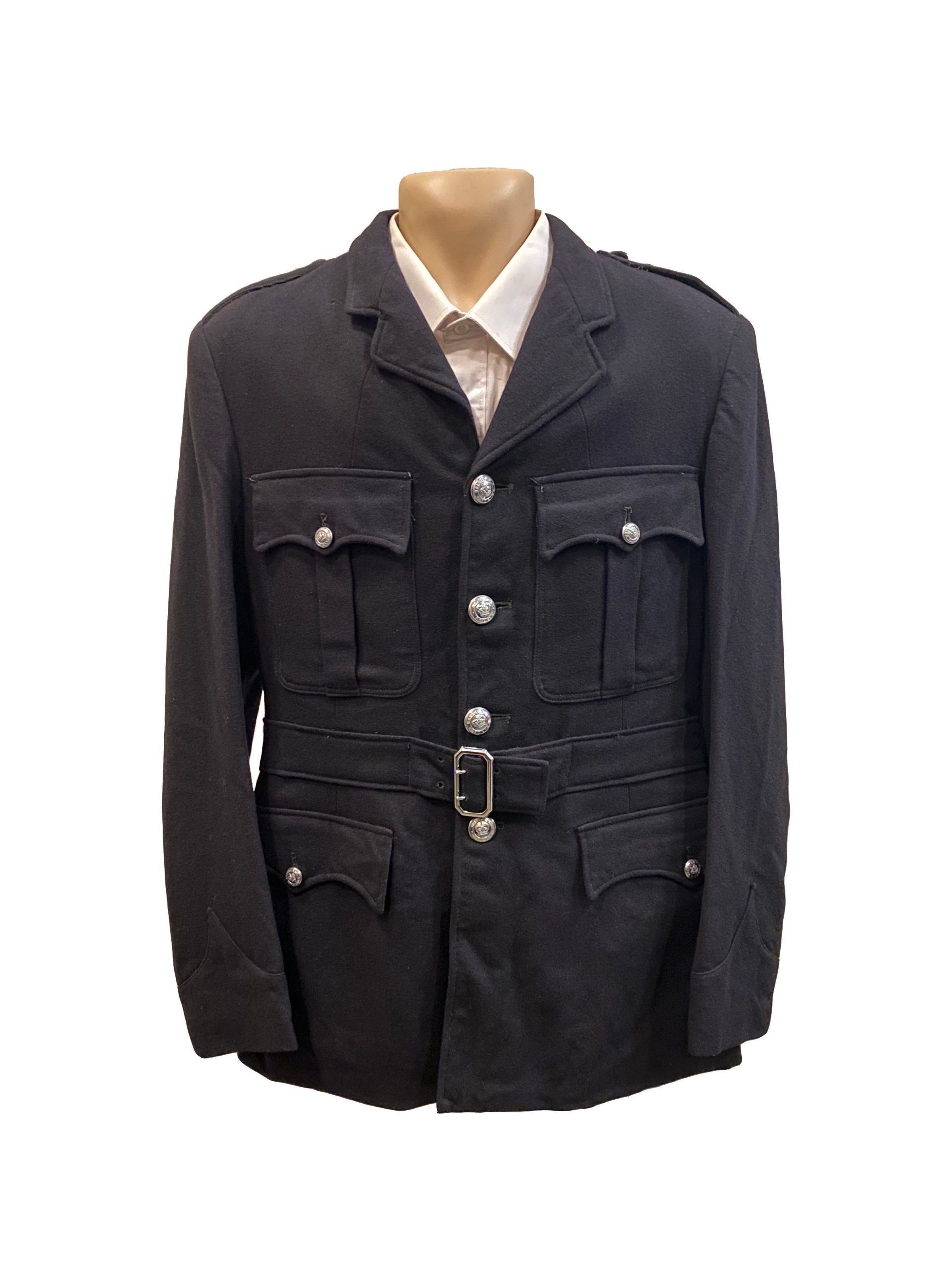
Brighton Borough Police tunic c1960-1967Entry/Object ID
1816Description
Black wool police tunic with open collar, four large buttons to the front, two breast pockets, two hip pockets, all pockets having small buttons, and a fixed wool belt sewn onto the tunic, with a chrome plated two prong buckle. There are two small button fastened epaulettes, each having the chrome plated numbers "99' attached. The epaulettes have both been stitched along the sides to the shoulders of the tunic. All buttons are chrome plated and marked "Brighton Police" with a Queen's Crown ". The end of each sleeve has a scalloped detail. No labels.Use
For use by a Brighton Borough Police constable or sergeantContext
Brighton Borough Police adopted an open necked tunic for constables and sergeants in 1952. In common with other police forces, including the Metropolitan Police, these tunics had five front buttons, no belt and just two breast pockets. However by the 1960s Brighton and many other police forces were using four button, belted tunics with two waist pockets in addition to the breast pockets. The adoption of this style of tunic probably followed the use of a similar style of tunic in the Metropolitan Police in 1959.
This particular tunic is one of those used in the 1960s by Brighton Borough Police until the force was amalgamated into Sussex Constabulary in 1968. Such tunics are seen being worn by officers in Brighton in the numerous photographs taken during the 1964 Mods and Rockers disorder. The epaulettes and numbers are interesting. The epaulettes have been stitched along the sides onto the tunic shoulders, and this may have been to prevent them being taken hold of by a detained or other person(s) during an arrest or other confrontation. The number "99" is the officer's number and in Brighton Borough Police numbers were re-issued and were dependent upon rank, the higher the rank the lower the number. So when an officer was promoted from constable to sergeant, their number would be reallocated to a new officer and they would be allocated a lower sergeant's number. In 1967 the number "99" was allocated to Sergeant C.H. Milsom, but this tunic does not have sergeant's stripe badges on the sleeves. This means that they have either been removed or that this tunic was in use at a time in the early 1960s when there were fewer officers in the Brighton force and the number "99" was possibly issued to a constable. An examination of the sleeves is not conclusive but there are some marks that could possibly indicate the original presence of at least one chevron badge.
Unlike some of the other Sussex police forces in the 1960s, Brighton officers did not have any additional force insignia on their tunic lapels or epaulettes.
This tunic is pictured with a white shirt for display purposes, but would originally have been worn with a light blue shirt and a black tie. Until the mid 1990s most police forces used blue shirts for male constables and sergeants, with only the ranks of in inspector and above having white shirts.