Name/Title
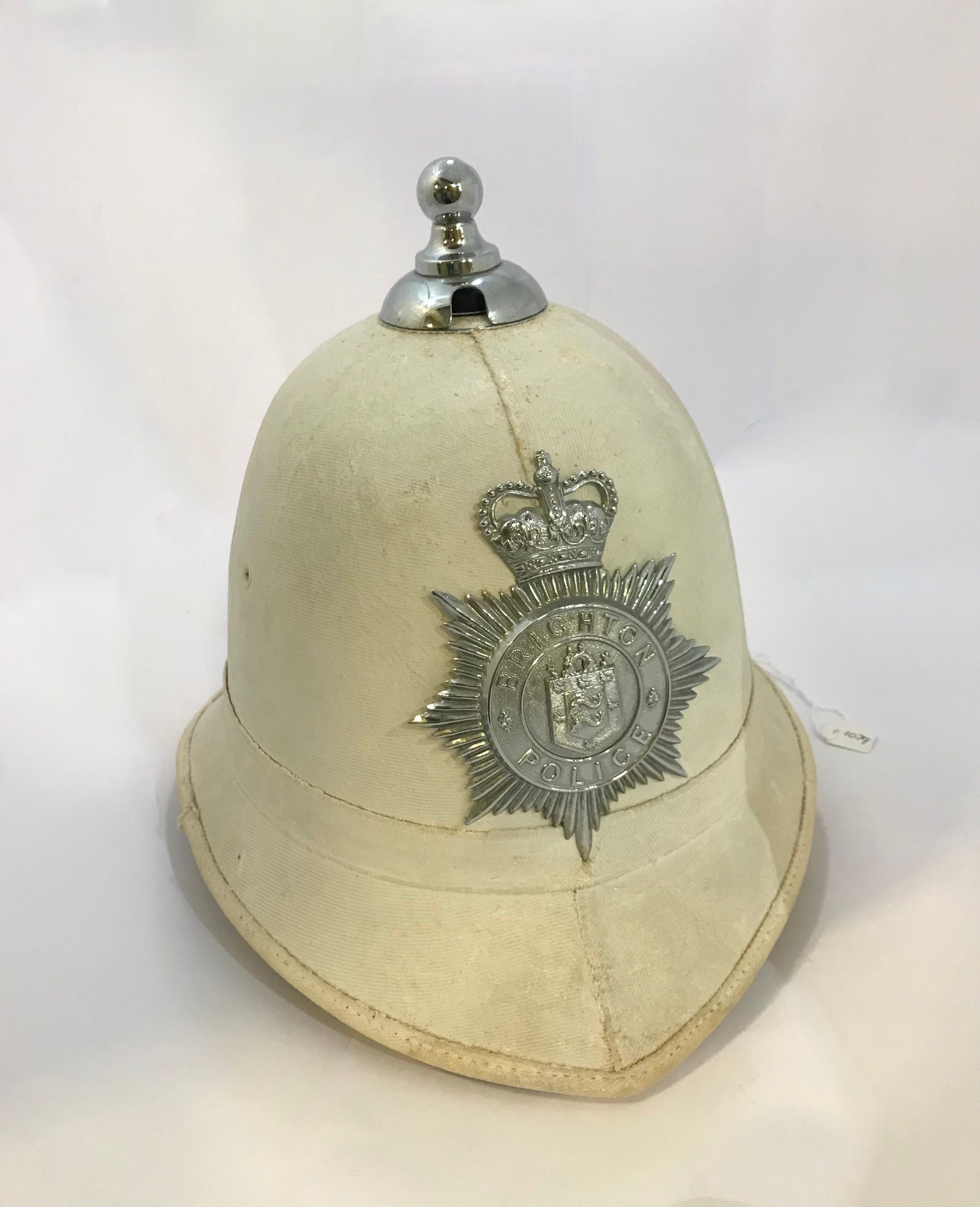
Brighton Borough Police white helmet 1952-1967Entry/Object ID
1079Description
Two panelled white cloth covered cork Brighton Borough Police helmet, with white hatband and green buckram type lining. Fitted with chrome plated ball top and chrome plated Queen's Crown Brighton Borough Police helmet plate with separate coat of arms centre. On the leather headband is stamped "Made in England Christys London" and handwritten in pen is "PS 102". This helmet has internal clips to attach a removable chinstrap, which is not present.Use
Standard daytime summer headdress for Brighton Borough Police male constables and sergeants 1952 to1967.Context
Brighton Borough Police first introduced the white helmet in 1933 for daytime summer use. They were worn in conjunction with white gloves, making officers more visible amongst the crowds of tourists and at the same time raising the status of the Force. Their use ended in 1939 and only resumed in 1952, again worn in conjunction with white gloves. They continued to be worn as daytime summer wear until the Borough Force was disbanded at end of 1967 and amalgamated with the other Sussex Forces to form Sussex Constabulary in 1968.
The badge or helmet plate on this example, with a "Queen Elizabeth Crown", dates it from 1952-1967. This style of helmet is known as a "ball top" which was used for both summer and winter wear in Brighton from the 1890s onwards. The writing inside the helmet identifies the officer to whom it was issued to, "PS" or Police Sergeant "102". The book "The History of Brighton Police 1838-1967", published to commemorate the end of the force in 1967, lists all of the officers then serving. Officer 102 was indeed a sergeant, "F.K.Knight" and this is most likely his helmet
While Brighton Borough Police are well known for using white helmets, they are not the only Sussex Police Force to have issued them or indeed the first. Both the Hove and Eastbourne Borough Forces used white helmets before Brighton, Hove possibly as early as the 1890s and Eastbourne from the 1900s. However it appears both had stopped using them by the 1930s or earlier.