Name/Title
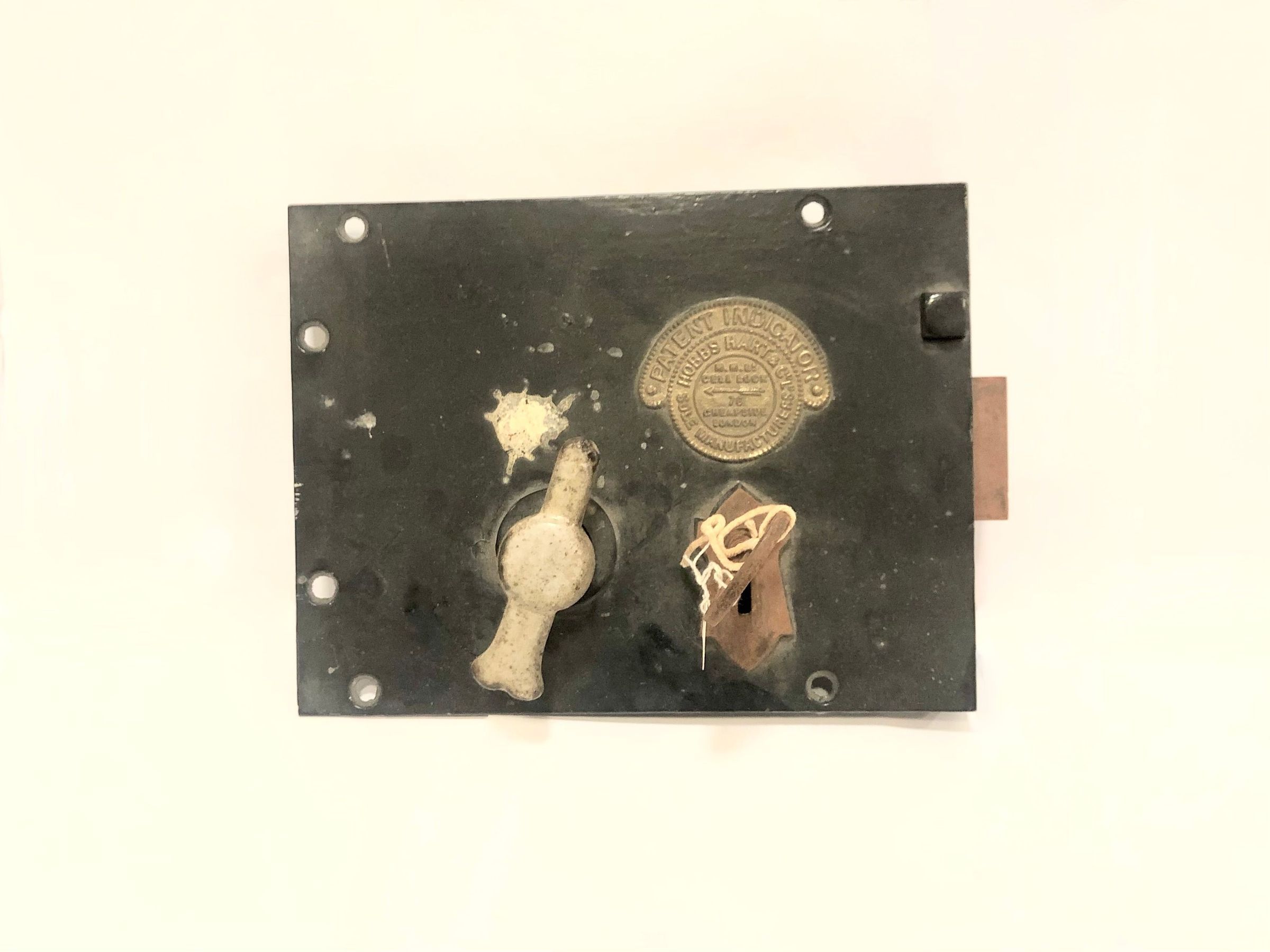
Brighton Police female cell door lock c1887 - 1900Entry/Object ID
155Description
Large black painted metal cell door lock, with cream painted handle and a key. Has a brass circular plate marked "Patent Indicator Hobbs Hart & Co LD Sole Manufacturers M.M LD Cell Lock 76 Cheapside London"."Use
For locking a cell door.Context
The basic type of lock used for uk police and prison cell doors hardly changed at all from the 19th century until the end of the 20th century. It has only been with the advent of new purpose built custody centres and the introduction of electrically controlled security locks in the 2000's that things began to change. In Sussex it was only with the opening of such centralised custody centres that the older small cell blocks in police stations across the region were closed. Many of these buildings dated back to the Victorian or Edwardian era and consequently so did the cells, and many would have had their original locks.
This particular lock is believed to have come from one of the doors in the female cell corridor at the museum. Indeed it is identical to the remaining locks, which are also painted black. None of the remaining locks in the male or female cells have surviving maker's plates but there are distinctive marks on them where there would have been an identical shaped plate to the one on this lock. That and the fact that they are all appear to be the same design as this lock, suggest that they were all made by the same manufacturer. The locks in the male cells, though are all painted the same colour as the doors, a cream/buff colour.
The company of Hobbs, was formed in 1851, although they only became Hobbs Hart and Company after 1860. The patent mentioned on this lock plate the "Indicator" dates from 1861 but the company only became "Limited" in 1887. So this particular lock must date from after 1887. This ties in with the construction of the female cell corridor as we see it. In the late 1890s the Town Hall basement was re constructed as part of a significant remodelling of the whole building. Prior to then the female cells had been at what is now the front of the building running at right angles to the male cell corridor. However as part of the re building, new female cells were build in their current location and the old ones removed. The male cells remained largely unaltered and remained where they are today.
Based on the date of this particular lock, would appear that rather than re-use the old female cell locks, new ones were purchased as part of the re-build. However this does not mean that the male cell locks date from after 1887, even though they are of a similar design and have the ghost marks of an identical, manufacturer's plate. This is because Hobbs Hart and Company, used exactly the same shaped plate on their cell locks before they became a limited company. Given that the male cells were built in 1870/1871, it is quite possible that the existing locks are the original ones and bore plates marked "Hobbs Hart & Co.". It is known that the cells had similar locks when built, as they can be seen on the original architect's plans.
Locks like this automatically lock when the door is closed. The small square shaped button at the top right, activates a sprung bolt when the door is closed and the button is pushed in by the door frame. Hobb's "Indicator Patent" relates to a lock that normally has an indicator that turns as the door is locked using a handle, so that it is easier to tell that the lock is secure. In their cell door locks, there is no indicator signal, although the door handle does move and given that it roughly arrow shaped, it is probably intended to act as an indicator, showing that when horizontal, the lock bolt is activated. Though these locks do not need a key to lock, they do need one to open them.
In the Sussex Police custody centres that replaced cell blocks in the old police stations, the cells are locked with modern locks that superficially resemble older locks. Though these locks still have keys for use in an emergency, they are normally opened with a card key and a code number using a keypad. This does not actually unlock the lock itself but releases the catch plate that is in the door frame.