Name/Title
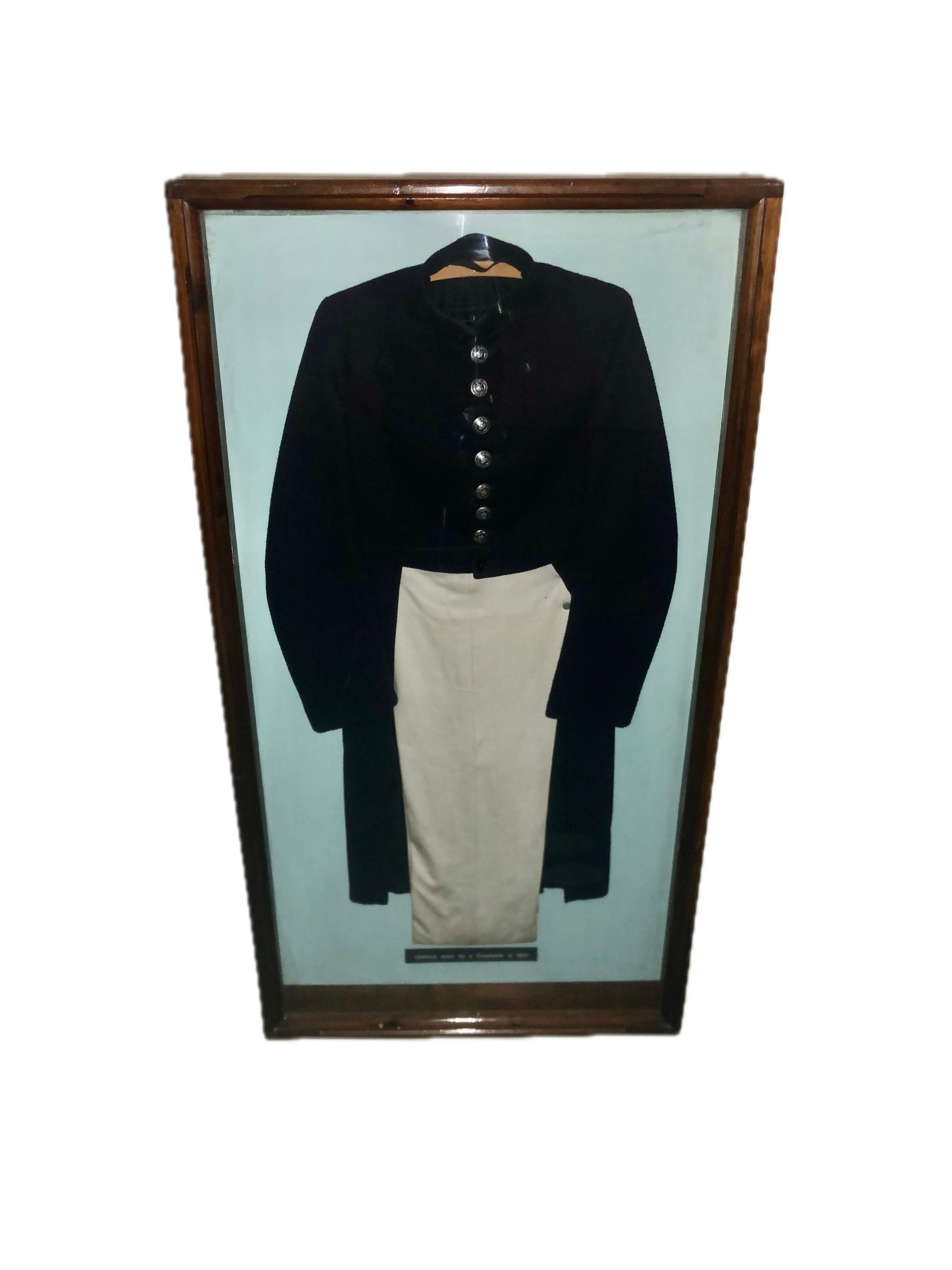
Cased reproduction of early police officer's swallow tailed coat and summer trousers c1957Entry/Object ID
12Description
Large glass fronted wall mounted wooden case containing a blue wool single breasted high closed collar swallow tailed coat and a pair of white cotton trousers, with side buttons. The coat has seven buttons to the front and swallow tails to the rear. At the bottom of the plated large buttons is a smaller black plastic one. The large buttons to the front are chrome plated and marked " West Sussex Constabulary" with Queen's crowns. There are no marks or numbers on the collar. At the bottom of the case is a printed label marked "Uniform worn by a Constable in 1857".Use
To represent the type of uniform tunic worn by the first police officers in the 19th century.Context
Prior to the establishment of the Metropolitan Police in London there were many concerns that such a force would be an arm of the state such as the military and used to oppress civilians rather than protect them. Consequently when the force formed in 1829, a number of measures were introduced to trey and alleviate these concerns. Not only were officers not to be permanently armed with lethal weapons, but they were to have a uniform that was to be as far removed from contemporary military ones as possible. As a result the first uniforms of a blue swallow tailed tunic and re -enforced top hat were based upon civilian clothing of the period. Overcoats and capes were also provided. During the winter the tunics were worn with blue woollen trousers and in the summer with white cotton ones. Officer's personal numbers were embroidered on the collars and there were pockets provided in the swallow tails for carrying truncheons and other items. As other police forces were established elsewhere in the UK, they broadly followed the example of the Metropolitan Police and adopted very similar uniforms.
Over time the style of police tunic began to change and by the late 1850s, swallow tailed tunics were being replaced with a three quarter length garment, though the Metropolitan Police did not adopt this until 1864.
This particular swallowtail tunic is one of a number that are known to have come from Sussex Police, along with pairs of white cotton trousers. They are all very well tailored and usually have buttons from either East or West Sussex Constabularies from the 1950s/60s. These reproductions of original tunics, are believed to have been used in the various sports days, tattoos and other public displays that were regular features in both of the Sussex county police forces and went on to be held by Sussex Constabulary. Though not original, they are in themselves museum pieces, dating from the 1950s, and are excellent representations of the type of uniforms worn by the first police officers.
The presence of West Sussex Constabulary buttons on this example may indicate that it originated from that county and there are photos from the 1950s of similar uniforms being displayed in the Force. The irony is that this type of uniform was never worn by West Sussex officers, who wore a three quarter length frock coat with a belt when the constabulary was formed in 1857 (Barrett 2010 page 10-11). However this exact same cased exhibit is known to have been part of the Sussex Constabulary police exhibition which was held in Brighton in 1970, and appears in one of the photographs showing the various displays.
There are also some photographs from 1957, when West Sussex Constabulary celebrated its 100th birthday of an officer wearing a reproduction coat like this. Of note is the fact that like that example, this one only has seven chrome buttons to the front, with a small plastic one at the bottom. Other examples of tailcoats that came from Sussex Police have 8 large buttons. It is highly likely that this coat is the same one that appears to have been made for the centenary, especially as it is specifically labelled with the date 1857.