Name/Title
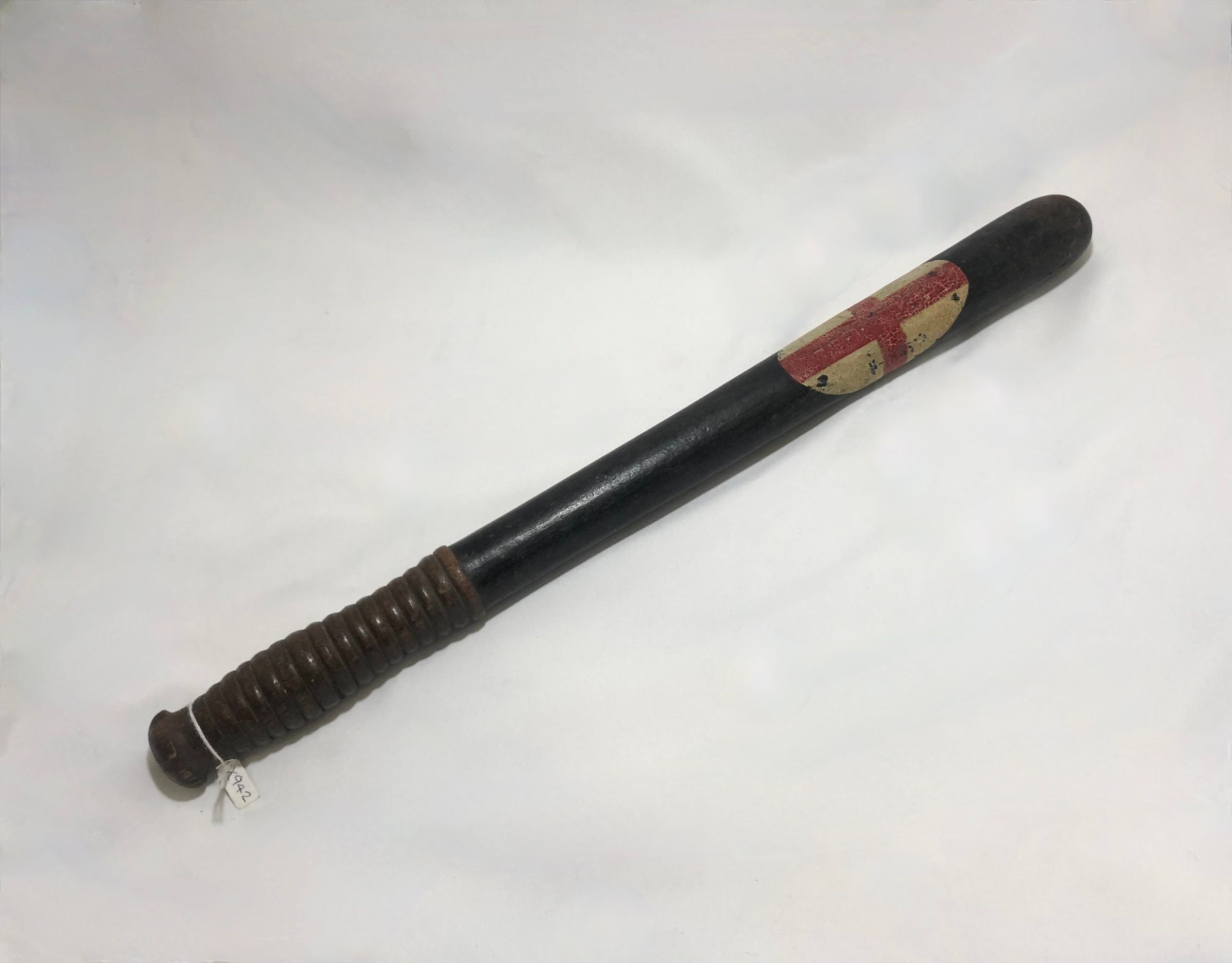
City of London special constable's truncheon c1840 - 1850Entry/Object ID
942Description
Wooden truncheon, painted black 18 1/2 inches (47cm) long with a crudely painted version of the arms of the City of London. Multi turned handle. No wrist strap. Has old collector's sticker on handle marker with number "5". Stamped on end of handle possibly "Parker".Use
For use by a special constable for protection and as a symbol of their authority.Context
In the 19th century special constables were non uniformed members of the public temporarily sworn in as constables to deal with public disorder. The role was formalised in the Special Constables Act of 1831. This gave local magistrates the authority to appoint special constables "on the occasion or threat of a riot". This 1831 Act was in response to the large scale rioting that had followed the rejection of the Second Reform Bill in 1831 by the House of Lords. The Bill which was popular amongst the general population, sought to give greater representation in Parliament to the masses, by standardising the size of constituencies and doing away with "rotten boroughs". Such boroughs were small areas allowed to have their own MP, despite having very small numbers of people living there, a system that allowed wealthy landlords to select their own members of parliament. The Special Constables Act only allowed specials to be sworn in for as long as there was a threat of a riot.
Throughout the century there were a whole series of violent demonstrations in the UK as a result of various political movements and objections to them. Some of these demonstrations led to huge numbers of special constables being sworn in, especially in London. It is reported that as many as 170,000 Special Constables were enrolled in the capital in 1848 to prevent "Chartist" demonstrators from marching into London( The Times Newspaper). Even as late as 1887 there were riots in London, necessitating the swearing in of thousands of special constables.
The only equipment given to these special constables was a truncheon, sometimes these were painted to give the holder their authority from the crown, ranging from highly decorated examples to more simple ones such as here. However many were not marked in any way.
As with regular police officers' truncheons there was no single design. There is some evidence that many of these truncheons were continually re-issued from storage for much of the 19th century as each crisis came along, which makes them hard to date.
This particular truncheon is of a common type known to have been issued to special constables in the City of London and has painted on it a simple version of the red and white shield of the city's arms. The area of the City is what had been the boundaries of medieval London, as enclosed by the City walls, and is often referred to as "the square mile" as it is approximately that size in area. This area to this day is not policed by the Metropolitan Police but by the separate City Of London Police founded in 1839.
Truncheons identical to this one are often ascribed as having been issued to special constables in the City of London during the "Chartist" riots of 1848. However at least one similar example is known to have been issued during the 1868 "Fenian" riots. It is suspected that like many other special constable's truncheons they may have been re-issued from storage (Cook 2014 page 43). As such this probably dates from 1840 to 1850. The stamp on the handle thought to read "Parker" probably relates to the company of Parker Field and being marked just Parker, could date it to any time between 1842 and 1877