Name/Title
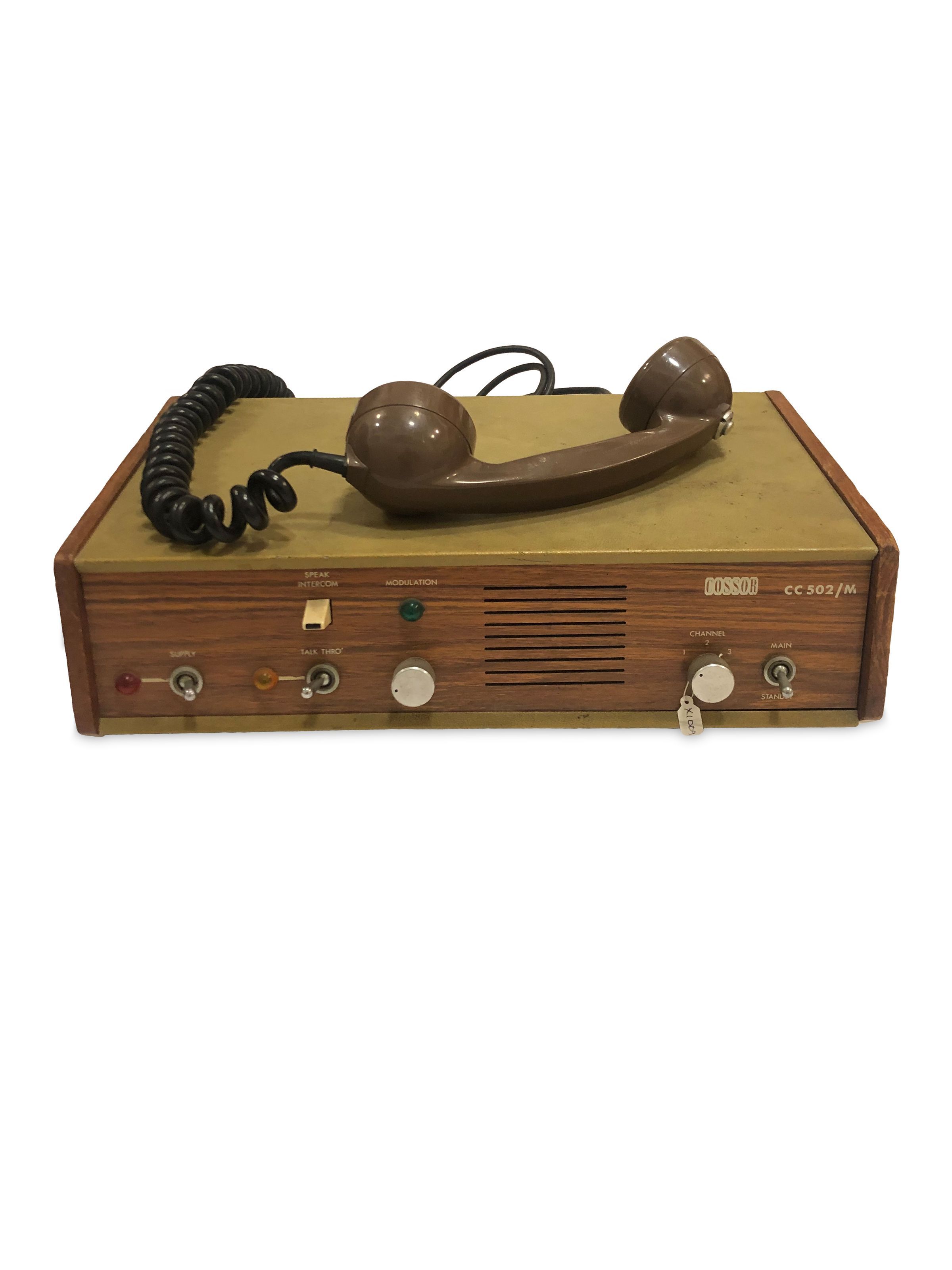
Cossor CC502/M radio remote controller c1965Entry/Object ID
1109Description
Cossor CC502/M radio remote controller, with small circular red, green and amber lights, with three metal toggle switches (two side operating and one upwards operating)and one upwards operating plastic toggle switch, and two circular metal control knobs. Has a side mounted "telephone" style handset with a transmit button at the top. Marked "Cossor CC502/M.Use
To allow transmissions to be made on a police radio network, once connected to a suitable base station.Context
By the 1960s most police forces only had radios in vehicles and all communications would have been managed via a central control room.
In the case of the county forces of East and West Sussex, this would have been from Lewes HQ and Chichester HQ respectively. The smaller borough forces would have had communications managed from their main station. At this time experiments were being made into adopting a separate system of personal radios that officers could comfortably carry that could be operated on a more local basis. Some police forces such as Lancashire developed their own systems, while the Home Office decided to conduct various trials to see what type of system could be adopted nationally. It is known that there was limited use of personal radios in Sussex and this may have been part of trials of VHF radio that the Home Office started in late 1964.
The Pye PF1 Pocketfone system was adopted by the Home Office as the standard national police personal radio in 1966. It was rolled out to the various Sussex forces in 1966/67 and was the first two way radio personal radio available to all officers in any of the these forces. The personal radio system would work alongside that in place for vehicles on a different network. The county forces would operate their personal radios on a local sub divisional or divisional basis, with mini control rooms operating in each station, whilst the radios for vehicles were operated from their HQs. Interestingly though some local stations would also have stationary units with which they could access the main county wide vehicle network. The smaller borough forces would operate their personal radio network alongside their existing vehicle one, as the technology was not compatible. After the Sussex Forces were amalgamated in 1968, control of the vehicle radio network moved to Lewes and local stations retained control of the personal radio network.
The two systems continued to work separately until the mid 1990s, when local control was removed to what became Area Control Rooms. Eventually these closed as well and the control of personal radio also moved to the Force Control Room at Lewes.
This particular remote control radio unit is made by Cossor, who began as AC Cossor Ltd and by 1961 had been bought by the American Company Raytheon, but continued as Cossor Electronics. It came from Battle Police Station and is thought to date from the early to mid 1960s. It would have been connected to a base station to transmit and receive radio messages across a network from a fixed location. There are two possible uses for this actual controller depending on its actual date of manufacture.
It may have been used as part of the late 1964 trials to establish the viability of VHF personal radios. Cossor C22 8H radios were thought to have been used in Sussex as part of this trial and this controller may have been used manage communications using these particular radios, given that it from the same manufacturer.
This controller is also compatible with other Cossor systems that would have allowed it to be connected to the East Sussex Constabulary countywide vehicle radio network. So it may have been used in that capacity at Battle or elsewhere. Its survival may even indicate that it was re purposed after the 1968 amalgamation or even later. However it is not currently known how compatible the technology would have been with later systems.
It came to the museum with a later "MASCOT" switching box but it is not thought they were used together as they are not contemporary.