Name/Title
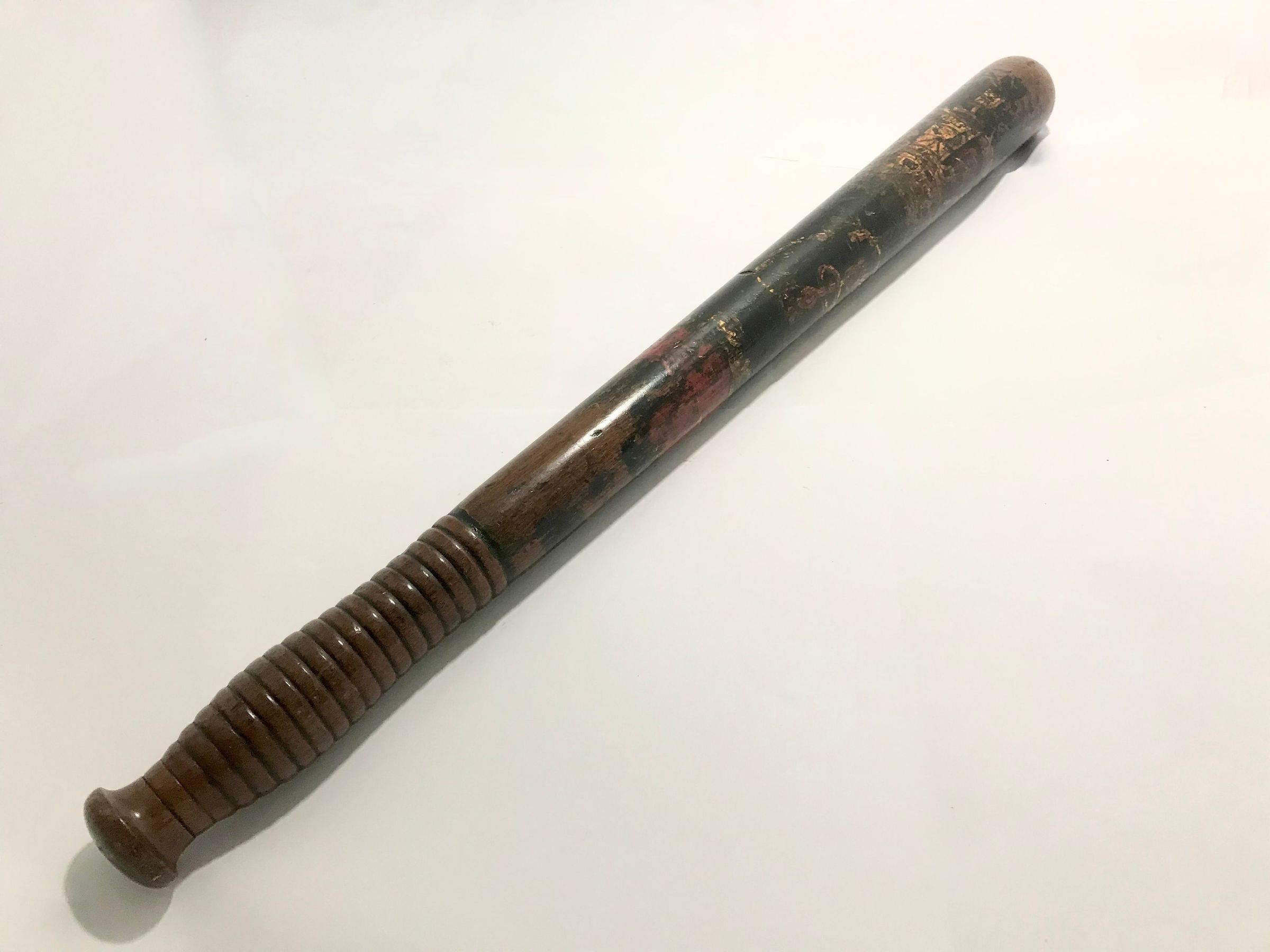
Decorated truncheon by Parker c1837 - 1841Entry/Object ID
252Description
Wooden heavily worn decorated truncheon, with plain multi turned handle 18 inches (46cm) in length The body is painted black with a large crown painted at the top, over an ornate 'VR" cypher in gold, over a red and gold cartouche, inside which are letters possibly "K.....T". Stamped on the end of the handle is the mark, "Parker Holborn".Use
For use by a police or parish constable for protection and as a symbol of their authority.Context
The earliest police truncheons tend to be 17-20 inches (43-51cm) long and are often highly decorated usually with a crown and sometimes with the addition of a royal coat of arms. This was because in the days before warrant or ID cards, the truncheon was the officer's badge of office and symbolised his authority from the crown for carrying out his duties. There was no single style of truncheon or design of decoration in the 19th century and individual police forces chose whatever they liked, some adopting truncheons of a reasonably standard design, made by a large supplier, and others purchasing more unique styles made by local manufacturers. As well as being a symbol of authority decorated truncheons were designed to be used in self defence and were not just ornaments.
The truncheon pictured though heavily worn is of a standard design and decoration produced for much of the 19th century. Indeed if you wanted a a typical example of a Victorian painted truncheon , this would be it. This one was made by the London firm of "Parker," also known as "Parker Field" and "Field", who were famous sword makers, gunsmiths and suppliers of police equipment. The company produced thousands of near identical truncheons to this generic design. Sometimes the cartouche would contain the word "Police" or "Special", but this appears to contain a specific name, possibly "Kent". The "VR' clearly dates from 1837, when Queen Victoria came to the throne. The handle is stamped, "Parker Holborn", and the company used this stamp from 1794 to 1841 (Cook 2014) which means the truncheon could not be for Kent Country Constabulary, as that was only established in 1857. If the word is Kent it may be that the truncheon was made for a parish or town within Kent, prior to the formation of the county force. The length suggests that it dates to the first part of Queen Victoria's reign, truncheons got progressively smaller throughout the 19th century.
By the 1870s the public were well used to the concept of uniformed police and the need for decorated truncheons declined. In the 1880s warrant cards were issued as a form of ID and he truncheon became less symbolic. At the same time there was a move towards smaller 14-15 inch truncheons that could be carried in a pocket sew into the trousers. By the 1890s most police forces had discontinued decoration in favour of plain truncheons of this shorter length.