Name/Title
Draeger Alcotest 80/A breath testing kitEntry/Object ID
719Description
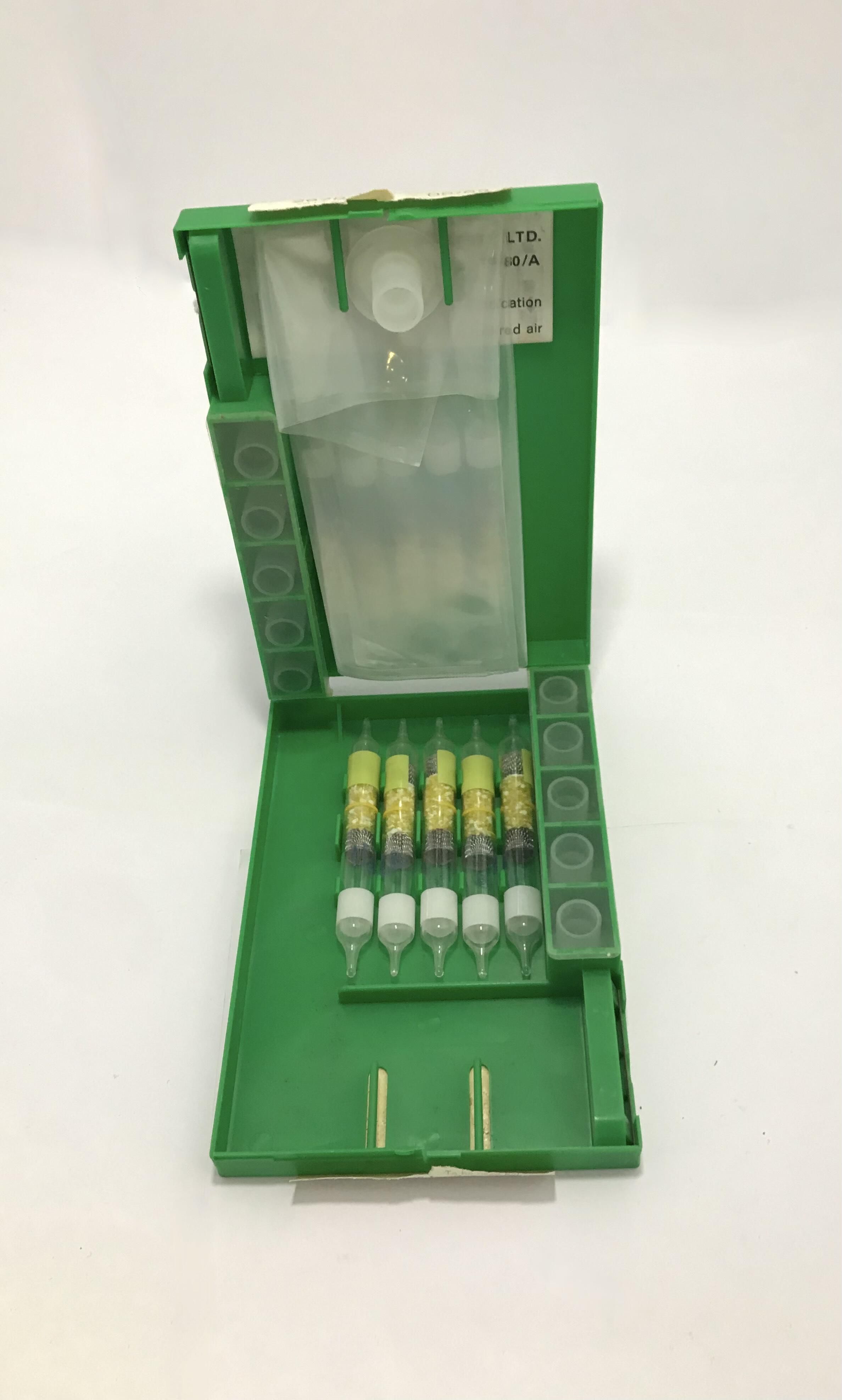
Complete Draeger Alcotest 80/A breath testing kit, comprising 10 testing tubes, 10 mouthpieces, and inflation bag, contained in a green coloured hard plastic folding case, Marked "Alcotest 80/A" and "Draeger Safety Ltd". this appears to be dated "08/89".Use
For an officer to conduct a roadside screening breath test to see if a driver is likely to be over the legal alcohol drink drive limitContext
From 1925 onwards the British Government introduced various offences in relation to driving motor vehicles under the influence of alcohol. However none of these set a legal limit and there were no powers compelling suspects to provide samples of blood or urine for analysis.
The Road Safety Act of 1967 introduced a legal drink drive limit and powers for the police to request sample of blood and urine for scientific analysis, as well as creating offences for failing to provide samples. It also introduced powers for officers to request drivers to submit to a roadside breath test in order to establish if they were likely to be over the drink drive limit of 80 micrograms of alcohol per 100 millilitres of blood. This necessitated the approval of devices to test motorists suspected of drink driving at the roadside.
The first UK approved roadside breath testing device, or Breathalyser, the Draeger Alcotest 80, was introduced in 1967 and police began to conduct roadside breath test for the first time. These devices were similar to that pictured. The ends of the glass tube would be broken and one end attached to the plastic bag, and a mouthpiece attached to the other end. The motorist suspected of drinking would blow into the mouthpiece inflating the bag. The glass tube would then be examined and the crystals inside would change colour depending on whether the motorist had been drinking alcohol and whether they were likely to be over the legal limit. If they failed the test, they would be arrested and taken to a police station where blood or urine would be taken to be tested in a laboratory. Only these lab tests would provide the evidence that a person was over the legal drink drive limit, and secure a court conviction.
In the first year that the Breathalyser was introduced road traffic accidents in which alcohol was a contributing factor fell from 25% to 15%, significantly reducing injuries.
The type of Breathalyser pictured is the Alcotest 80/A which was introduced in 1975 and these were used in Sussex at the time. Though they were widely replaced from the 1980s by electronic devices they remained in production and use for some time, presumably because they were cheaper than the new devices.
Since 1967 various amendments have been made to drink driving legislation to remove loopholes within the law and improve the effectiveness of police enforcement. In 1979 the chemical based Breathalysers began to be replaced with electronic handheld devices such as the Lion Alcometer SL2, which were much easier to use. In 1983 evidential breath testing devices such as the Lion Intoximeter 3000 were introduced at police stations, which could provide the necessary evidence for a conviction from a sample of breath without the need for blood or urine tests