Name/Title
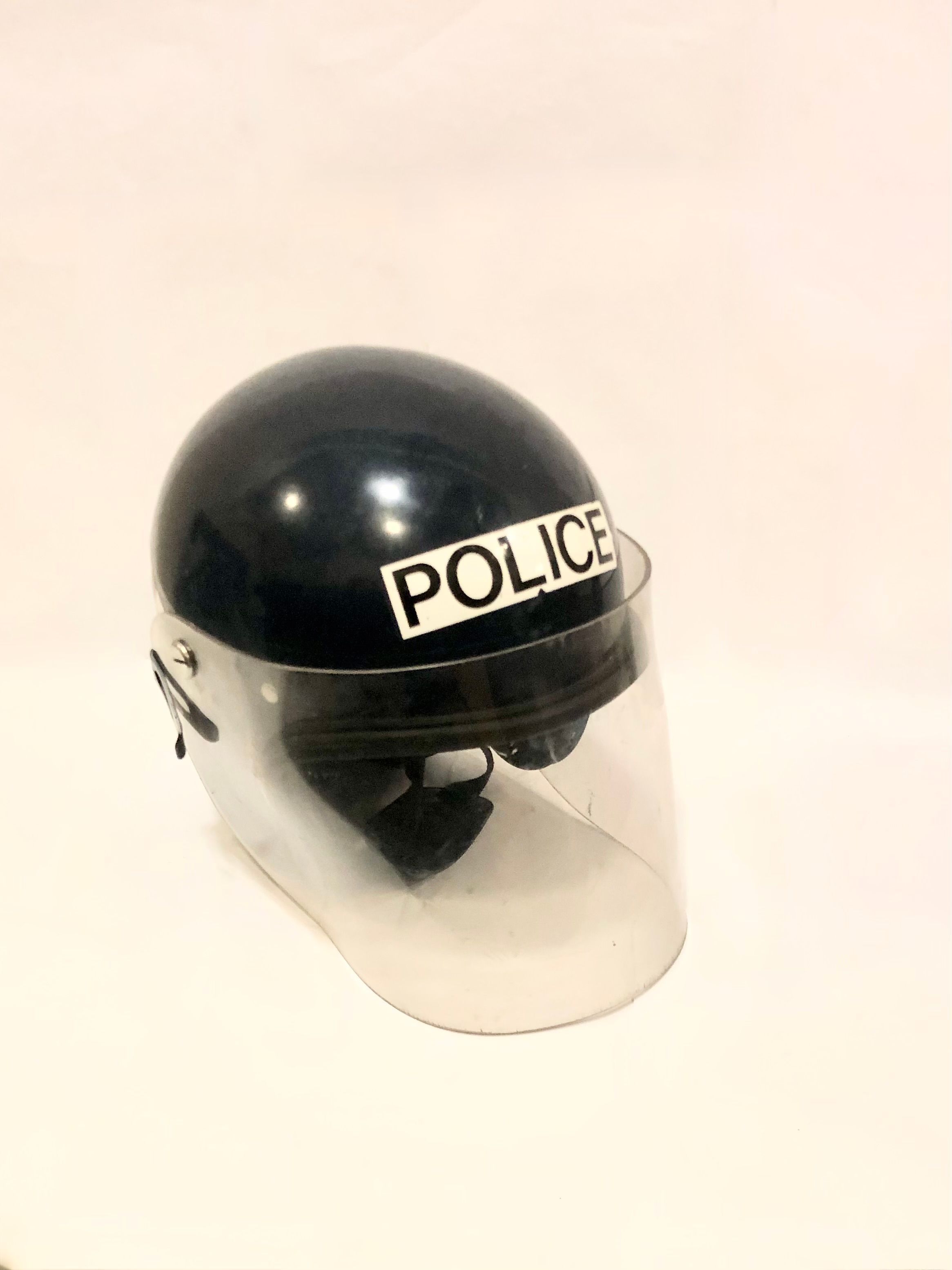
Early style Police Public Order helmet 1982Entry/Object ID
2541Description
Police dark blue re-enforced public order helmet, with lifting clear perspex visor, and padding to the neck. Marked at front under visor on a black on white sticker "Police". Marked to rear with a black and white checkered band and a sticker with number "24" and another sticker that cannot be read. Inside is a sticker marked "Feb 1982 2". There is also a small size label marked "Size 2 56-57 cm"Use
For a PSU constable to wear during a public order situationContext
Following a number of riots and violent public order situations in 1981, police in the UK began to be equipped with specially designed protective equipment. This included so called "riot" helmets, shields, arm and leg pads and fireproof clothing. Until this time all that was generally available were re-enforced "custodian" versions of the traditional police helmet. Along with the equipment came better training and tactics that have evolved over the intervening years. Officers that receive additional training are organised into Public Support Units (PSU's) which normally consist one inspector , three sergeants and 21 constables, including three drivers. Each PSU is subdivided into three "serials" consisting of one sergeant and six constables, with their own customised mini bus and a driver. Several PSU's are usually commanded by a suitably trained officer, usually a chief inspector, who themselves have specially trained "Tactical Advisors".
This particular helmet is of an early style and is clearly dated 1982. The number on the rear would normally designate the police force it was from, in this case "24". This number suggests that the helmet was not from Sussex Police. The Home Officer number for Sussex being 47, though it is known that during the miner's strike of 1984 Sussex was using the number 37, its then number in alphabetical order. Today "24" relates to the M.O.D. Police. However at the time it the helmet was used "24" may have been used to designate another police force. Similar helmets appear in some photos of the 1984 disturbances, as used by some officers, but it is know that at this time Sussex Police were definitely using a different style of helmet marked at the rear "37". Most photos from the miner's strike show the later helmets as worn by Sussex officers in use.
Police public order helmets such as this are often called "NATO" helmets. This term dates back to the 1970s when the British Army were heavily involved in the "troubles" in Northern Ireland. Due to increased rioting the army needed a better helmet that the steel ones, fitted with an improvised visor, that they were using. So a purpose made riot helmet, the "Cromwell" was introduced, which was an army motorcycle helmet with a visor fitted. Because these were Army issued motorcycle helmets they were labelled inside with NATO stock numbers, present on all military equipment, used within the NATO Alliance. When in 1981 the police suddenly needed protective equipment, they were supplied with Army riot helmets complete with NATO stock numbers. To begin with some were still green in colour. Consequently the term "NATO helmet" stuck and is still in use within the police, distinguishing these PSU helmets from reinforced versions of the traditional police helmet, which are called "custodians".