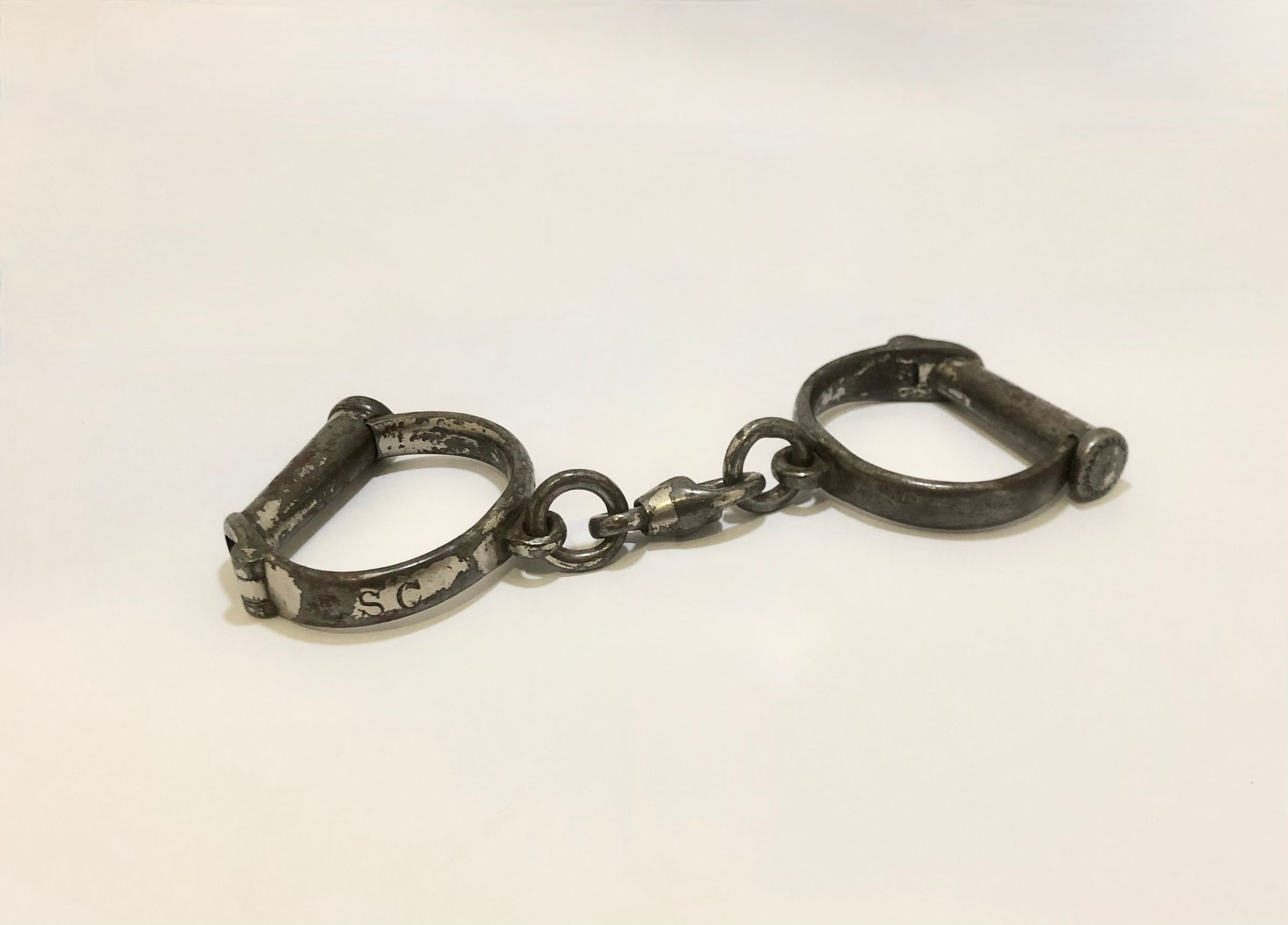
A pair of very worn nickel plated Darby handcuffs. Marked "E.S.C." on one cuff and a curved "J. Nichols" mark on the other along with a mall "6". No key.
Use
To restrain prisoners. This type was in use across Sussex from at least the mid 19th century until the 1960s.
Context
These type of fixed handcuffs are known as "Darbies" or "D" cuffs. "Darbies" is a 17th century word used to refer to all types of hand/wrist restraints and "D" refers to the shape of this style. This type, which were made by various makers, do not have a lock in the strictest sense as they have a simple bolt which is released by screwing in the "key". This simple robust design probably explains why these type of handcuffs were in use for over 100 years.
There is some debate as to the maker "J.Nichols" and the mark on these particular handcuffs. However it is thought it may relate to a James Nichols who was making handcuffs in Birmingham from the late 1820s until c1861. Prior to that he is believed to have been in partnership with Thomas Griffin, who in turn is thought to be connected to the Hiatt/Griffin family of restraint makers (Lauher 2004). This indicates that these handcuffs may well date from as early as the 1840s or 1850s.
In a Sussex context "ESC" is the abbreviation for East Sussex Constabulary and there are similar marked other handcuffs in the museum collection. The "6" is likely to be either an asset number or that of an officer.