Name/Title
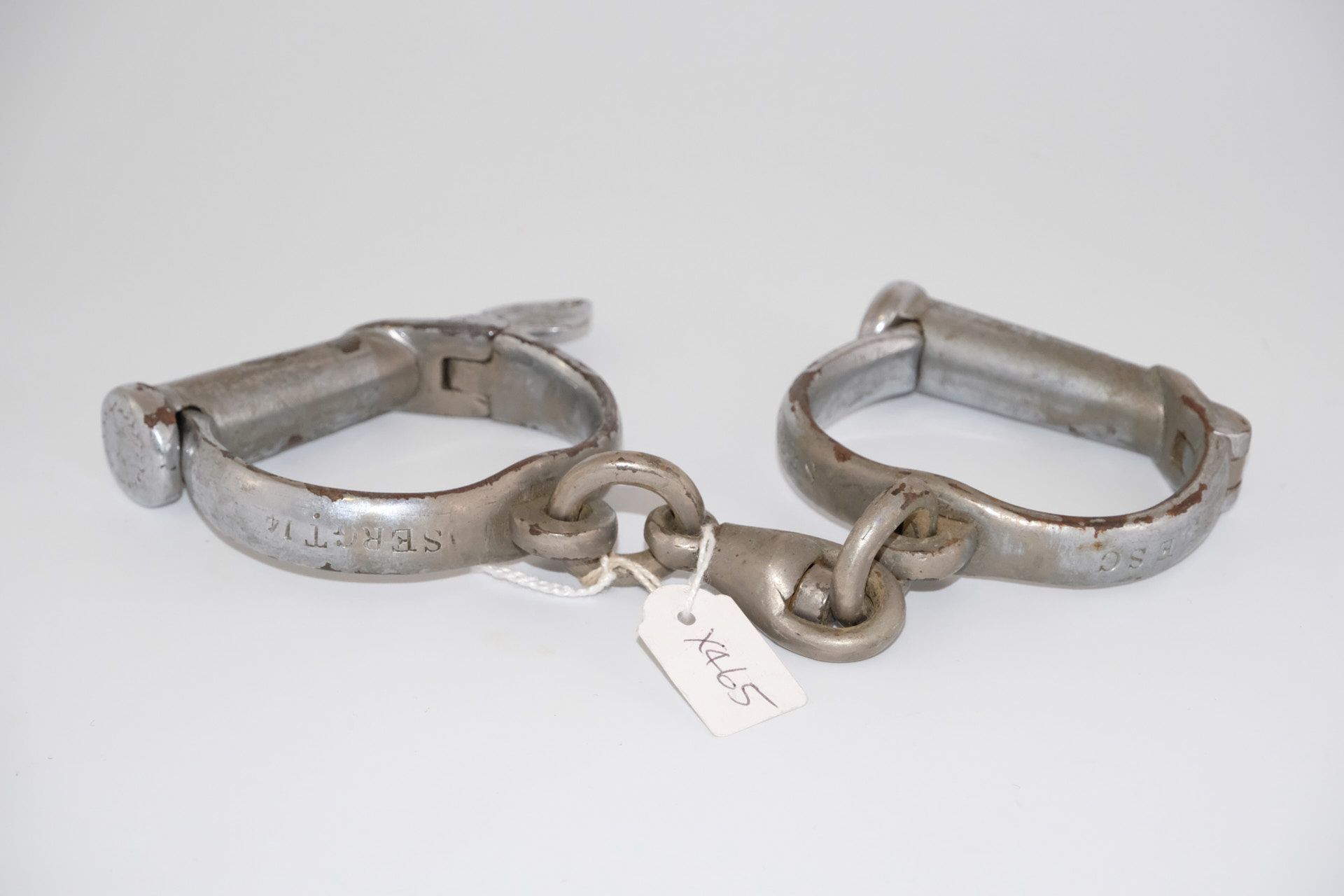
East Sussex Constabulary "Darby" handcuffs c1900 - 1930Entry/Object ID
465Description
Nickel plated Darby handcuffs. Marked "ESC Sergt. 14", "Froggatt", "Best Warranted Wrought", "Hard". With key.Use
To restrain prisoners. This type was in use across Sussex from at least the mid 19th century until the 1960s.Context
These type of fixed handcuffs are known as "Darbies" or "D" cuffs. "Darbies" is a 17th century word used to refer to all types of hand/wrist restraints and "D" refers to the shape of this style. This type, which were made by various makers, do not have a lock in the strictest sense as they have a simple bolt which is released by screwing in the "key". This simple robust design probably explains why these type of handcuffs were in use for over 100 years.
Froggatt were a Birmingham company making restraints from at least 1830 until 1937, when they were taken over by Hiatt, another old Birmingham restraint and police equipment manufacturer (Nichols 2002). Froggatt handcuffs are much scarcer than those of many of their competitors.
In a Sussex context "ESC" is the abbreviation for East Sussex Constabulary. "Serg" is the abbreviation for sergeant and the 14 is probably a collar/ID number. It is interesting that they are marked in this way as they date from a time when handcuffs were not always personal issue. They are difficult to date with any certainty other than they are pre 1937. The museum has other ESC marked handcuffs which date to the 1880s, so these could be as old as those.
It is reported that Harry Houdini the famous escapologist favoured using handcuffs made by Froggatt.