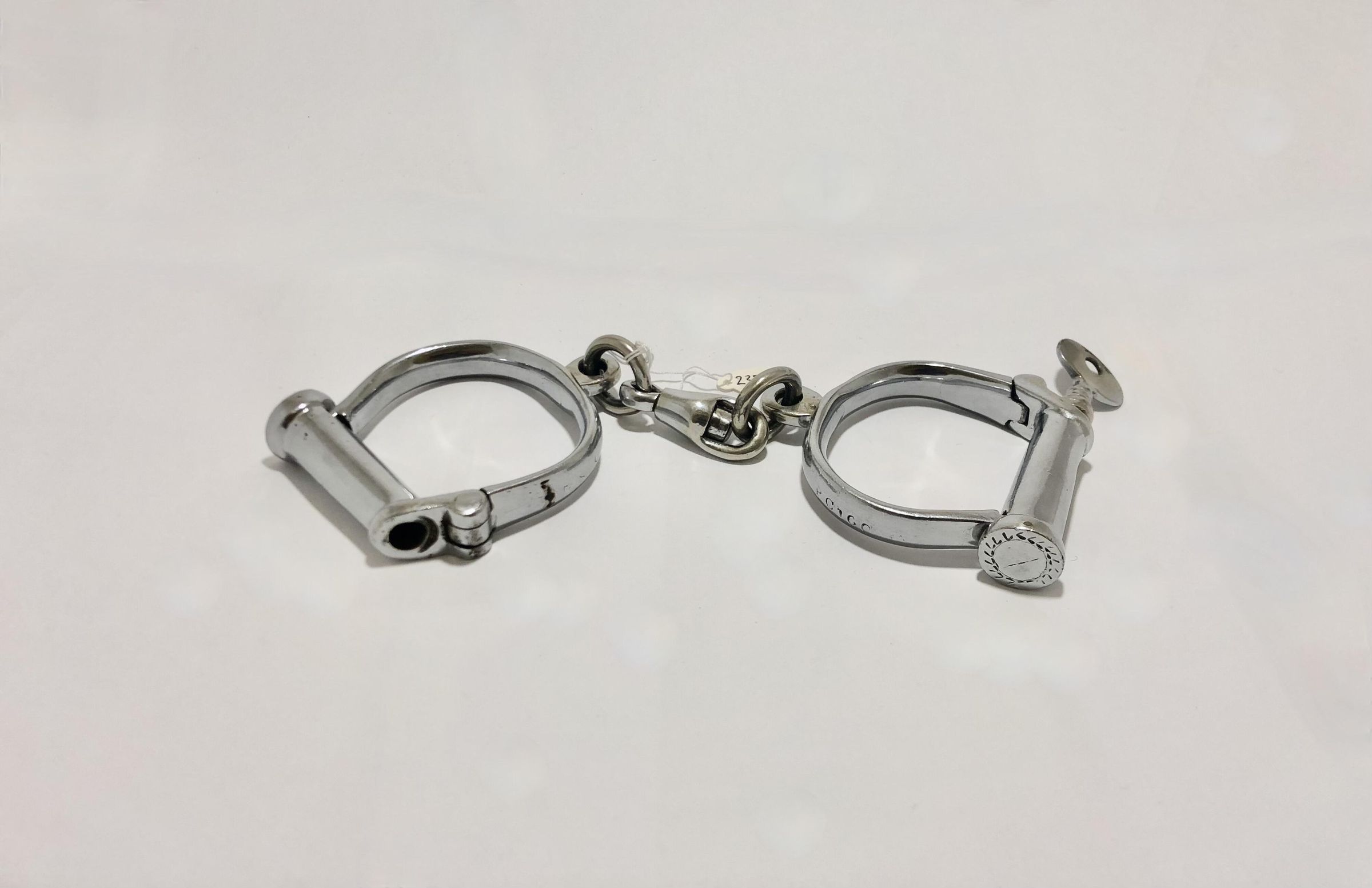
Chrome plated Darby handcuffs with key. Marked on both cuffs "ESC ", and on one "PC160" and the other "PC 106". No maker's marks.
Use
To restrain prisoners. This type was in use across Sussex from at least the mid 19th century until the 1960s.
Context
These type of fixed handcuffs are known as "Darbies" or "D" cuffs. "Darbies" is a 17th century word used to refer to all types of hand/wrist restraints and "D" refers to the shape of this style. This type, which were made by various makers, do not have a lock in the strictest sense as they have a simple bolt which is released by screwing in the "key". This simple robust design probably explains why these type of handcuffs were in use for over 100 years.
In a Sussex context "ESC" is the abbreviation for East Sussex Constabulary. The "PC 160" and
"PC 106" are police constable's warrant numbers. It is interesting that they are marked in this way as they date from a time when handcuffs were not always personal issue. The two different numbers are interesting and given the same three numerals are used, it may be that one of the numbers is an error. It is known that from the 1950s East Sussex Constabulary did issue handcuffs to individual officers (Stoner 2004 page 21) and they may have done so earlier. On the other hand when Sussex Constabulary was established in 1968, handcuffs were not issued to individual officers (Amalgamation Memorandum 1967).
These particular handcuffs are known to have been used in East Sussex Constabulary in the 1950s and 1960s. Though they have no maker's marks the style of swivel used suggests that they were made before the Second World War.