Name/Title
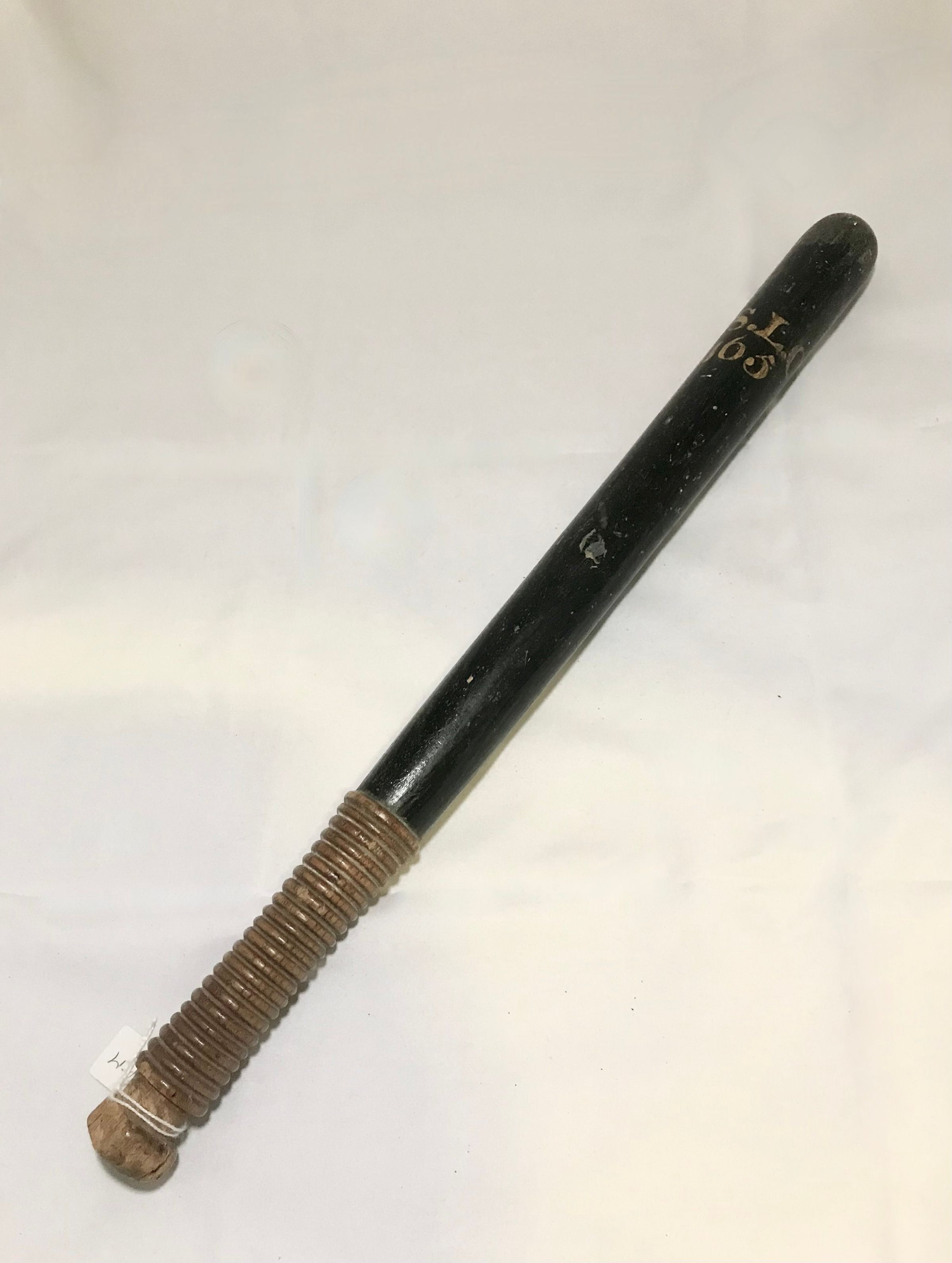
East Sussex Constabulary "Local Constable's" truncheon c1840 -1865Entry/Object ID
526Description
Wooden truncheon, 18 1/2 inches (47 cm) long, painted black with unpainted handle with multi turned grip and notch for a strap, marked at the top in gold/yellow paint "E. S. L. C", and "165". No maker's markings.Use
For use by an East Sussex Local Constable for both protection and as a symbol of their authority.Context
The "E.S.L.C" on this truncheon stands for "East Sussex Local Constable" and the number "165" would be that officer's number. Local Constables were used in East Sussex from 1840 to the mid 1860s.
The 1839 Rural Constabulary Act allowed for the establishment of County Police Forces in England and Wales by local magistrates otherwise known as Courts of Quarter Sessions, but it was not compulsory and was not accepted in East Sussex, mainly due to the cost to ratepayers. Elsewhere in England and Wales where county police forces were formed, a number of issues arose with the Act, including the cost to county ratepayers and it was necessary for an amendment to be enacted , The County Police Act of 1840. At the time the chairman of the Courts of Quarter Sessions in East Sussex was the Earl of Chichester and he managed to use the powers of the amended Act to persuade the East Sussex Magistrates to establish East Sussex Constabulary. Money was saved by not creating a completely full time paid police force. Instead using the 1840 legislation, a small number of paid constables were supplemented by a much larger number of unpaid constables, who could claim expenses and fees for specific tasks, whose work would be in the main restricted to their own parishes. These unpaid constables were known as "Local Constables" and were not issued with uniforms.
East Sussex Constabulary continued to operate with this mixture of a small amount of paid officers and many more Local Constables until 1856 when further legislation was introduced (The County and Borough Police Act) making it compulsory for counties to establish sufficient police forces. This did not altogether remove the reliance in East Sussex Constabulary of unpaid officers, and under the 1842 Parish Constables Act, unpaid Local Constables continued to supplement the East Sussex Force until the 1860s.
Previously "E.S.L.C." truncheons have been identified as belonging to "East Sussex Lewes Constabulary (Clark 1935 page 44). Lewes did have a small force of constables prior to the formation of East Sussex Constabulary but it is thought that there were never more than 6 of them, where as the number on this particular truncheon suggests it is one of at least 165. Not only this but one example number "66" was thought to have been in the possession of the Head Parish Constable of Seaford (Op cit), yet Seaford would never have come under the jurisdiction of any Lewes police force. Therefore the most plausible is that these truncheons were issued to "Local Constables", which is what they were actually called as demonstrated in contemporary newspaper reports.